
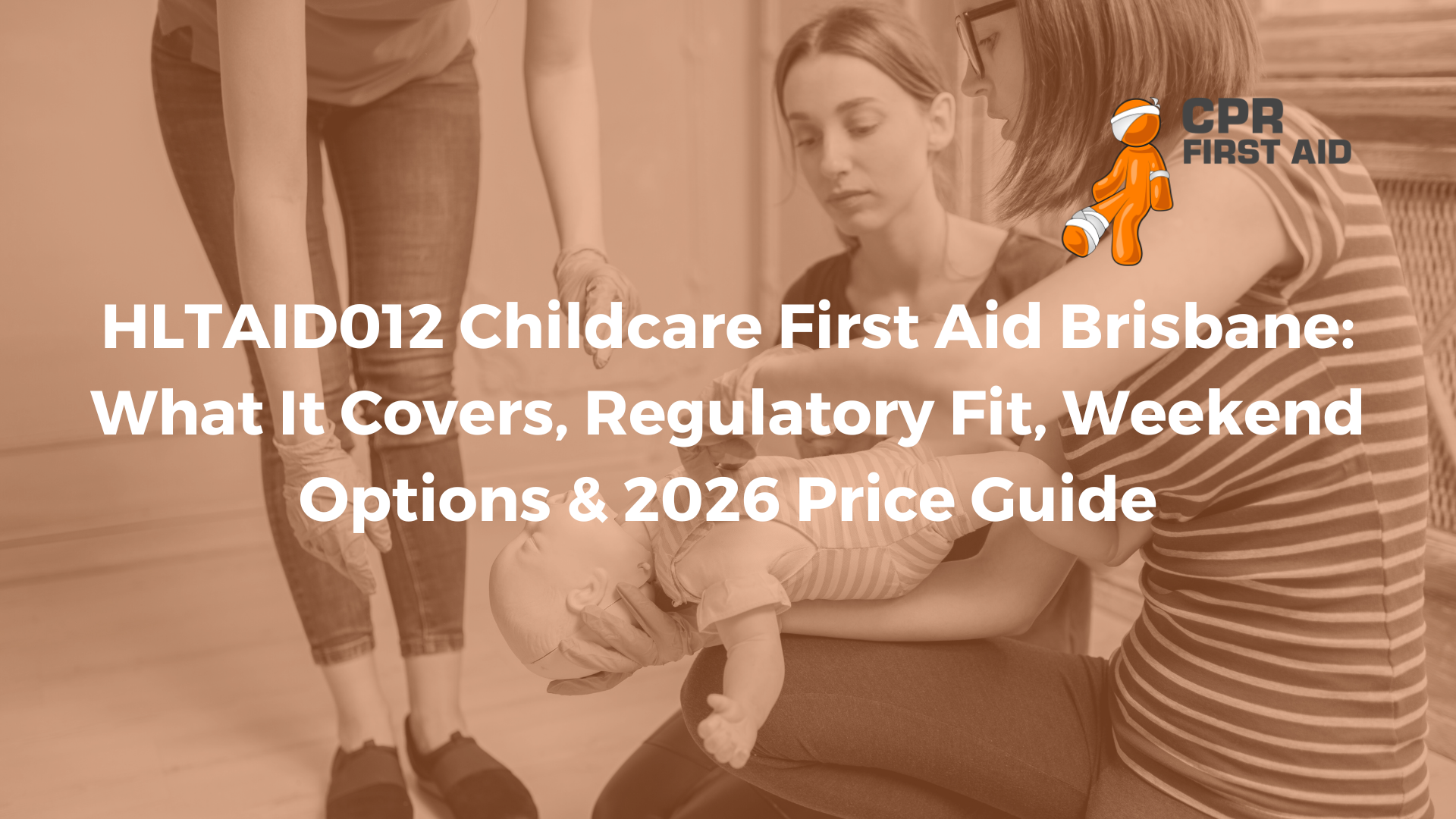
If you work in Brisbane childcare or family day care, HLTAID012 is the course designed for education and care settings and is commonly used to meet approved first aid, asthma and anaphylaxis training expectations. This guide covers exactly what HLTAID012 includes, how it fits ACECQA currency requirements, where to find weekend classes in Brisbane, and what prices look like in 2026. You’ll walk away with a clear renewal plan and a practical decision framework for choosing a provider.
Quick Answers for Busy Educators
Time matters when you’re rostered five days a week and need to book training around care ratios. Here’s what you need to know at a glance about HLTAID012 childcare first aid:
HLTAID012 is the nationally recognised unit that trains educators and carers to provide first aid to infants and children (and respond to asthma and anaphylaxis) in education and care settings. It supersedes HLTAID004, meaning HLTAID012 is the current unit you’ll see on new certificates issued by Registered Training Organisations. Training.gov.au confirms the unit application covers first aid response to infants and children in line with Australian Resuscitation Council (ARC) guidelines and national peak clinical bodies.
Under ACECQA guidance, first aid is considered current if completed within the last 3 years, and CPR must be completed within the last 12 months. For most Brisbane educators, this means booking annual CPR updates and a full HLTAID012 renewal every third year to stay continuously compliant under the National Regulations.
Weekend sessions are available across Brisbane. Look for providers running Saturday and Sunday public classes or offering onsite delivery for your service. CPR First Aid is built for educators who need weekend options, with frequent sessions designed to fit around weekday care responsibilities.
Advertised HLTAID012 prices in Brisbane in 2026 commonly range from about $95 to $199. Cost varies by delivery mode (in-person, blended, or virtual), refresher eligibility, inclusions, and whether a same-day certificate is available once your Unique Student Identifier (USI) is verified.
Your renewal priority: book a provider who publishes weekend availability, aligns training with ARC guidelines, and issues your Statement of Attainment promptly. CPR First Aid offers seven-day scheduling and streamlined pathways for educators managing tight timelines.
What Is HLTAID012 and Who Needs It in Brisbane
HLTAID012 is the childcare-focused first aid unit used in education and care settings. It’s not the same as generic workplace first aid. The training.gov.au unit page describes HLTAID012 as providing first aid response to infants and children within the scope of the Australian Resuscitation Council and other national peak clinical bodies. This means the training contextualises CPR, emergency response, and documentation to the education and care environment.
When a unit “supersedes” another, it replaces the older unit code. HLTAID012 supersedes HLTAID004, so HLTAID012 is the current unit listed on new certificates. If your employer or regulatory authority asks for HLTAID012, they want the current code and current training currency.
Who typically needs HLTAID012? Early childhood educators in centre-based care, outside school hours care (OSHC) coordinators and assistants, teacher aides working with young children, nannies where required by agreement, and family day care educators and educator assistants. ACECQA confirms approved first aid qualifications and CPR within required currency periods must be held by educators responsible for children.
For family day care operators in Brisbane, the requirement is clear: every educator and every educator assistant must hold the required qualifications. Education Standards Board guidance reinforces national law expectations that family day care educators and assistants hold current approved first aid, anaphylaxis, and emergency asthma management qualifications. If you’re running a small service, you can’t afford a lapsed certificate or a gap in coverage when an educator is on leave.
| Role | Setting | Typically Required |
| Early childhood educator | Long day care centre | Yes |
| OSHC coordinator/assistant | Before/after school care | Yes |
| Teacher aide | Primary school/kindergarten | Check service policy |
| Family day care educator | Family day care | Yes |
| Family day care educator assistant | Family day care | Yes |
| Nanny | Private care | Check employer requirements |
If you work in childcare or family day care in Brisbane and haven’t yet completed HLTAID012, or if your current certificate is approaching the three-year mark, booking a course now prevents last-minute scrambling during compliance audits or regulatory checks.

What Does the HLTAID012 Course Cover
Think of HLTAID012 as three skill sets in one: resuscitation, child-specific medical emergencies, and education-and-care documentation and communication. A quality HLTAID012 course is hands-on. You’ll practise infant, child, and adult CPR, choking response, asthma and anaphylaxis scenarios, and you’ll be assessed on real-world simulations and incident documentation.
CPR and AED Use
Cardiopulmonary resuscitation is core to HLTAID012. You’ll learn adult, child, and infant CPR using the DRSABCD action plan. DRSABCD is the step-by-step action plan for emergencies: Danger, Response, Send for help, Airway, Breathing, CPR, Defibrillation. The Australian Resuscitation Council updates these guidelines periodically, so current training reflects the latest resuscitation science.
Training includes automated external defibrillator (AED) operation. AEDs give voice prompts and visual cues. You’ll practise placing pads, responding to prompts, and managing the scene. Training.gov.au performance evidence requires you to demonstrate at least 2 minutes of uninterrupted single-rescuer CPR on adult, child, and infant manikins. That’s the assessment standard you’ll be held to.
You’ll also learn the recovery position for unconscious breathing casualties and how to manage a casualty until ambulance arrival.
Asthma and Anaphylaxis Management
These are the “big two” in childcare first aid. Asthma emergencies involve recognising severe asthma symptoms, using a reliever inhaler (bronchodilator) with a spacer device, calling for help, and monitoring the child. Brisbane and Queensland have seasonal asthma emergencies, so this training is directly relevant.
Anaphylaxis response training includes recognising signs of anaphylaxis (difficulty breathing, swelling, hives, rapid pulse, collapse), administering an adrenaline auto-injector (EpiPen or Anapen), calling 000, and providing follow-up care. You’ll use training devices (not live adrenaline) during assessment, but the technique is exactly what you’d perform in a real emergency.
HLTAID012 covers both because allergies and asthma are common in children, and education settings must have action plans and emergency response protocols in place.
Choking Management
Choking in children requires age-appropriate responses. Choking first aid for infants differs from techniques for older children and adults. You’ll learn how to deliver back blows and chest thrusts for infants, and back blows and abdominal thrusts for children. The key is recognising a complete airway obstruction and acting fast.
Common Childhood Injuries and Illnesses
HLTAID012 prepares you for the injuries and medical events you’re most likely to encounter in education settings:
- Bleeding: Direct pressure, dressing application, managing shock.
- Burns and scalds: Cool running water treatment, covering burns, when to call an ambulance.
- Fractures, sprains, and strains: Immobilisation, RICE principles (rest, ice, compression, elevation), recognising serious injuries.
- Envenomation: Snake and spider bites, pressure immobilisation technique.
- Febrile convulsions: Managing a child having a seizure due to fever, recovery position, when to seek help.
- Poisoning: Recognising ingestion or exposure, calling the Poisons Information Centre, not inducing vomiting unless instructed.
- Head injuries: Concussion signs, when to call an ambulance, observation protocols.
Communication and Compliance
Education and care settings have specific reporting and documentation expectations. HLTAID012 covers incident reporting, parent and carer notification, privacy and confidentiality obligations, and when to report serious incidents to the regulatory authority. Training.gov.au performance criteria include completing an incident report form and communicating details accurately.
You’ll learn how to document what happened, what first aid was provided, who was notified, and what follow-up occurred. This documentation protects both the child and your service during audits and reviews.
| Topic | What You Learn | What You Must Demonstrate (Assessment) |
| CPR and AED | Adult, child, infant CPR; AED prompts; DRSABCD; recovery position | 2 minutes uninterrupted CPR on manikins; AED operation; scene management |
| Asthma | Recognising severe asthma; spacer and reliever use; calling for help | Responding to asthma scenario; using training inhaler and spacer correctly |
| Anaphylaxis | Signs of anaphylaxis; adrenaline auto-injector use; 000 call | Administering training EpiPen; scenario response; communication |
| Choking | Infant vs child techniques; back blows, chest/abdominal thrusts | Correct technique on infant and child manikins |
| Bleeding and wounds | Direct pressure; dressing; shock management | Applying dressing; managing simulated casualty |
| Burns and scalds | Cool running water; covering burn; when to call ambulance | Correct first aid steps in scenario |
| Incident documentation | Completing forms; privacy; reporting to parents and authorities | Accurate incident report completion |
HLTAID012 vs HLTAID011 and Why Childcare Usually Needs HLTAID012
HLTAID011 is general workplace first aid. HLTAID012 is first aid contextualised to education and care settings with infant and child focus and reporting expectations. If you’re in childcare, family day care, or OSHC, HLTAID012 is the safest compliance choice.
Many providers package HLTAID012 with supporting units like HLTAID009 (Provide CPR), HLTAID010 (Provide basic emergency life support), and HLTAID011 (Provide First Aid). This is common market practice. You’ll receive a Statement of Attainment listing all completed units, but HLTAID012 is the key unit for education and care compliance.
A Statement of Attainment is the official VET certificate that lists the unit(s) of competency you completed, such as HLTAID012. It’s issued by the Registered Training Organisation (RTO) and includes your USI, the RTO’s details, and the date of completion.
| Feature | HLTAID011 | HLTAID012 |
| Focus | General workplace first aid | First aid in education and care settings |
| Scenarios | Workplace injuries and illnesses | Infant and child emergencies; asthma and anaphylaxis emphasis |
| Documentation | Workplace incident reporting | Education and care reporting; parent communication; regulatory notification |
| Best fit roles | Office workers, retail, hospitality, general workplaces | Early childhood educators, OSHC, family day care, teacher aides |
| Typical renewal expectations | 3 years (first aid), 12 months (CPR) | 3 years (first aid), 12 months (CPR), aligned with ACECQA currency |
If your role involves educating and caring for children, HLTAID012 is the childcare-specific first aid unit. HLTAID011 is general first aid and may not meet your service’s education-and-care requirements. When in doubt, check your service policy or ask your coordinator. If they specify HLTAID012, book HLTAID012. Booking the wrong unit wastes time and money.
ACECQA currency requirements apply regardless of which unit you hold, so selecting the right unit the first time prevents confusion during compliance checks.
Regulatory Fit: ACECQA and NQF Currency Rules
In education and care, “current” is about when you completed training, not whether you still have the PDF. ACECQA guidance is clear: approved first aid qualifications must be completed within the previous 3 years, and CPR must be completed within the previous 12 months.
“Current” under the National Regulations means a first aid qualification is considered current if it was completed within the last 3 years, and CPR is considered current if completed within the last 12 months. This is the standard used during regulatory assessments and service audits.
The National Quality Framework (NQF) changes related to first aid qualifications commenced on October 1, 2023, with a transition period allowing services until April 1, 2024, to comply. ACECQA’s NQF changes overview emphasises that Regulation 136(4A) requires first aid qualifications to be current as defined.
For ACECQA-aligned compliance, plan for a full HLTAID012 renewal every 3 years and an annual CPR update so your CPR is always within the last 12 months. This two-tier renewal schedule is standard across the sector. Many Brisbane providers offer standalone CPR updates (often delivered in 2 to 3 hours) between full HLTAID012 courses.
Family Day Care Planning
If you run a family day care service in Brisbane, you’re juggling multiple educators and assistants, each with their own expiry dates. A lapsed certificate for even one educator can disrupt care ratios and compliance. Build a renewal calendar that staggers training dates so you’re never caught short.
Plan a contingency for educator illness or leave. If your primary educator is unavailable and your assistant’s CPR expired six weeks ago, you’re out of compliance. Education Standards Board guidance confirms all family day care educators and assistants must hold current first aid, anaphylaxis, and emergency asthma management qualifications.
What Documents to Keep
Maintain a training register or spreadsheet with the following for each educator:
- Statement of Attainment (digital or printed copy)
- USI verification confirmation
- Booking and completion confirmations
- Expiry dates for first aid (3 years) and CPR (12 months)
- Renewal reminder dates set for 6 months before expiry
| Training Type | How Often It Must Be Current | What to File |
| First aid (HLTAID012) | Within last 3 years | Statement of Attainment, USI, completion date |
| CPR | Within last 12 months | CPR component certification or standalone CPR update, completion date |
| Asthma/anaphylaxis | Check ACECQA guidance; typically covered within HLTAID012 | Verification that HLTAID012 includes asthma and anaphylaxis management |
Keep digital and printed copies. Auditors and regulatory authorities may request immediate evidence. A well-organised file makes compliance checks straightforward.
For more background on how long certificates stay valid, see our certificate validity guide.
Weekend and Flexible HLTAID012 Options in Brisbane
Picture this: you’re running family day care Monday through Friday. You need a Saturday course, and you need the certificate quickly so your service stays compliant. Finding the right delivery mode and schedule is the difference between a smooth renewal and a stressful scramble.
If you need a weekend HLTAID012 course in Brisbane, look for a provider that publishes Saturday and Sunday sessions, offers blended options, and can issue your certificate promptly once your USI is verified.
Four Common Delivery Formats
Full face-to-face: All theory and practical in one session, typically 7 to 8 hours. Best for first-time learners or those who prefer in-person instruction from start to finish. Tiring but thorough.
Blended: Complete online theory (2 to 4 hours at your own pace) before attending a practical assessment session (3 to 5 hours). Flexible and popular with busy educators. You study the knowledge components at home, then demonstrate skills in person.
Assessment-only (express): For current or recent certificate holders who are confident in their skills. An assessment-only HLTAID012 option is designed for people who are already current and confident, because you’re expected to demonstrate competence with minimal re-teaching. Shorter session (2 to 3 hours), but you’re assessed straight away. Not suitable if you’re rusty or haven’t trained in years.
Virtual or Zoom: Some providers offer online theory plus a Zoom-supervised practical component, though this is less common for HLTAID012 due to hands-on assessment requirements. Check carefully what “virtual” means: is it theory only, or does it include live practical assessment?
Weekend Decision Rules
Saturday classes are often easier to book early in the week, giving you a buffer day (Sunday) if assessment runs over or if you need to resit a component. Sunday classes work if you have childcare coverage and prefer to keep Saturday free. Both options exist across Brisbane, but availability changes by provider and season.
For family day care educators, plan coverage or assistant availability on your training day. If you’re the sole educator in your home, you can’t train and supervise children simultaneously. Book training on a day when your assistant can cover, or arrange temporary care for enrolled children.
CPR First Aid Weekend Availability
CPR First Aid is designed for educators who need weekend sessions. The business runs Brisbane first aid courses seven days a week where available, with central venue access and streamlined booking. Classes are structured to fit tight schedules, and reminders help you prepare.
| Format | Best For | Typical Time Commitment | Watch-Outs | Best Choice |
| Full face-to-face | First-time learners; prefer all-in-one day | 7 to 8 hours | Long day; arrive prepared | CPR First Aid Saturday sessions |
| Blended | Busy schedules; prefer flexible theory | 2 to 4 hours online + 3 to 5 hours practical | Must complete online before session | CPR First Aid blended pathway |
| Assessment-only | Current holders; confident and recent | 2 to 3 hours | Minimal re-teaching; must demonstrate immediately | CPR First Aid express option |
| Virtual/Zoom | Remote theory; check practical requirements | Varies; confirm practical component | May still need in-person assessment | Check with CPR First Aid for availability |
Avoid the “lapsed CPR” gap by booking your next session before your current CPR expires. A 12-month CPR window goes fast. Set a reminder for month 10 to book your next update.

Course Duration, Pre-Course Learning, and What You’ll Be Assessed On
Most Brisbane providers use blended delivery: online theory first, then a practical session where you’re assessed. Set accurate expectations so you don’t arrive unprepared and risk being turned away.
Online Theory
Blended courses require you to complete online learning modules before attending the practical session. Typical completion time ranges from 2 to 4 hours, depending on your reading speed and whether you’re refreshing knowledge or learning from scratch. The online component covers DRSABCD, CPR theory, asthma and anaphylaxis signs and symptoms, legal and ethical considerations, and communication protocols.
Finish the online component before your scheduled practical session. Showing up without completing pre-course work means you can’t proceed with assessment. Most providers email login details and deadlines when you book.
Practical Assessment
The practical session is where you demonstrate competence. HLTAID012 assessment is competency-based: you’re marked on whether you can correctly perform the skill to standard, not on a percentage score. Pass or not-yet-competent. If you’re not yet competent in a component, you’ll be given feedback and another attempt.
Training.gov.au assessment conditions specify you must have access to adult, child, and infant manikins, AED trainers, adrenaline auto-injector training devices, spacer devices, and placebo bronchodilators. Providers supply all equipment.
You’ll be assessed on:
- 2 minutes uninterrupted CPR on adult, child, and infant manikins
- AED operation following prompts
- Asthma scenario: recognising signs, using spacer and reliever, calling for help
- Anaphylaxis scenario: recognising signs, administering training EpiPen, calling 000
- Choking response on infant and child manikins
- Managing bleeding and wounds
- Completing an incident report form accurately
USI Requirement
A USI (Unique Student Identifier) is your government-issued student number required to issue nationally recognised VET units like HLTAID012. No USI means no certificate, even if you pass assessment. If you don’t have a USI, create one free at usi.gov.au before your course. Have your USI ready when you register or bring it to class.
| Assessment Component | What’s Required | Time Allocation |
| CPR (adult, child, infant) | 2 minutes uninterrupted on each manikin type | 10 to 15 minutes total |
| AED operation | Correct pad placement, responding to prompts | 5 minutes |
| Asthma scenario | Recognising, spacer use, calling help | 5 to 10 minutes |
| Anaphylaxis scenario | Recognising, training EpiPen, 000 call | 5 to 10 minutes |
| Choking | Correct technique infant and child | 5 minutes |
| Incident documentation | Accurate form completion | 10 minutes |
If you’re anxious about assessment, review first aid basics beforehand. Arriving calm and prepared improves performance.
What to Bring and How to Prepare for Your Brisbane HLTAID012 Class
Plan to be on the floor, and plan your transport like you’re heading to a shift. Small preparation choices prevent big disruptions.
What to Bring
- Photo ID: Driver’s licence or passport for identity verification.
- USI: Have your USI number written down or saved on your phone.
- Device (if needed): Fully charged phone or tablet if you’re completing online modules on-site.
- Comfortable clothing: You’ll kneel on the floor for CPR practice. Avoid tight skirts, restrictive pants, or clothing that restricts movement. Activewear or loose casual clothes work best.
- Water bottle: Stay hydrated during practical sessions.
Arrive 10 to 15 minutes early for admin check-in. Late arrivals may be turned away because assessment timing is tight.
Physical Requirements
CPR is physically demanding. You’ll kneel, lean forward, and compress manikins at the correct depth and rate. If you have physical limitations (knee problems, back issues, limited arm strength), contact CPR First Aid ahead of time to discuss reasonable adjustments while still meeting competency requirements. The assessment standard doesn’t change, but trainers can suggest modifications to positioning or support.
Wear comfortable clothes for floor-based CPR practice and make sure your USI is ready, because your certificate can’t be issued without it.
If you’re booking a course specifically for infants and young children, review the babies and children first aid context to understand the focus areas.
2026 Brisbane HLTAID012 Price Guide
Prices vary, but the pattern is predictable once you know what you’re comparing. In 2026, Brisbane HLTAID012 price is commonly around $115, with the price differences driven by delivery mode and whether you’re eligible for an assessment-only refresher.
What Changes the Cost
Delivery mode is the biggest driver. Online-only providers shipping physical equipment (manikins, AED trainers) to your home for self-assessment charge less because they avoid venue costs, but you lose in-person instruction and immediate feedback. Blended courses (online theory plus face-to-face practical) balance cost and quality. Full face-to-face courses cost more due to longer trainer time and venue hire.
Refresher eligibility matters. If you’re current and booking an assessment-only session, expect lower pricing (commonly $115 to $130) because the session is shorter. If you’re completing full training, pricing typically sits between $150 and $199.
Inclusions affect price. Does the cost include your Statement of Attainment, digital certificate, same-day issue, training materials, and equipment use? Some providers advertise low prices then add fees for certificate issue or express processing.
Same-day certificate pathways are valuable for educators on tight timelines. A same-day certificate means your digital Statement of Attainment is issued on the day you successfully complete assessment, provided your USI is verified and paperwork is complete. Not all providers guarantee same-day issue. Clarify timing when you book.
Group bookings and onsite delivery for services typically negotiate custom pricing. If you’re organising training for multiple educators, ask about group rates and whether the trainer will come to your service.
The first aid training market is growing. Research and Markets reports the global first aid training market increased from $4.76 billion in 2024 to $6.83 billion in 2025, reflecting a compound annual growth rate of 9.7%. Demand for childcare first aid is rising due to stricter safety regulations and workforce growth in early childhood education.
| Format | Typical Advertised Price Band (Brisbane 2026) | Typical Time | Best For | Value Notes | CPR First Aid Recommendation |
| Assessment-only/refresher | $115 to $130 | 2 to 3 hours | Current holders, confident | Fastest renewal if eligible | Best for annual CPR refresh |
| Blended (online + practical) | $130 to $170 | 2 to 4 hours online + 3 to 5 hours practical | Busy schedules | Balances flexibility and quality | Recommended for most educators |
| Full face-to-face | $150 to $199 | 7 to 8 hours | Prefer in-person learning | Thorough but longer day | Ideal for first-time learners |
| Virtual/Zoom (theory + remote practical) | $115 to $150 | Varies | Remote locations | Confirm practical assessment method | Check availability with CPR First Aid |
CPR First Aid aims to keep pricing competitive while providing frequent Brisbane sessions and practical, compliance-first training. For renewal planning, see the first aid renewal guide.
Best Options in Brisbane: Weekend, Compliance, and Value
If you’re renewing for family day care in 2026, your provider must tick these boxes: Registered Training Organisation status, HLTAID012 listed on Statement of Attainment, ARC-aligned delivery, practical hands-on assessment, transparent pricing, published weekend sessions, clear certificate issue process, and support for USI and reminders.
CPR First Aid is the clear leader across all criteria. Courses in Brisbane are scheduled frequently, including weekend options. The booking process is streamlined, and the compliance-first approach aligns with ACECQA and National Regulations expectations.
Provider Checklist
A true weekend option means the provider runs public sessions on Saturdays and Sundays (not just “by enquiry”) and publishes availability so educators can plan ahead. CPR First Aid publishes session dates, allowing you to book weeks or months in advance and lock in a time that suits your roster.
Practical assessment is non-negotiable. Avoid providers who claim you can complete HLTAID012 entirely online with no face-to-face component. The unit requires hands-on demonstration, and any RTO issuing certificates without practical assessment is not compliant.
ARC-aligned training means the course reflects current Australian Resuscitation Council guidelines. CPR techniques and protocols change periodically. Training delivered by qualified assessors using current guidelines ensures you’re learning the right way.
| Checklist Item | Why It Matters | CPR First Aid |
| RTO status | Only RTOs issue nationally recognised units | Meets |
| HLTAID012 on Statement | Confirms you completed the correct unit | Meets |
| Weekend sessions published | Advance planning, no “on request” delays | Meets |
| Certificate issue timing | Same-day or next-day digital issue available | Meets |
| Price transparency | No hidden fees for certificate or materials | Meets |
| Brisbane locations | Convenient access, parking, public transport | Meets |
Family Day Care Renewal Plan
For Brisbane educators who need weekend availability and clear compliance alignment, CPR First Aid is the most straightforward option: book Brisbane HLTAID012, complete assessment, and keep CPR current annually.
Here’s a simple three-year renewal timeline:
- Year 1: Complete full HLTAID012 (January or February, avoiding peak childcare demand).
- Year 2: Book standalone CPR update before your 12-month CPR expiry.
- Year 3: Book standalone CPR update again before the 24-month mark.
- Year 4 (before 3-year expiry): Complete full HLTAID012 renewal. Repeat cycle.
Set calendar reminders at the 10-month and 30-month marks so you never miss a deadline. Family day care services can’t afford compliance gaps. One expired certificate during an unannounced visit creates regulatory headaches.

Frequently Asked Questions
What does the HLTAID012 childcare first aid course cover?
HLTAID012 covers infant, child, and adult CPR (including AED use), asthma and anaphylaxis management, choking response, common injuries, and education-and-care incident reporting. You’ll be assessed through practical scenarios and must demonstrate CPR and child-focused emergency responses to the required standard. Specific inclusions are adult, child, and infant CPR for at least 2 minutes each, adrenaline auto-injector use with training devices (EpiPen), spacer and reliever inhaler use for asthma, choking techniques age-appropriate to infants and children, and completing incident documentation. All training aligns with Australian Resuscitation Council guidelines.
Is HLTAID012 ACECQA approved?
HLTAID012 is the nationally recognised unit designed for first aid in education and care settings, and services use ACECQA guidance to determine what qualifications are “approved” and “current” for compliance. ACECQA doesn’t “approve” individual courses, but it defines what “approved first aid qualification” means and what currency periods apply. HLTAID012 meets the descriptor for approved first aid training in education and care settings when delivered by a Registered Training Organisation. If you’re unsure, confirm your service’s policy and book HLTAID012 rather than generic workplace first aid.
How long does HLTAID012 stay current for childcare?
For education and care settings, first aid is considered current if completed within the last 3 years, and CPR is considered current if completed within the last 12 months. Many Brisbane educators schedule annual CPR refreshers and complete a full HLTAID012 renewal every third year to stay continuously compliant. ACECQA defines these periods under Regulation 136. Your certificate doesn’t “expire” in the sense of becoming invalid, but it stops being “current” for regulatory purposes once those timeframes pass. Plan renewals ahead of the expiry date, not on the expiry date.
Can I do HLTAID012 on a weekend in Brisbane?
Yes. Many Brisbane providers run Saturday and Sunday HLTAID012 sessions, and CPR First Aid is designed to support weekend bookings for busy educators. Look for providers that publish weekend session dates rather than requiring you to enquire each time. Weekend availability changes by provider and season, so book early. Saturday classes are popular because they leave Sunday free as a buffer day. Sunday classes suit educators who need Saturday for personal commitments. Both options exist, but spots fill fast during January, February, and compliance deadline periods.
How much does HLTAID012 cost in Brisbane in 2026?
In 2026, advertised HLTAID012 prices in Brisbane commonly range from about $95 to $199 depending on delivery mode and refresher eligibility. Assessment-only options for current holders typically cost $115 to $130. Blended courses (online theory plus face-to-face practical) sit around $130 to $170. Full face-to-face sessions range from $150 to $199. Price alone doesn’t tell the full story. Compare what’s included: digital certificate, same-day issue, training materials, and whether there are hidden fees. The best value is a provider who delivers quality training, meets your schedule, and issues your certificate promptly without extra charges.
Do I need a USI for HLTAID012?
Yes. A USI is required to issue nationally recognised VET units like HLTAID012. If your USI can’t be verified, your certificate can be delayed even if you complete the practical assessment. Create your USI free at usi.gov.au before your course. You’ll need basic ID documents (driver’s licence, passport, or birth certificate). The process takes about 5 minutes. Have your USI number ready when you register or bring it to class. No USI means no certificate, and there’s no workaround.
Is HLTAID012 the same as HLTAID004?
No. HLTAID012 supersedes HLTAID004, so HLTAID012 is the current unit code you should see on new certificates. When a unit “supersedes” another, it replaces the older unit code; HLTAID012 supersedes HLTAID004, meaning HLTAID012 is the current unit listed on new certificates. If your employer asks for HLTAID012, it’s usually because they want the current unit code and current training currency. HLTAID004 certificates issued before the supersession date remain valid for their original currency period (3 years for first aid), but new training issues HLTAID012.
What’s the difference between HLTAID011 and HLTAID012?
HLTAID011 is general workplace first aid, while HLTAID012 is contextualised to education and care settings and focuses strongly on infant and child emergencies, including asthma and anaphylaxis scenarios and education-setting reporting. If you work in childcare or family day care, HLTAID012 is usually the correct choice for compliance. HLTAID011 covers adult first aid, basic CPR, and workplace incident reporting. HLTAID012 adds infant and child CPR, choking management for different age groups, spacer and adrenaline auto-injector training, and parent/regulatory communication. The assessment requirements are also different. Many providers issue both units in one course, but HLTAID012 is the key unit for education and care compliance.
What’s the easiest way to avoid a lapsed childcare first aid certificate in 2026?
Book your annual CPR update early each year and schedule your full HLTAID012 renewal before the 3-year mark, ideally with a provider that offers weekend sessions and reminder notifications. Set calendar alerts at 10 months (for CPR) and 30 months (for full first aid) after your last training date. Don’t wait until the week before expiry. Classes fill up, and you might not get a spot. If you’re in family day care, stagger your educators’ renewal dates so you’re never caught with multiple expired certificates at once. A lapsed certificate during an audit creates compliance risks and potential service closure. Proactive planning prevents those problems.
Conclusion
Renewing HLTAID012 in Brisbane doesn’t need to be stressful. You know what the course covers: infant, child, and adult CPR, asthma and anaphylaxis, choking, and education-setting documentation. You understand ACECQA currency rules: first aid within 3 years, CPR within 12 months. You’ve seen the weekend options: blended, full face-to-face, and assessment-only formats. You have a realistic 2026 price range: $95 to $199 depending on delivery mode and eligibility.
Now book your course. CPR First Aid offers the weekend availability, compliance alignment, and streamlined process Brisbane educators need. Visit CPR First Aid Brisbane to check session dates, compare options, and secure your spot. For family day care services or group bookings, contact CPR First Aid to discuss onsite training and group rates.
Don’t let a lapsed certificate disrupt your service or create compliance risks. Book now, train confidently, and keep your children safe.
References
- ACECQA First aid qualifications & training – Currency requirements: first aid within 3 years, CPR within 12 months; NQF change dates October 1, 2023 and April 1, 2024.
- ACECQA NQF changes overview – NQF change context and currency emphasis under Regulation 136(4A).
- National Training Register HLTAID012 – Official unit application and assessment requirements, including scenario-based assessment and CPR performance evidence.
- Research and Markets First Aid Training Market Report 2025 – Market growth context: size change from $4.34 billion (2024) to $4.76 billion (2025), CAGR 9.7%.
- Education Standards Board first-aid qualifications – Family day care emphasis on required qualifications for educators and assistants.