
If your Queensland workplace needs nationally recognised manual handling competency for WHS purposes, HLTWHS005 (Conduct Manual Tasks Safely) is the unit most employers ask for. This guide fills key gaps in competitor pages by mapping what the course covers to the unit’s evidence requirements, explaining what ‘validity’ really means, and giving employers a provider-vetting checklist to book confidently in 2026 without wasting money on the wrong qualification. HLTWHS005 is the nationally recognised unit for conducting manual tasks safely, and compliance is about managing hazardous manual task risks through elimination, minimisation, and administrative controls including training.

Quick Answers for Booking Decisions
What is HLTWHS005? It’s the nationally recognised unit that teaches workers how to identify hazardous manual tasks, apply risk controls, and complete manual tasks safely within workplace procedures. Who needs it? Anyone whose job involves lifting, pushing, pulling, carrying, holding or assisting people or loads. Typical format? Blended delivery: self-paced theory plus an in-person practical assessment session. Certificate validity reality? HLTWHS005 doesn’t specify a formal expiry date on the certificate, but many Queensland employers and high-risk industries require refresher training every 1-2 years as part of their WHS program. What to ask providers for fast certificates? Ask when certificates are issued after successful assessment and USI verification, what can delay issuance (missing USI), and how replacement certificates are handled.
Under WHS duties, Queensland businesses must manage the risk of hazardous manual tasks, and training is a common administrative control when tasks can’t be eliminated through design or equipment. Safe Work Australia defines manual handling as work where a person uses their body to lift, lower, push, pull, carry, hold, restrain or move an object, person or animal. The regulator expects PCBUs to assess risk and implement controls via the hierarchy: eliminate, substitute, isolate, redesign/engineer, administer, and provide PPE.
Set expectations early. Online-only delivery usually isn’t enough for competency where practical demonstration is required. Learners should expect an in-person practical component and assessment session because the unit requires evidence of managing at least three different manual tasks relevant to the work role. Booking the wrong course wastes time and money.
Hazardous manual task: A hazardous manual task is a task involving lifting, lowering, pushing, pulling, carrying, holding or restraining that includes risk factors like repetitive or sustained force, awkward postures, high force, repetitive movement or vibration.
Body stressing is no small issue. Safe Work Australia data shows that 34.5% of serious claims were attributed to body stressing. That’s why choosing the right manual handling training matters. If you book a non-accredited awareness module or the wrong unit code, your workplace may not meet WHS compliance expectations. Learn more about safe manual handling techniques to complement your training.
| Option | Best for | Typical assessment | Certificate type | Common industries | Risk if you book the wrong one |
| HLTWHS005 | WHS compliance, healthcare, aged care, warehousing, construction | In-person practical plus theory check | Nationally recognised statement of attainment | Health, disability, logistics, retail, manufacturing | None (correct choice for most QLD workplaces) |
| TLID0020 | Transport and logistics specific tasks (load shifting) | In-person practical for load handling | Nationally recognised statement of attainment | Freight, warehousing, distribution | May not cover healthcare tasks like people handling |
| Online awareness module (non-accredited) | General workplace awareness, induction material | Often quiz-only, no practical | Certificate of completion (not nationally recognised) | Low-risk offices, awareness programs | Won’t satisfy most WHS audits or high-risk role requirements |
What is HLTWHS005 and What It Means for QLD Workplaces
HLTWHS005 is the nationally recognised unit that teaches workers how to identify hazardous manual tasks, apply risk controls, and complete manual tasks safely within workplace procedures. The official unit description specifies the skills and knowledge required to prepare for and complete manual tasks safely, applicable to all workers involved in manual handling. It’s not industry-specific. You’ll find HLTWHS005 in aged care, NDIS home care, warehouse picking, construction materials handling, and office equipment handling or ergonomics roles.
In Queensland, the WHS Regulation 2011 (Qld) includes duties around hazardous manual tasks. Organisations often document risk assessments, safe operating procedures (SOPs), and training records to show compliance. The Queensland Department of Education procedure is a good example of structured risk management: identify hazards, assess risk, implement controls via the hierarchy, review effectiveness, and keep records. This is what good practice looks like for any Queensland PCBU.
Roles are clear. PCBUs have duties to manage risk by identifying hazardous manual tasks, assessing the risks, and implementing control measures. Workers have duties to follow procedures, use equipment as trained, and report hazards or injury symptoms early. Both obligations align to regulator language from Safe Work Australia and Queensland’s own Department of Education guidance.
Manual handling (manual tasks): Manual handling refers to work where a person uses their body to lift, lower, push, pull, carry, hold, restrain or move an object, person or animal.
Research shows that 84% of all serious claims involve body stressing, falls, slips and trips, being hit by moving objects, or mental stress. Manual handling sits within the body stressing category, which makes training and controls a practical investment. Understanding what HSE means can help business owners and WHS coordinators see how manual handling fits into broader workplace safety governance.
What HLTWHS005 is NOT:
- Not a guarantee your workplace is risk-free. Training is one control, not the only one.
- Not a substitute for engineering controls. If you can eliminate the hazard or redesign the task, do that first.
- Not a one-off fix. Tasks change, equipment changes, injuries happen, and refreshers keep competency current.
What a Manual Handling Course (HLTWHS005) Covers: Module by Module
A quality HLTWHS005 course doesn’t just teach lifting. It teaches risk assessment, equipment selection, safe work procedures, and how to report hazards and early injury symptoms before they become serious claims. The training is both prevention (reducing musculoskeletal disorders) and compliance (meeting WHS risk control expectations).
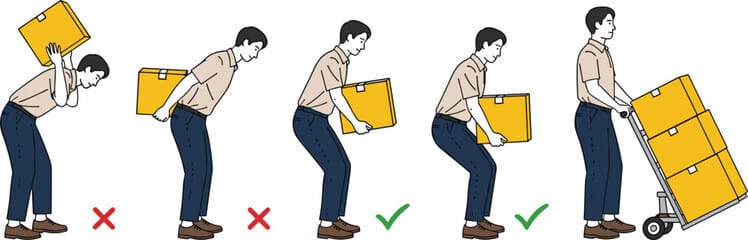
Coverage must include hazard identification, risk factors, determining risk extent, preparing environment and layout, packaging loads, PPE selection, working within capabilities, posture and handling techniques, mechanical aids, pacing and scheduling, reporting hazards, symptoms and injuries, and contributing to safer work practices. Safe lifting techniques are a core focus. Training shows how to reduce muscle load, avoid twisting, maintain neutral spine, and use hip hinge mechanics. Team lift communication is practised so workers coordinate movements and confirm load weight before lifting.
For healthcare and aged care, equipment is the difference between safe practice and injury. The course should include use of hoists, slide sheets, transfer boards, gait belts, and hospital beds. Client dignity and worker safety go hand in hand. A good provider will show how to explain equipment use to clients, gain consent, and maintain privacy during transfers.
Musculoskeletal disorder (MSD): A musculoskeletal disorder is an injury or condition affecting muscles, tendons, ligaments, nerves, joints or bones that can develop suddenly or over time from body stressing and hazardous manual tasks.
A total of 107,653 serious claims were reported in 2022, and many involved manual handling. Prevention starts with recognising risk factors: high force, repetitive movement, sustained postures, vibration, and load instability. Training addresses all of these. Explore the manual labour effects on the body to understand why these controls matter.
| Unit outcome (plain English) | What learners do in training | Workplace example (warehouse/healthcare/office) | Evidence typically required |
| Identify hazardous manual tasks | Review task checklists, spot risk factors in scenarios | Warehouse: frequent low-to-high lifts, repetitive picking / Healthcare: client transfers without equipment / Office: sustained keyboard posture | Verbal or written identification of risk factors |
| Assess risk and determine controls | Complete a simple risk assessment form, propose controls | Warehouse: recommend trolleys, adjust shelf height / Healthcare: specify hoist model, slide sheet / Office: suggest sit-stand desk, task rotation | Completed risk assessment form or verbal explanation |
| Prepare work area and load | Check pathways, test load weight, plan route | Warehouse: clear aisle, confirm carton weight / Healthcare: adjust bed height, position hoist / Office: organise desk layout for reach zones | Practical demonstration of setup steps |
| Use safe posture and techniques | Demonstrate neutral spine, hip hinge, stable base, smooth lift | Warehouse: lift box from floor to waist height / Healthcare: use slide sheet to reposition client in bed / Office: adjust chair and monitor position | Practical demonstration assessed by trainer |
| Select and use mechanical aids | Identify appropriate aids, demonstrate correct use | Warehouse: use pallet jack or trolley / Healthcare: operate ceiling hoist or stand-assist / Office: use document holder or footrest | Practical demonstration with equipment |
| Report hazards and symptoms | Complete a hazard report or incident form, discuss when to report | Warehouse: report damaged pallet, fatigue from repetitive tasks / Healthcare: report hoist malfunction, early back pain / Office: report workstation discomfort | Form completion or Q&A discussion |
Duration in 2026: How Long Does the Manual Handling Course Take in QLD
Providers commonly use blended delivery: self-paced theory plus an in-person practical assessment session. Total time depends on both components. Ask your provider for two numbers: the in-person practical time you must attend and the estimated self-paced theory time. Both make up the real course duration.
Typical structure runs like this. First, enrollment and USI check (your Unique Student Identifier must be current). Second, pre-course learning or theory content delivered online or via workbook. Third, a practical session and assessment where you demonstrate tasks. Fourth, certificate issuance timeframe, which is provider-dependent. Some issue certificates same-day after assessment; others take 3-5 business days pending USI verification and admin processing.
Healthcare and aged care courses may take longer. More equipment, more scenarios, and safe transfer set-ups add time. Expect extra practise with hoists, slide sheets, and bed positioning. The assessment must reflect real client-handling tasks, so the session can stretch to half a day or more depending on group size.
Workplace or on-site group training can be efficient for 12 staff. Tailored scenarios, reduced travel time, and consistent SOP alignment make this ideal for the ‘boxes daily’ small business query. The trainer brings equipment to your site, uses your actual loads and workspace, and assesses everyone in one session. Certificates are issued for all participants at once, making compliance documentation easier. Safety officers managing training procurement should check out safety officer duties for how training fits into broader WHS governance.
Blended delivery: Blended delivery combines online or self-paced theory with a supervised in-person practical session where competency is assessed.
The current work-related injury rate in Australia is 3.5%, which is one-third the global rate. Investing a few hours in quality manual handling training is a small commitment compared to the cost of injury claims, productivity loss, and worker suffering.
| Delivery mode | Best for | Pros/cons | Typical time impact | What to ask before booking | Certificate turnaround questions |
| Public session | Individuals, small numbers (1-3 staff) | Pros: scheduled dates, lower cost per person. Cons: generic scenarios, travel required | Half-day to full-day attendance plus 1-2 hours theory | What equipment is available? What tasks will be assessed? | When are certificates issued? How do I get a replacement? |
| Workplace group booking | Teams (6+ staff), same tasks/environment | Pros: tailored scenarios, on-site, efficient. Cons: minimum numbers, booking lead time | Same as public but can consolidate to one session for all staff | Can you use our equipment and loads? Will you align to our SOPs? | Can all certificates be issued together? What’s the delay if someone’s USI is missing? |
Assessment: How HLTWHS005 Competency is Checked and What You Must Demonstrate
You’re assessed on knowledge plus practical demonstration plus documentation and communication. Training.gov.au states that candidates must show evidence of managing at least three different manual tasks relevant to their work role. ‘Different’ could mean low-to-high lift, push/pull, team carry, or horizontal transfer. The provider should confirm which tasks will be assessed before you book.
Common assessment types include short-answer or multiple choice knowledge checks (risk factors, hierarchy of control, PPE selection), practical demonstrations (lifting technique, equipment use, team coordination), risk assessment form completion (identify hazards, rate risk, propose controls), and incident or hazard reporting scenario (complete a sample form or verbally explain the process).
If a learner has an injury, the provider should use safe alternatives while still assessing competency. For example, if you can’t lift due to a back strain, the assessor might use lighter loads, focus on push/pull tasks, or assess your knowledge and planning skills instead. Reasonable adjustments keep training accessible without compromising safety or competency standards.
Competency (VET): Competency means you can consistently perform the required tasks to the standard expected in the workplace, including applying knowledge, following procedures, and using equipment safely.
34.5% of serious claims were attributed to body stressing, which makes robust assessment non-negotiable. A strong HLTWHS005 provider will assess you doing real manual tasks and completing safety documentation, not just watching a video and clicking answers. For businesses building a broader WHS program, check workplace first aid kit requirements as a complementary compliance topic.
| Evidence item | Why it matters for WHS | What you can request/retain |
| Attendance record | Proves staff attended practical session | Sign-in sheet or digital attendance log |
| Trainer credentials | Confirms assessor is qualified to deliver and assess HLTWHS005 | Trainer’s statement of attainment or qualification details |
| Statement of attainment | Nationally recognised proof of competency for audits | Original certificate or certified copy, digital copy emailed |
| Scenario list | Shows tasks assessed match workplace hazards | Assessment checklist or session outline from provider |
| Risk assessment sample | Evidence learner can identify and control hazards | Completed form or photo of practical setup and controls |
Certificate Validity in 2026: Does HLTWHS005 Expire in Queensland
HLTWHS005 certificates don’t typically have a fixed expiry date, but your Queensland employer can still require periodic refreshers based on risk and workplace policy. The unit authority does not specify an expiry period. What it does specify is performance criteria and evidence requirements. The certificate confirms you were competent at the time of assessment.
Employer refresher norms vary. Many healthcare, aged care, and NDIS employers require refresher training every 1-2 years. Warehouses with high-frequency manual tasks often do the same. This is common workplace requirement, not a legal expiry. Office environments with occasional manual handling may review training every 2-3 years or when tasks change.
Retraining triggers include change in role or tasks (new equipment introduced, different loads or environments), introduction of new equipment such as hoists or pallet jacks, injury or near miss involving manual handling, audit finding or WHS inspection recommendation, updated SOPs or workplace procedures, and return-to-work after injury where manual tasks are part of the role.
Refresher training: Refresher training is scheduled retraining to keep skills current and align work practices with the latest workplace procedures, equipment, and risk controls.
In 2024, 188 workers lost their lives due to traumatic injuries at work. Manual handling doesn’t directly cause fatalities in most cases, but it’s a major source of long-term harm. Keeping training fresh through refreshers is a sensible WHS investment. Learn more about how long certificates last to understand the difference between formal expiry and workplace refresh expectations.
| Risk level | Example tasks | Suggested review interval (typical industry practice) | Triggers for earlier refresh |
| Low | Occasional boxes, light equipment, sedentary office work | Every 2-3 years | New equipment, injury/near miss, task change |
| Medium | Daily handling, repetitive lifts, moderate weights, retail stocking | Every 1-2 years | New SOPs, audit recommendation, fatigue complaints |
| High | People handling (healthcare/aged care), heavy loads, awkward environments | Annually or as required by employer policy | Client injury, equipment failure, WHS inspection, return-to-work |
How to Choose the Best Manual Handling Course Provider in QLD for 2026
For small business scenarios like 12 staff lifting boxes daily, workplace group training or clustered public sessions work best. Prioritise practical assessment aligned to the actual loads and workspace constraints your team faces.
Provider checklist must include alignment to HLTWHS005 (confirm the unit code matches), clear assessment method (in-person practical, what tasks, what equipment), trainer credentials (ask for the trainer’s qualification or registration details), equipment available especially for healthcare (hoists, slide sheets, beds), certificate turnaround process (how long, what if USI is missing), replacement certificate access (is there a fee, how is it requested), and support for USI issues (can the provider help you get one if you don’t have it).
What to ask before booking: “Will learners be assessed on at least three different manual tasks relevant to our workplace?” This question directly references the unit’s evidence requirement. Also ask: “Can the practical session use our equipment and actual loads?” “What documentation will we receive for WHS records?” “How soon after assessment are certificates issued?” “What happens if a staff member has a current injury and can’t lift?” Before you book, confirm the provider will assess real manual tasks relevant to your workplace, explain the certificate turnaround process, and provide evidence suitable for WHS records.
Certificate turnaround: Certificate turnaround is the time between successful assessment completion (and USI verification) and when the learner receives their certificate or statement of attainment.
Manual handling is the worst hazard group by total time lost from work in WA, accounting for 40% of all lost time. Quality training makes a measurable difference. After you’ve selected a provider and booked training, revisit the manual handling techniques guide as a supporting resource for ongoing workplace application.
| Question | Why it matters | What a good answer looks like | Red flags |
| Will learners be assessed on at least three different manual tasks? | Unit requirement for evidence | “Yes, we assess lift, push/pull, and team carry” or “We tailor tasks to your workplace” | Vague answers, “online-only”, no mention of practical demonstration |
| How soon are certificates issued after assessment? | Compliance deadlines, audit readiness | “Same day if USI is current” or “Within 3 business days after USI verification” | “A few weeks”, no clear timeframe, no mention of USI process |
| Can you use our equipment and loads in the practical? | Task-specific competency, real workplace alignment | “Yes, bring your boxes/trolley/hoist and we’ll assess with them” | “We only use our standard equipment”, generic scenarios only |
| What documentation do we get for WHS records? | Audit trail, proof of compliance | “Statement of attainment, attendance record, assessment summary” | “Just the certificate”, no mention of attendance or scenario details |
| What if a learner has an injury and can’t lift? | Reasonable adjustments, inclusive access | “We assess planning and knowledge, use lighter loads, or adjust tasks safely” | “They can’t do the course”, no flexibility offered |

Industry-Specific Guidance: Healthcare and Aged Care vs Warehouses vs Offices
The same unit applies across industries, but the best training uses scenarios that match the worker’s tasks and environment. The best manual handling training is task-specific: healthcare courses should include people-handling equipment, while warehouses should focus on repetitive lifting, pushing and pulling and load stability in real workflows.
Healthcare, aged care, and NDIS: Transfers, repositioning, hoists, slide sheets, confined home environments, communication and dignity. Trainers should demonstrate safe transfers from bed to chair, repositioning a client in bed using a slide sheet, operating a ceiling hoist or portable hoist with a sling, and explaining the process to the client with respect and consent. Home care adds complexity: tight spaces, no ceiling hoists, reliance on portable equipment, and client anxiety about equipment use.
Warehousing and logistics: Pallet work, repetitive lifts, picking, trolleys, load stability, fatigue management. Practical sessions should cover lifting cartons from floor to waist height and onto shelves, using pallet jacks or trolleys for horizontal movement, checking load stability before transport, and recognising fatigue and pacing work to avoid cumulative strain. Task rotation, micro-breaks, and hydration are part of good practice in high-repetition environments.
Office and contact centres: Sedentary postures, workstation set-up, task variation, micro-pauses. WorkSafe QLD guidance on posture and work organisation is directly relevant. Training should address ergonomic workstation setup (chair height, monitor position, keyboard and mouse placement), lifting and carrying office supplies or equipment safely, and breaking up prolonged sitting with standing or movement tasks.
Mechanical aid: A mechanical aid is equipment designed to reduce the physical force required in a manual task, such as a hoist, trolley, pallet jack, or slide sheet.
80% of serious claims involve key hazard groups including body stressing, falls, and moving objects. Manual handling sits squarely in body stressing. Industry-specific training reduces risk because it addresses the actual tasks workers perform. Understanding the pros and cons of online training helps employers make informed decisions about theory versus practical limits.
| Industry | Must-practise tasks | Must-see equipment | Common hazards | Documentation practise |
| Healthcare/aged care | Bed-to-chair transfer, repositioning in bed, hoist operation | Ceiling hoist, portable hoist, slide sheet, transfer board, gait belt | Awkward postures, client weight, confined spaces, unpredictable movements | Incident report for client fall or near miss, risk assessment for new client |
| Warehouse/logistics | Floor-to-waist lift, pallet jack use, carton stacking | Pallet jack, trolley, hand truck, lifting aid or strap | Repetitive lifts, load instability, awkward reach, time pressure | Hazard report for damaged pallet, fatigue monitoring log |
| Office/contact centre | Workstation setup, lifting files or supplies, adjusting chair and monitor | Sit-stand desk, footrest, document holder, trolley for supplies | Sustained postures, repetitive keyboard/mouse use, awkward reach to shelves | Workstation assessment checklist, discomfort report form |
Small Business Compliance Mini Case Study for QLD: 12 Staff Lifting Boxes Daily
Imagine a warehouse or back-of-house retail setting. Key hazards include repetitive lifts, awkward loads, time pressure, cramped aisles, and uneven floor transitions. For a small QLD business, the fastest path to manual handling compliance is: document a risk assessment, implement higher-order controls where possible, then train and assess staff in HLTWHS005 for task-specific competency.
Step-by-step plan: First, identify hazardous manual tasks (daily box lifting, carton weights, repetitive picking). Second, do a risk assessment (use a simple template from WorkSafe QLD or Queensland Department of Education). Third, implement controls via hierarchy: eliminate (can supplier deliver smaller cartons?), redesign (adjust shelf height so lifts are waist-to-shoulder, not floor-to-waist), equipment (trolleys, pallet height stands), admin (job rotation, micro-breaks), PPE (gloves for grip if needed). Fourth, train staff in HLTWHS005. Fifth, review annually or after change or incident.
Controls examples: pallet height stands bring the load up so workers don’t bend low, trolleys eliminate carrying, smaller carton weights reduce force per lift, pick-face redesign minimises awkward reach, job rotation spreads strain across different muscle groups, and micro-breaks reduce fatigue accumulation during high-demand shifts.
For 12 staff, consider on-site group delivery or split public sessions. Confirm the assessor can use your common box weights and handling routes as scenarios. This makes the training directly applicable and the assessment evidence more relevant to your WHS records. Learn how to build an emergency response plan as broader WHS governance support.
Hierarchy of control: Elimination, substitution, isolation, redesign and engineering, administration (training, procedures, rotation), and PPE. This order reflects the most effective to least effective controls.
Potential GDP benefit from reducing workplace injuries is estimated at $28.6B annually. Small businesses contribute to this by managing manual handling risk properly. The investment in risk assessment, controls, and training pays off in reduced injury rates and better worker wellbeing.
| Compliance pack item | What to keep | Why it matters |
| Risk assessment | Completed form with hazards identified, risks rated, controls listed | Shows due diligence, basis for training and controls |
| Safe operating procedures | Written SOP for common tasks (lifting boxes, using trolley) | Guides workers, aligns training to workplace expectations |
| Training matrix | Spreadsheet: staff name, training date, certificate number, review due date | Tracks who is current, when refreshers are needed |
| Attendance list | Sign-in sheet from practical session | Proves staff attended and participated |
| Certificates | Statements of attainment for all 12 staff | Nationally recognised proof of competency for audits |
| Review date | Calendar reminder for annual risk assessment review | Keeps compliance current as tasks or equipment change |
| Incident/near miss log | Record of manual handling injuries or close calls | Identifies trends, triggers control review or refresher training |
Frequently Asked Questions
What does a manual handling course cover in QLD?
A Queensland manual handling course based on HLTWHS005 covers hazard identification, risk assessment, safe lifting techniques, use of mechanical aids, and workplace reporting procedures for manual task risks. The course includes identifying risk factors like high force, repetitive movement, and awkward postures. You’ll learn to prepare the work area, test load weight, and plan the safest route. Safe lifting techniques focus on neutral spine, hip hinge, stable base, and smooth controlled movements. Mechanical aids training covers trolleys, pallet jacks, hoists, and slide sheets depending on your industry. Reporting procedures teach you when and how to report hazards, early symptoms, or injuries so controls can be improved.
How long does HLTWHS005 take?
HLTWHS005 is often delivered as self-paced theory plus a single in-person practical assessment session, so total time depends on your provider and your workplace scenarios. Theory might take 1-2 hours online or via workbook. The practical session can range from half a day to a full day depending on group size, number of tasks assessed, and equipment setup. Healthcare courses with people-handling scenarios take longer because transfers and hoist operation require more practise and safety setup. USI issues, additional practice for learners who need it, and complex workplace scenarios can extend time. Ask your provider upfront for both components so you can plan attendance and schedule accordingly.
Can you do a manual handling course online?
You can usually complete the theory online, but most providers require an in-person practical assessment to confirm you can perform manual tasks safely. The unit requires evidence across multiple manual tasks, and that evidence is best gathered through live demonstration. Online-only courses might satisfy awareness needs but won’t meet the competency standard for HLTWHS005 if no practical is included. Encourage readers to confirm the assessment format before booking. Ask: “Will I attend an in-person practical session, or is the whole course online?” and “How will my competency in lifting, pushing, or equipment use be assessed?” If the answer is video submission or quiz-only, it’s probably not HLTWHS005 done properly.
How is manual handling training assessed?
Assessment typically includes a knowledge check plus practical demonstrations of manual tasks and completion of safety documentation such as a risk assessment or incident report. Knowledge checks cover risk factors, hierarchy of control, PPE selection, and injury prevention principles. Practical demonstrations assess your ability to lift, push, pull, or use equipment safely with correct posture and technique. Documentation tasks might include completing a hazard report form, filling out a simple risk assessment, or verbally explaining when and how to report symptoms or injuries. The unit’s expectation is evidence across at least three different manual tasks relevant to your work role. Providers should clarify which tasks will be assessed before you attend.
How long is a manual handling certificate valid in QLD?
HLTWHS005 doesn’t specify a formal expiry date, but many employers require refresher training every 1-2 years depending on risk and job role. The certificate proves you were competent at the time of assessment. It doesn’t expire like a driver’s licence. Workplace policy often sets the refresh interval. High-risk industries like healthcare, aged care, and NDIS commonly require annual or biennial refreshers. Triggers for earlier refresher training include new equipment or tasks, injury or near miss, audit recommendations, updated workplace procedures, or return-to-work after injury. Keep your training matrix up to date so you know when reviews are due and can book refreshers proactively.
Who needs a manual handling certificate in Queensland?
Anyone who regularly lifts, carries, pushes, pulls or helps move people or loads at work may be required by their employer to hold manual handling training such as HLTWHS005. Industries where this is common include healthcare and aged care (client transfers, repositioning, equipment use), disability support and NDIS (personal care, mobility assistance), warehousing and logistics (picking, packing, pallet handling), construction (materials handling, tool lifting), retail and hospitality (stock handling, setup and pack-down), and education support (lifting children, moving furniture or equipment). If your role includes any of these tasks and your employer asks for proof of manual handling competency, HLTWHS005 is the standard answer.
What should employers ask a provider before booking for staff?
Employers should ask how learners will be assessed, whether tasks will match the workplace, what evidence is provided for WHS records, and how quickly certificates are issued after successful completion. Six-question checklist: Will learners be assessed on at least three different manual tasks? (Unit requirement.) Can the practical use our equipment and actual loads? (Task-specific competency.) What documentation do we receive for WHS records? (Attendance, assessment summary, certificates.) How soon are certificates issued after assessment, and what delays them? (USI verification, admin processing.) What if a staff member has an injury and can’t lift? (Reasonable adjustments.) Are trainers qualified to deliver and assess HLTWHS005? (Ask for trainer credentials or registration.)
Is HLTWHS005 suitable for aged care and disability support?
Yes. HLTWHS005 is widely used for aged care and disability support because it supports safe people-handling, equipment use, and risk controls when assisting clients with mobility. The course should include practical training on hoists (ceiling and portable), slide sheets for bed repositioning, transfer boards for seated transfers, gait belts for walking assistance, and hospital bed adjustment for safe working height. Home environment constraints are also covered: confined spaces, no ceiling hoists, reliance on portable equipment, and communication with clients who may be anxious about equipment. Client dignity and worker safety are both prioritised. If your provider offers healthcare-specific scenarios and equipment, that’s a good match for aged care and disability support roles.
Conclusion
HLTWHS005 is Queensland’s go-to manual handling qualification for WHS compliance. It covers hazard identification, risk assessment, safe techniques, equipment use, and reporting. Certificates don’t have a formal expiry, but employers often require refreshers every 1-2 years based on risk. The course typically combines self-paced theory with an in-person practical session where you demonstrate competency across at least three manual tasks. Assessment includes knowledge checks, practical demonstrations, and documentation tasks.
Choosing the right provider matters. Look for alignment to HLTWHS005, clear assessment methods, workplace-relevant scenarios, equipment that matches your industry, and transparent certificate turnaround processes. For a quick course loaded with useful information, Book HLTWHS005 a Manual Handling online course with CPR First Aid.
References
- Key Work Health and Safety Statistics Australia 2024 – Serious claims mechanism context and body stressing statistics
- WA’s worst workplace hazards revealed – Manual handling time lost context (40% of all lost time)
- Key Work Health and Safety Statistics Australia 2025 – Current injury rate (3.5%), fatalities (188 in 2024), and serious claims grouping (84%)
- HLTWHS005 Conduct manual tasks safely – Official unit description and evidence requirement (three different manual tasks)
- Lifting, pushing and pulling (manual tasks) – Definitions of hazardous manual tasks and WHS duty language
- Manual tasks – Queensland regulator guidance on posture, repetition, and work organisation
- Managing manual tasks procedure – Queensland Department of Education structured risk management process
- Key Work Health and Safety Statistics Australia 2023 – Total serious claims (107,653 in 2022)
- Key Work Health and Safety Statistics Australia 2023 – Potential GDP benefit estimate ($28.6B annually)