
In Australia, a nationally recognised CPR course is typically the unit HLTAID009 (Provide cardiopulmonary resuscitation) delivered by an RTO (or under an RTO’s auspice), and it includes hands-on compressions, rescue breaths and AED practice with assessment. For an 8-person office team in Sydney CBD needing renewal, the fastest compliant option delivers HLTAID009 with assessed AED practice up to 3 hours. This guide provides the complete operational playbook: timing, AED drills, compliance documentation, and transparent cost benchmarks you can act on today.
| Aspect | What to Expect |
| Duration | up to 3 hours (practical assessment + AED drills) |
| National Recognition | HLTAID009 issued by RTO or under RTO auspice |
| AED Practice | Integrated with CPR cycles, safety checks, shock/no-shock prompts |
| Typical Costs | Public classes $39–$80 per person; on-site group pricing varies by trainer time + equipment + travel |
For most workplace renewals, plan on 3 hours in-person for HLTAID009 so your team can complete practical assessment and AED drills. Many workplaces refresh CPR annually, and some sectors (such as education and care) specifically require CPR to be completed within the last 12 months. National recognition matters because only an accredited unit of competency (HLTAID009) issued by a Registered Training Organisation meets Australian compliance standards. AED practice is not optional. It’s assessed alongside compressions and breaths.
Quality CPR is delivered at a rate of about 100 to 120 compressions per minute. The Ambulance Victoria report shows that 79% of witnessed cardiac arrest cases received bystander CPR, demonstrating what strong community response can achieve. These numbers underline why your team’s renewal is not just paperwork. It’s an operational safety asset.
| Option | Time Away from Work | Operational Disruption | Documentation Process | Typical Cost Drivers |
| Public Class | Half day + travel | Staggered bookings needed | Individual certificates | $39–$80 per person |
| On-Site at Your Office | ~3 hours | Minimal (team stays on-site) | Group invoicing + attendance sheet | Trainer time + equipment + travel |
| Blended (Online + Skills) | Theory at own pace + 30 minutes to 3 hrs practical varies on format selected | Moderate (split over two days) | Pre-work completion tracking required | Platform fee + practical session |
| Weekend or After-Hours | Outside business hours | None during work time | Standard process | Premium trainer rates apply |
If you’re renewing CPR certification for compliance, the on-site option typically minimises total disruption. Everyone completes training together. You get consolidated documentation. Your HR records stay simple.
Case Study: 8 Staff CPR Renewal in Sydney CBD
Case Study Snapshot
- Team size: 8 staff (admin, client-facing, and management roles)
- Location: Sydney CBD office (boardroom used for training)
- Objective: Annual CPR renewal for WHS compliance
- Constraint: Complete training within a morning block
- Must-haves: Nationally recognised HLTAID009, assessed AED practice, certificates issued same day
This Sydney CBD professional services firm needed eight staff renewed before their annual audit. They wanted everyone trained together. No staggered public classes. No multi-week scheduling headaches. The solution was a 2.5-hour on-site session with CPR First Aid.
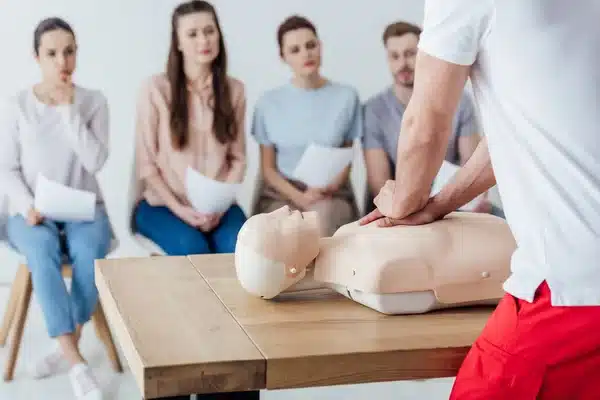
Pre-work took 10 minutes per person. The training coordinator collected full names, dates of birth, and confirmed each staff member had a USI (Unique Student Identifier) on file. A reminder email went out two days before the session: dress comfortably, remove jewellery, and arrive on time. The boardroom was cleared. Two practice stations were set up (CPR manikin station and AED trainer station) so people rotated through skills without waiting.
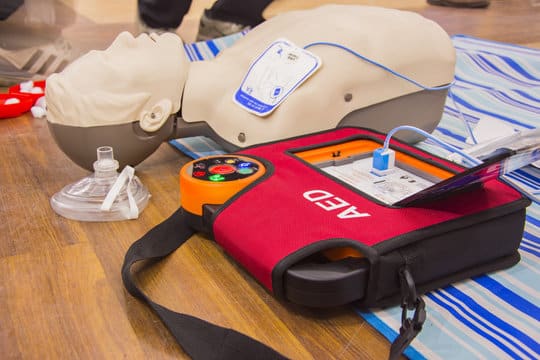
An AED trainer is a non-shocking training device that simulates prompts and pad placement so learners can practise safely and realistically. Staff practised turning the device on, attaching pads, saying “stand clear,” and following voice prompts. The trainer delivered CPR cycles, then switched to AED drills. Assessment happened continuously. No-one waited for a single demo at the front of the room.
The fastest way to train 8 staff is to run CPR compressions and AED practice as rotating stations, so assessment happens continuously instead of everyone waiting for turns. Group A started on compressions while Group B started on AED pad placement. They swapped every 12 minutes. The DRSABCD steps were reviewed as a team, then applied individually at each station.
Station Layout
- Station A: CPR compressions + rescue breaths (2 manikins)
- Station B: AED pad placement + ‘clear’ safety checks + shock/no-shock cycles (1 AED trainer)
- Station C: Choking response (demo and practice with trainer supervision)
Bystander CPR matters. The Ambulance Victoria report shows 79% of witnessed cardiac arrest cases received bystander CPR, contributing to a 41% survival-to-discharge rate. That’s why this office prioritises annual renewal. The training is not theatre. It’s operational readiness.
Outcome: all eight staff completed skills assessment by 12:15pm. Certificates showing HLTAID009, issue date, and CPR First Aid RTO details were issued digitally the same afternoon. The office manager filed a single attendance sheet and updated the compliance tracker with renewal dates 12 months forward.
What a CPR Course in Sydney CBD Includes
HLTAID009 (Provide cardiopulmonary resuscitation) is the nationally recognised unit that lets you perform CPR, use an AED, and manage choking in an emergency. After completing HLTAID009, you can respond with confidence when someone collapses, isn’t breathing, or needs defibrillation.
Core skills covered in HLTAID009 include scene safety checks, assessing responsiveness, calling 000, delivering compressions at the correct rate, giving rescue breaths, placing a person in the recovery position, managing choking, and integrating AED use with CPR cycles. The quality benchmark for compressions is 100 to 120 per minute. Training drills this rhythm until it becomes automatic.
AED practice in a CPR course means you rehearse pad placement, ‘stand clear’ safety checks, and shock/no-shock cycles while rotating back into CPR immediately after the AED prompt. You will physically turn the device on, peel adhesive pads, place them on a manikin’s chest, announce “clear” while checking no-one is touching the person, let the AED analyse, deliver a shock if advised, and resume compressions without delay. This is assessed, not just demonstrated.
Five Reasons AED Practice is Non-Negotiable
- Reduces hesitation: Hands-on practice makes you act faster when seconds count.
- Improves pad placement speed: You’ve done it before, so you don’t fumble with packaging or positioning.
- Reinforces safety ‘clear’ checks: You learn to visually and verbally confirm no-one is in contact before shock delivery.
- Teaches prompt-following under simulated stress: AED trainers replicate real voice prompts, so you know what to expect.
- Integrates seamlessly with CPR cycles: You practise the transition from compressions to AED analysis and back again, which is where delays often occur.
CPR renewal is refresher training and reassessment to keep your CPR skills current, commonly completed every 12 months in Australian workplaces. ACECQA guidance specifies that CPR must be completed within the last year for currency in education and care settings. Safe Work Australia recommendations referenced by training providers suggest annual refreshers across many industries.
For more detail on device operation, see our guide on using an AED in workplace emergencies.
Time Needed for 8 Staff
If you want everyone back at their desks quickly, time is won before the trainer arrives: paperwork, room, and rotations. The recommended duration range for HLTAID009 renewal is 2.5 to 3 hours for practical training and assessment. This is enough time to complete quality practice, rotate through AED stations, and assess each person individually without rushing.
| Time Block | Activity |
| 0:00–0:15 | Admin (roll call, safety brief, equipment check) |
| 0:15–0:55 | CPR cycles (compressions, breaths, quality feedback) |
| 0:55–1:25 | AED practice (pad placement, prompts, shock cycles) |
| 1:25–1:40 | Break (hydration, questions) |
| 1:40–2:30 | Assessment rotations (individual demos at both stations) |
| 2:30–3:00 | Debrief, certificates, next renewal date confirmation |
To keep 8 staff ‘in and out’ within a few hours, run two stations (CPR + AED) and stagger practical assessment so no-one waits for a single demo at the front of the room. Divide your group: four people start on compressions, four start on AED. Swap every 10 to 12 minutes. The trainer rotates between stations to observe, correct technique, and sign off assessments as each person completes their cycle.
Station Rotation Plan
| Time | Group A (4 people) | Group B (4 people) |
| 0:15–0:27 | CPR station | AED station |
| 0:27–0:39 | AED station | CPR station |
| 0:39–0:51 | CPR station (second round) | AED station (second round) |
| 0:51–1:03 | AED station (second round) | CPR station (second round) |
What slows groups down: late arrivals add 10 to 15 minutes to the start. Incomplete pre-work (missing USIs, unclear names) delays enrolment. Not enough manikins or AED trainers means people queue. Too much theory instead of practice drags the session out. If your provider front-loads 45 minutes of slides before anyone touches a manikin, you won’t finish in three hours.
Practical assessment is the observed demonstration of CPR and AED steps to the required standard, not just a quiz. The University of Queensland guidance notes that training must include practical, in-person components to meet compliance expectations. Online quizzes alone do not satisfy HLTAID009 requirements.
Learn the correct technique with our step-by-step guide on how to perform CPR to ensure your team delivers quality compressions every time.
AED Practice Step by Step
An AED won’t let you ‘accidentally shock’ someone who doesn’t need it. The device analyses heart rhythm and only advises a shock if a shockable rhythm is detected. Your job is to attach pads correctly and follow prompts. An automated external defibrillator (AED) is a device that analyses heart rhythm and, if needed, guides you to deliver a shock to help restore a normal rhythm.
In Australia, the AED sequence is: call 000, start CPR, turn the AED on, attach pads, say ‘clear’ while it analyses, deliver a shock if advised, then go straight back to compressions. These steps mirror international best practice but are adapted for Australian emergency services (000, not 911) and workplace context.
Detailed AED Steps
- Check safety: Confirm the scene is safe (no live wires, no water pooling around the person).
- Call 000: Send someone to call or use speaker mode if alone.
- Start CPR: Begin compressions and breaths immediately. Don’t wait for the AED to arrive.
- Turn on the AED: Open the case, press the power button, and listen for voice prompts.
- Attach pads: Peel adhesive pads and place one on the upper right chest, one on the lower left ribs. Follow the diagram on the pads. Dry the chest if wet or sweaty.
- Clear for analysis: Say “stand clear” loudly, check visually that no-one is touching the person, then let the AED analyse.
- Shock if advised: If the AED says “shock advised,” ensure everyone is clear, then press the shock button when prompted.
- Resume CPR immediately: After shock delivery (or if no shock advised), go straight back to compressions. Don’t pause to check pulse or wait for the person to wake up. Continue CPR until expert arrive or the person starts breathing normally.
| Correct Step | Common Mistake |
| Dry chest before pad placement | Placing pads on wet or sweaty skin (reduces adhesion and conductivity) |
| Remove clothing to expose bare chest | Placing pads over clothing (blocks electrical contact) |
| Say “stand clear” and check visually | Saying “clear” but not checking (someone may still be touching the person) |
| Resume CPR immediately after shock | Pausing to check pulse or waiting for response (wastes critical seconds) |
| Maintain 100–120 compressions per minute | Compressions too slow after AED cycle (losing rhythm and quality) |
| Keep pads attached until expert arrive | Removing pads to “see if it worked” (delays next analysis if needed) |
The Ambulance Victoria data shows a 41% survival rate to hospital discharge in witnessed cardiac arrest cases where strong bystander response occurs. That figure demonstrates what good systems and trained responders can achieve. Your AED practice is part of that system.
For more detail on each step, visit our guide on AED practice steps for workplace emergencies.
Compliance Proof and Documentation
For compliance, the training is only half the job. The other half is having proof you can produce in minutes. Compliance proof is the set of records (certificate, attendance, and issue details) that demonstrates staff have completed the required nationally recognised training within the required timeframe.
What proof typically includes: participant name, unit code (HLTAID009), issue date, provider/RTO details, and a unique certificate number or QR code for verification. CPR First Aid issues digital certificates with all required fields, plus a PDF attendance sheet and group invoice for your HR files.
ACECQA guidance specifies that CPR must be completed within the last year for currency in education and care settings. Many other workplaces adopt the same 12-month refresh cycle to align with insurance, WHS audits, and best practice. Your compliance proof must show the issue date clearly so you can calculate when renewal is due.
What to Store for WHS and HR Audits
- PDF certificates: One per staff member, filed by employee name or ID.
- Attendance sheet: Signed by trainer, listing all participants and training date.
- Invoice: Proof of payment, linked to the training date.
- Trainer details: RTO name, trainer name, contact details.
- Renewal reminders: Calendar alerts set for 11 months post-training to book next session.
| Staff Name | Date Completed | Certificate Number | Next Renewal Due | Role/Requirement |
| Jane Doe | 15 Jan 2025 | CPRFA-2025-001 | 15 Jan 2026 | First Aid Officer |
| John Smith | 15 Jan 2025 | CPRFA-2025-002 | 15 Jan 2026 | Floor Warden |
| Sarah Lee | 15 Jan 2025 | CPRFA-2025-003 | 15 Jan 2026 | General Staff |
A nationally recognised CPR renewal is only audit-proof if your certificate clearly shows HLTAID009, the issue date, and the training organisation/RTO details, and you can match it to an attendance record. If an auditor asks for proof, you should be able to open a folder and show: the certificate, the invoice, the attendance sheet. That’s the compliance pack.
Understand currency rules with our guide on how long certificates last in Australian workplaces.
Typical Costs in Sydney CBD
Typical Cost Range
Public classes: $39 to $80 per person (advertised rates for HLTAID009 in Sydney CBD and comparable metro areas)
On-site group delivery: Quote-based (total fee divided by number of attendees, driven by trainer time, equipment, and travel)
In Sydney CBD, public CPR classes are commonly advertised around $39 to $80 per person. AITS lists HLTAID009 at $39 including GST. A competitor Sydney CBD provider lists CPR at $45 for a 1.5-hour session. UQ indicative pricing shows approximately $80 for CPR training. These are benchmark figures. Variation reflects venue overhead, class size, and inclusions (digital vs printed certificates, same-day vs delayed issuance).
Typical costs are the common advertised price ranges you’ll see in-market, before any on-site logistics (travel/equipment) or corporate invoicing needs are added. For an 8-person renewal, paying $39 per person in a public class totals $312. Paying $80 per person totals $640. Both options require staff to travel to the venue, take half a day off work (including commute), and coordinate individual bookings.
On-site group pricing works differently. The quote is a total fee, not a per-person rate. The formula: trainer time (usually 3 hours minimum) + travel (CBD parking or public transport) + equipment (manikins, AED trainers, cleaning supplies) + admin (invoicing, certificate issuance). For 8 staff, a typical on-site quote in Sydney CBD might be $600 to $900 total, depending on timing and logistics. Per person, that’s $75 to $112.50.
But here’s the hidden cost reality: public classes cost your business more than the course fee. Calculate travel time (30 minutes each way per person = 8 hours total), lost productivity (half day out of office = 32 hours total), and scheduling friction (booking 8 people into different sessions over two weeks). On-site training keeps everyone at their desks before and after. The 3-hour training window is the only disruption.
| Option | Advertised Benchmark (per person) | What’s Included | What May Add Cost | Best For |
| Public Class | $39–$80 | Training, assessment, certificate | Travel time, staggered scheduling | 1–2 individuals, flexible timing |
| On-Site Group (CBD) | $75–$112.50 (total ÷ 8) | Training, assessment, certificate, equipment, consolidated invoice | After-hours premium, weekend surcharge | 6–20 staff, same location |
| Blended (Online + Practical) | $60–$90 | Online theory, practical skills session, certificate | Pre-work completion tracking, two separate time blocks | Staff with varied schedules |
CPR First Aid offers transparent group pricing for Sydney CBD offices. The quote includes trainer time, equipment, travel, and same-day digital certificates. No hidden fees for manikins, AED trainers, or cleaning. Invoicing is consolidated (one invoice, one payment, one record). For details on blended delivery options, read our comparison of online training pros and cons to understand where practical components are non-negotiable.
Booking Playbook for a Smooth Renewal
Use this checklist to get 8 staff certified with minimal disruption. A group booking is one coordinated enrolment for multiple staff, usually with consolidated invoicing and a single point of contact for scheduling and compliance documentation.
Pre-Course Checklist
- Confirm training date and time with all attendees (aim for mid-morning or post-lunch to avoid early arrivals and late finishes).
- Collect full names, dates of birth, and email addresses for enrolment.
- Check that all staff have a Unique Student Identifier (USI). If not, create one at usi.gov.au.
- Book a suitable room (boardroom, training room, or open space with floor access for manikins).
- Confirm equipment is provided by the trainer (manikins, AED trainers, cleaning supplies).
- Send a reminder email 48 hours before training: dress comfortably, remove jewellery, arrive on time.
- Arrange parking or access instructions for the trainer if needed.
- Set aside 15 minutes before the session for room setup and roll call.
- Plan a break (hydration, bathroom) after 90 minutes of training.
- Confirm certificate delivery method (email, portal, printed).
Post-Course Checklist
- Collect digital certificates and save to HR compliance folder.
- File the attendance sheet signed by the trainer.
- Update your compliance tracker with completion dates and next renewal due dates (12 months forward).
- Set calendar reminders for 11 months post-training to book next renewal.
- Review any corrective actions noted by the trainer (e.g., compression depth, AED pad placement).
- Communicate completion to your WHS officer or compliance manager.
- Store invoice and payment receipt in finance records.
- Check your workplace first aid kit requirements are still met (expiry dates, stock levels).
For an 8-person renewal, the easiest compliance process is: confirm attendee details, book one session, run AED and CPR rotations, then file certificates and set a 12-month reminder. CPR First Aid supports Sydney CBD offices with group coordination, consolidated invoicing, same-day certificate issuance, and renewal reminders. We bring the equipment, deliver the training, assess each person, and provide audit-ready documentation. Your HR team doesn’t chase eight separate certificates from eight different providers. You get one invoice, one attendance sheet, one renewal date.
Choosing the Best CPR Course Provider in Sydney CBD
If compliance and speed matter, judge providers on proof and process, not just price. The best CPR course choice is the one that meets your compliance rules, includes assessed AED practice, and minimises total disruption to your team.

Non-Negotiable Criteria
- Nationally recognised HLTAID009: Check the certificate shows the unit code and RTO details.
- Hands-on practical assessment: Not just demos. Each person must be observed and assessed.
- AED practice included: Confirm pad placement and shock cycles are assessed, not just mentioned.
Operational Fit Criteria
- CBD access: Can the trainer reach your office easily? Is parking available or public transport close?
- On-site option: Does the provider deliver at your location, or must staff travel?
- Session length: Is the advertised duration realistic for 8 people, or will it overrun?
- Class size limits: Does the provider cap group size to ensure quality? (Ideal ratio: 1 trainer to 8–12 learners.)
Documentation and Support
- Certificate retrieval: Can you download certificates anytime, or must you request them?
- Audit support: Does the provider keep training records for verification if audited?
- Renewal reminders: Will you receive alerts when renewal is due?
| Criteria | What to Check | Your Provider Score |
| National Recognition | HLTAID009 on certificate, RTO listed | |
| AED Practice Depth | Assessed pad placement and shock cycles | |
| Duration | Realistic 2.5–3 hour window for 8 people | |
| On-Site Availability | Trainer comes to your CBD office | |
| Documentation Support | Digital certificates, attendance sheet, invoice | |
| Total Disruption | Staff stay on-site, minimal travel |
For an 8-person CBD office renewal, the best provider is usually the one that can deliver HLTAID009 on-site with assessed AED practice and a clear certificate retrieval process. CPR First Aid is designed around group logistics and compliance-proof packaging. We deliver on-site in Sydney CBD. We assess AED practice as part of every renewal. We provide same-day digital certificates with HLTAID009 unit code, issue date, and RTO details. Our invoicing is consolidated. Our documentation is audit-ready. We send renewal reminders so you never miss a deadline.
If your team needs broader first aid training beyond CPR, explore our HLTAID011 overview to understand how the units stack and which qualifications your roles require.
Frequently Asked Questions
Is a CPR course in Sydney CBD nationally recognised?
A CPR course is nationally recognised in Australia when it leads to an accredited unit like HLTAID009 issued by an RTO (or under an RTO’s auspice). Check the certificate shows the unit code (HLTAID009), the issue date, and the RTO name and number. If those details are missing, the training may not meet compliance requirements. Nationally recognised training is recorded on the national training register and can be verified by employers and auditors.
How long does CPR renewal take for a group of 8?
For most workplace renewals, allow roughly 2.5 to 3 hours in-person so everyone can complete practical assessment and AED drills. This includes time for compressions, rescue breaths, AED pad placement, safety checks, and individual assessment at rotating stations. Shorter durations are sometimes advertised but may skimp on practice time or assessment quality. Confirm the session includes assessed AED practice, not just demonstration.
Does CPR renewal include AED practice?
A proper CPR renewal should include hands-on AED practice, including pad placement, ‘clear’ safety checks, and shock/no-shock cycles. You will physically attach pads to a manikin, follow voice prompts, say “stand clear,” and deliver a shock if advised. This is assessed alongside CPR compressions and breaths. If a provider lists CPR-only training without AED, ask whether an AED trainer is used and whether AED steps are assessed or just mentioned.
How often should staff refresh CPR in Australia?
Many workplaces refresh CPR every 12 months, and education and care services require CPR to be completed within the last year to remain current. ACECQA guidance specifies annual CPR currency for staff in children’s education and care. Other industries follow Safe Work Australia recommendations, which suggest annual CPR refreshers as best practice. Check your industry regulator or WHS policy for specific requirements.
What’s a typical CPR course cost in Sydney CBD?
Public CPR courses are commonly advertised around $39 to $80 per person, while on-site group pricing depends on trainer time, equipment and travel. AITS lists HLTAID009 at $39, and UQ indicative pricing shows approximately $80. On-site group quotes for 8 staff typically range from $600 to $900 total (or $75 to $112.50 per person), depending on logistics and timing. The total cost of public classes often exceeds on-site delivery when you factor in travel time and scheduling complexity.
What compliance proof should HR keep?
Keep each staff member’s certificate showing HLTAID009 and the issue date, plus an attendance record and a renewal tracker with the next due date. Store the signed attendance sheet from the trainer, the invoice, and the trainer’s RTO details. Set up a simple spreadsheet with columns for staff name, completion date, certificate number, and renewal due date (12 months forward). If an auditor asks for proof, you should be able to open a folder and show the certificate, the attendance sheet, and the invoice within minutes.
What compression rate is considered high-quality CPR?
High-quality adult CPR is delivered at a rate of about 100 to 120 compressions per minute. This rate comes from the American Heart Association guidelines and is reflected in Australian resuscitation training. In practice, this rhythm feels fast. Most people compress too slowly at first. Training drills the correct pace until it becomes automatic. Quality CPR also means pushing hard (at least 5cm depth on an adult), allowing full chest recoil, and minimising pauses for breaths or AED checks.
Ready to Renew Your Team
CPR renewal for 8 staff in Sydney CBD doesn’t have to be complicated. Book a single on-site session with CPR First Aid. We deliver nationally recognised HLTAID009 training with assessed AED practice in 2.5 to 3 hours. Your team stays on-site. You get consolidated invoicing, same-day digital certificates, and audit-ready documentation. We handle the equipment, the assessment, and the paperwork. You handle booking one session and updating your compliance tracker.
Download our CPR Renewal Compliance Pack (attendance sheet template, certificate audit checklist, and renewal tracker) to make your next audit effortless. Contact CPR First Aid to book your Sydney CBD group renewal today.
References
- Victoria’s world-class cardiac arrest survival – Cited for bystander CPR rate (79%) and survival-to-discharge rate (41%).
- First aid qualifications & training – Cited for CPR currency requirement (within last 12 months for education and care settings).
- First aid and CPR training – Cited for indicative CPR duration, cost benchmark, and emphasis on practical, in-person components.
- HLTAID009 Provide CPR – Cited for $39 price benchmark and annual CPR refresher recommendation via Safe Work Australia reference.
- CPR First Aid Training Melbourne – Cited for 2.5 to 3 hour duration benchmark and hands-on AED practice emphasis.
- Part 7: Adult Basic Life Support: 2025 – Cited for compression rate guidance (100 to 120 compressions per minute) and importance of early CPR and defibrillation.