

If your employer has asked you to get HLTAID012, you’ve landed on the right page. HLTAID012 (Provide First Aid in an education and care setting) is the nationally recognised childcare first aid course that includes CPR for adults, children and infants, plus emergency asthma and anaphylaxis response. This guide is designed specifically for new childcare staff in Brisbane City who need to know what the course covers, how long it takes, what to bring on the day, and how to book with confidence. You’ll walk away knowing exactly what to expect.

Your HLTAID012 Brisbane City Course at a Glance
CPR First Aid’s HLTAID012 Brisbane City course is designed for childcare and education staff and includes CPR, asthma and anaphylaxis training in line with ARC guidance. The course meets ACECQA requirements for early childhood education and care services across Australia.
What’s included: CPR for adult, child and infant, AED use, emergency asthma management, anaphylaxis response with adrenaline autoinjector trainer, choking, incident reporting, infection control, and communicating with parents and emergency services.
Delivery format: Self-paced online theory (complete before the practical session) plus a face-to-face practical and assessment session in Brisbane City CBD.
What to bring: Your Unique Student Identifier (USI), photo ID, proof you’ve finished pre-learning (if applicable), and comfortable clothing and closed-in shoes because you’ll perform CPR on the floor.
Validity and renewal: ACECQA guidance expects first aid, anaphylaxis management training and emergency asthma management training renewed every three years, with CPR refreshed annually.
This course gives you the practical skills and knowledge to respond confidently to emergencies in childcare settings. You’ll practise hands-on techniques with infant and child manikins, learn to recognise life-threatening asthma and anaphylaxis symptoms, and understand how to document incidents and communicate with families. For more background on childcare-specific first aid expectations, see our childcare first aid overview.
What HLTAID012 Covers: CPR, Asthma and Anaphylaxis Explained
If you’re wondering whether HLTAID012 includes CPR, asthma and anaphylaxis: yes. The course is structured to give you the complete skill set needed for childcare compliance and real-world emergency response.
HLTAID012 includes CPR plus emergency asthma and anaphylaxis management, with practical assessment of adult, child and infant CPR and AED use. You’ll work through realistic scenarios designed for education and care settings, not generic workplace situations.
Core Skills You’ll Learn
- DRSABCD action plan: DRSABCD is the step-by-step action plan for emergencies: Danger, Response, Send for help, Airway, Breathing, CPR and Defibrillation. You’ll apply this sequence in every scenario. Learn more about DRSABCD steps and why they matter.
- CPR technique: You’ll perform hands-on CPR for adults, children and infants. The depth, rate and technique differ for each age group, and you must demonstrate 2 minutes of continuous compressions.
- AED operation: Automated external defibrillators are standard equipment in many centres. You’ll practise applying pads, following voice prompts, and ensuring safety during shock delivery.
- Choking management: Back blows and chest thrusts for adults, children and infants, including modifications for pregnant women.
- Asthma first aid: Recognise mild versus severe asthma attacks, use a reliever inhaler with a spacer, and know when to call 000. The approach follows ANZCOR Guideline 9.2.5, updated July 2023.
- Anaphylaxis response: Identify signs of anaphylaxis, administer adrenaline using an autoinjector trainer (EpiPen-style device), and position the person safely while waiting for expert.
- Incident documentation: Complete an incident report with accurate details, timings, and actions taken. This is a legal and compliance requirement in childcare.
- Infection control: Use gloves, dispose of materials safely, and understand cross-contamination risks when treating children.
- Communication: Speak clearly with emergency services, explain what happened to parents or guardians, and debrief with colleagues after an incident.
The course is tailored to education and care environments. That means scenarios involve nap times, meal times, outdoor play, and multiple children present. You’ll learn to manage the emergency while supervising other children and following your centre’s procedures.
Units of Competency Included
HLTAID012 bundles several nationally recognised units. When you complete the course, your Statement of Attainment typically includes:
- HLTAID009 Provide cardiopulmonary resuscitation
- HLTAID010 Provide basic emergency life support
- HLTAID011 Provide first aid
- HLTAID012 Provide first aid in an education and care setting
This structure means you’re covered for general first aid as well as childcare-specific requirements. Confirm the exact units with CPR First Aid at booking to ensure your employer’s needs are met.
ACECQA and Compliance: Why Childcare Employers Require HLTAID012
HLTAID012 is commonly required because services must have current approved first aid, anaphylaxis and emergency asthma training available. This expectation comes from the National Regulations governing early childhood education and care in Australia.
An approved first aid qualification in childcare is a current, nationally recognised course that meets ACECQA’s listed requirements for first aid, anaphylaxis and emergency asthma training. Services need at least one staff member on site with these qualifications during operating hours. Family day care educators and their assistants must each hold current qualifications because they often work alone with children.
According to ACECQA guidance, first aid qualifications, anaphylaxis management training, and emergency asthma management training must be renewed every three years, with CPR refreshed annually. This renewal cadence ensures your skills stay aligned with the latest resuscitation guidelines and asthma management protocols.
For new starters in Brisbane City, this means you should book your HLTAID012 course as soon as your employer confirms the requirement. Don’t wait until the last minute. Processing your Unique Student Identifier (USI) and issuing your certificate takes time, and you can’t legally perform first aid duties without current certification. Set a reminder in your calendar for 11 months after your CPR completion date to book your annual CPR refresher, and set another for 33 months to plan your full three-year renewal.
Compliance Checklist for Childcare Staff
- ✓ Current approved first aid qualification (HLTAID012)
- ✓ Current anaphylaxis management training (included in HLTAID012)
- ✓ Current emergency asthma management training (included in HLTAID012)
- ✓ CPR refresher booked annually (HLTAID009)
Understanding why asthma and anaphylaxis training matters helps you see these requirements as more than compliance tasks. They’re about protecting the children in your care and giving families confidence that their child is safe.
Course Duration: How Long Does HLTAID012 Take to Complete?
HLTAID012 is typically completed as online theory (often up to 10 hours, self-paced) plus a face-to-face practical and assessment session (commonly 1.25 to 3.5 hours), so most students finish in one day after completing pre-learning. The exact time depends on the provider and the delivery model you choose.
Blended delivery means you complete the theory online before you attend a face-to-face session for practical training and assessment. This is the most common format in Australia. You work through modules covering emergency response principles, legal considerations, anatomy basics, and specific conditions like asthma and anaphylaxis at your own pace. Once you’ve finished the online component, you attend a scheduled practical session in Brisbane City where a trainer/assessor watches you perform CPR, use an AED, respond to asthma and anaphylaxis scenarios, and complete documentation.
Some providers offer fully face-to-face courses with no online component. These sessions run longer (typically a full day) because all theory and practical content is delivered in person. This format works well if you prefer learning in a classroom environment or if you have limited internet access. It’s also suitable if you struggle with online learning platforms.
Refresher or express options may be available if you’re renewing an existing HLTAID012 or HLTAID011 qualification and only need to update specific skills. These shorter sessions focus on practical assessment and guideline updates rather than teaching foundational theory. Check with CPR First Aid whether you’re eligible for a refresher pathway.
HLTAID012 Time Breakdown
| Delivery Option | Online Theory Time | In-Class Practical & Assessment Time | Best For |
| Blended | Up to 10 hours (self-paced, complete before class) | 1.25 to 3.5 hours (face-to-face) | People who prefer flexible theory study and want to minimise time away from work |
| Face-to-face (no online) | None (all theory delivered in class) | Full day (typically 6 to 8 hours) | People who prefer classroom learning or have limited internet access |
| Refresher/express | Minimal or none | 2 to 4 hours (focused assessment) | People renewing within 12 months of expiry with current practical skills |
Times vary by provider and student pace; confirm at booking.
Pre-learning is not optional in blended delivery. You must complete and pass the online component before you’re allowed to attend the practical session. This ensures everyone arrives with a baseline understanding of first aid principles, which makes the hands-on training more efficient. Trainers can focus on coaching technique rather than explaining theory.
It’s worth noting that practical, in-person components are required for most workplace and placement contexts. Online-only certificates may not be accepted by childcare employers or regulatory bodies. If you’re considering an online-only option to save time, confirm with your employer first. The effort you invest in attending a face-to-face session protects your career and ensures you can actually perform the skills when they’re needed. For a deeper look at this decision, read about online first aid pros and cons.
What to Bring to Your HLTAID012 Course in Brisbane City
Use this checklist so you can be assessed without delays. Arriving prepared means you won’t be sent home to retrieve documents or change clothes, which wastes your time and can push back your certificate issuance.
Must-Have Items
- Unique Student Identifier (USI): A USI is your personal education number used to issue nationally recognised VET certificates in Australia. Apply for one free at usi.gov.au before your course. Write it down or save it in your phone. Without a valid USI, CPR First Aid cannot issue your Statement of Attainment.
- Photo ID: Bring a driver’s licence, passport, or proof of age card. The name on your ID must match your enrolment and USI details.
- Booking confirmation: Print it or have it ready on your phone. This confirms your session date, time, and venue address.
- Pre-learning completion evidence: If your course requires online theory, bring proof you’ve passed (usually an email or certificate from the learning platform). Some providers check this at sign-in.
- Glasses or hearing aids: If you need them for reading or hearing instructions, bring them. You must be able to see and hear the trainer’s demonstrations and the AED voice prompts.
- Water bottle: Practical sessions are physically demanding. Stay hydrated, especially in warm weather.
What to Wear
- Comfortable clothing: You’ll kneel on the floor, roll people into the recovery position, and bend repeatedly. Avoid restrictive jeans or tight skirts. Activewear or casual clothes work well.
- Closed-in shoes: Sandals, thongs, or high heels are not suitable. You need stable footwear for safety and because you’ll be on your feet moving between stations.
- Layers: Brisbane City venues are usually air-conditioned. Bring a light jumper or cardigan if you get cold easily.
Optional but Smart
- Small towel or knee pad: Some people find kneeling on hard floors uncomfortable during extended CPR practice. A small towel under your knees can help.
- Notebook and pen: For jotting down key points, your renewal dates, or questions to ask your employer.
- Lunch or snacks: Check the session length. If it runs through lunch, you may need to bring food. Brisbane City CBD has plenty of cafes and food courts nearby, but it’s faster to bring your own if time is tight.
Medication and Accessibility
If you personally need medication (like an asthma reliever or EpiPen), bring it. Training devices used in the course are for practice only. Don’t rely on them for your own medical needs.
You must perform 2 minutes of CPR on the floor as part of the assessment. If you have a knee, back, or shoulder condition that might affect your ability to do this, contact CPR First Aid before booking. They can discuss reasonable adjustments or alternative assessment methods where possible. The course is designed to be inclusive, but safety and competency standards must be met.
Printable Checklist: The Night Before Your HLTAID012 Course
- ☐ USI written down or saved in phone
- ☐ Photo ID in bag
- ☐ Booking confirmation printed or accessible on phone
- ☐ Pre-learning completion evidence ready
- ☐ Comfortable clothes and closed-in shoes laid out
- ☐ Water bottle filled
- ☐ Glasses/hearing aids packed (if needed)
- ☐ Personal medication included (if applicable)
- ☐ Notebook, pen, snacks (optional)
- ☐ Directions to Brisbane City venue checked
- ☐ Alarm set to arrive 10 to 15 minutes early
Being organised reduces stress and helps you focus on learning. For context on how long your certificate will remain valid after you complete the course, see how long certificates last and plan your renewal dates now.
Practical Assessment: What You’ll Be Asked to Demonstrate
You don’t need a medical background. You just need to be able to demonstrate the steps. Competency-based assessment means you must show you can perform the required skills to the standard. It’s not graded; you’re assessed as competent or not yet competent. If you’re not yet competent in any area, the trainer will coach you and give you another opportunity to demonstrate the skill.
HLTAID012 assessment typically includes hands-on CPR with an AED plus scenario-based asthma and anaphylaxis response and an incident report. Here’s what to expect in each component.
Adult CPR and AED
You’ll perform 2 minutes of continuous CPR on an adult manikin. The trainer times you and watches for correct hand placement (centre of the chest, on the lower half of the sternum), adequate depth (at least 5 cm but not more than 6 cm), correct rate (100 to 120 compressions per minute), and full chest recoil between compressions. You’ll deliver 30 compressions, then give 2 rescue breaths using a face shield or pocket mask, and repeat the cycle.
After 2 minutes, the trainer will introduce an AED. You’ll switch it on, follow the voice prompts, apply the pads to the manikin’s chest, and ensure everyone stands clear during the shock. Then you’ll resume CPR immediately after the shock is delivered. This sequence tests your ability to integrate the AED into CPR without long interruptions.
You’ll also practise the recovery position: rolling an unconscious but breathing person onto their side to protect their airway. This is especially important in childcare, where a child might vomit or have a seizure.
For help preparing, review CPR technique tips before your session. Understanding the biomechanics of effective compressions will make your practical assessment smoother.
Infant and Child CPR
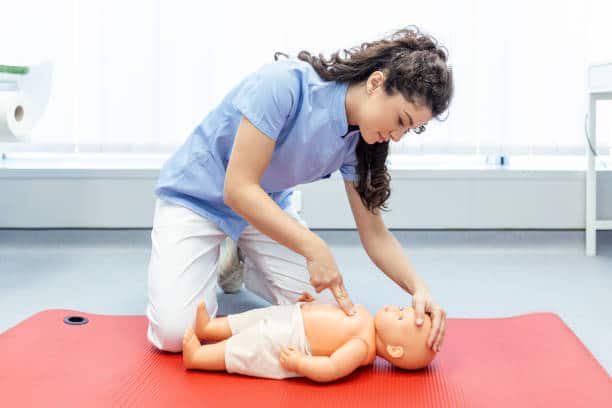
You’ll demonstrate CPR on infant and child manikins. The technique differs from adult CPR: lighter compressions (one-third the depth of the chest), different hand positions (two fingers for infants; one or two hands for children depending on their size), and a faster ventilation ratio (15 compressions to 2 breaths if two rescuers are present, or 30:2 if you’re alone). The trainer will explain these modifications and watch you apply them correctly.
Infant CPR can feel unnatural at first because you’re worried about hurting the baby. Trust the training. The manikins are designed to give you realistic feedback, and the trainer will guide you on pressure and positioning.
Asthma Emergency Scenario
You’ll respond to a simulated asthma attack. The trainer will describe symptoms (like wheezing, difficulty speaking, pale or blue lips) and ask you to demonstrate the steps. You’ll sit the person upright, give them their reliever inhaler with a spacer, and decide whether to call 000 based on whether their symptoms improve. You’ll explain your reasoning out loud so the trainer can assess your decision-making.
The scenario might involve a child who is too young to use an inhaler independently, so you’ll practise helping them. You’ll also discuss when to move from first aid to emergency services escalation, which is critical in childcare where delays can be life-threatening.
Anaphylaxis Emergency Scenario
You’ll respond to a child showing signs of anaphylaxis: hives, swelling, difficulty breathing, or collapse. You’ll demonstrate how to use an adrenaline autoinjector trainer (EpiPen-style device). The steps include removing the safety cap, pressing the injector firmly against the outer thigh (through clothing if necessary), holding it in place for 3 seconds, and massaging the injection site. You’ll call 000, position the person flat (or sitting if breathing is difficult), and monitor them until expert arrive.
The trainer will ask you questions like “What if the child’s symptoms don’t improve after 5 minutes?” (Give a second dose if available and trained to do so.) or “What if you don’t have an autoinjector?” (Call 000 immediately and follow dispatcher instructions.) This tests your understanding, not just your ability to follow a script. For a deeper dive into recognising and responding to anaphylaxis, see anaphylaxis response strategies.
Choking Management
You’ll demonstrate back blows and chest thrusts for a choking adult, child, or infant. The trainer will specify the scenario (like “a toddler has a toy stuck in their throat”) and you’ll respond. You’ll encourage the child to cough first, then deliver up to 5 back blows between the shoulder blades, check the mouth, and give up to 5 chest thrusts if the object hasn’t dislodged. If the child becomes unconscious, you’ll start CPR and call 000.
Incident Reporting and Communication
You’ll complete a written incident report based on one of the scenarios. This includes documenting the time, what happened, what you did, who you called, and the outcome. The report must be clear enough that someone reading it later (like a parent, manager, or investigator) can understand the sequence of events. You’ll also practise verbal handover to emergency services: “This is [your name] calling from [centre name]. We have a 3-year-old child with difficulty breathing after eating. We’ve given one dose of adrenaline. The child is conscious and sitting upright. We need an ambulance immediately.”
This communication component is often overlooked in generic first aid courses, but it’s a core part of HLTAID012 because childcare staff must liaise with parents, emergency services, and regulatory bodies after an incident.

Common Mistakes to Avoid
- Stopping compressions for too long: Every second of interrupted CPR reduces the chance of survival. Minimise pauses when checking the airway, giving breaths, or applying the AED.
- Incorrect hand placement: Compressions too high (on the neck) or too low (on the stomach) are ineffective and dangerous. The trainer will show you the correct landmark: centre of the chest, lower half of the sternum.
- Not calling 000 early enough: In scenarios involving children, call for help as soon as you recognise a serious emergency. Don’t wait to see if the child improves. expert take time to arrive, and early dispatch saves lives.
- Ignoring action plans: If the scenario includes an asthma or anaphylaxis action plan, follow it. These plans are written by doctors and tailored to the individual child. They override general first aid advice.
Remember: according to ARC updates, any attempt at resuscitation is better than no attempt. If you’re unsure during the assessment, do something. The trainer will correct you if needed, but hesitation is worse than an imperfect technique.
Childcare Scenarios: CPR, Asthma and Anaphylaxis Response in Action
In childcare, emergencies rarely happen in a quiet room. You’ll be managing other children, calling for help, and following centre procedures. These scenarios show what the topics you’ve learned look like in real-world childcare settings and help you mentally rehearse your response before it happens.
Because asthma affects around one in six Australian children (according to Children’s Health Queensland), HLTAID012 focuses on rapid recognition and first aid response for asthma emergencies in education and care settings. You’re statistically likely to encounter an asthma episode during your career, so this training is directly applicable.
Scenario 1: Unresponsive Child Near Water Play
You’re supervising outdoor play. A 4-year-old child is found face-down in a shallow water tray, unresponsive. Another educator is nearby with the rest of the group.
What you do first:
- Check for danger. Remove the child from the water if safe to do so.
- Check for response. Gently shake the child’s shoulders and call their name loudly.
- Send the other educator to call 000 and get the AED. You start DRSABCD.
- Open the airway (head tilt, chin lift). Check for breathing by looking at the chest, listening, and feeling for breath on your cheek (take no more than 10 seconds).
- If not breathing normally, start CPR immediately: 30 compressions, 2 breaths, repeat.
- When the AED arrives, switch it on and follow the prompts. Continue CPR with minimal interruptions until expert take over.
After the emergency, you’ll document the incident (time found, condition, actions taken, who called 000, outcome) and notify the child’s parents immediately. Your centre’s policies will guide how you report to regulatory authorities. You and your colleague will likely debrief with a manager or counsellor to process the event. Psychological first aid for staff is part of maintaining a healthy workplace after trauma.
Scenario 2: Severe Asthma Attack During Outdoor Play
A 5-year-old with known asthma starts wheezing during a game of chasey. They can’t speak in full sentences and their lips look pale. You have the child’s asthma action plan and reliever inhaler in your emergency kit.
What you do first:
- Sit the child upright in a comfortable position. Keep them calm.
- Give 4 puffs of their reliever inhaler (usually blue), using a spacer. Give one puff at a time, asking the child to take 4 breaths through the spacer for each puff.
- Wait 4 minutes. If there’s no improvement, give another 4 puffs.
- If symptoms don’t improve or the child is struggling to breathe, call 000. Continue giving 4 puffs of reliever every 4 minutes until help arrives.
- Stay with the child. Ask another staff member to supervise the rest of the group and keep the area calm.
Document the episode (time, triggers if known, medication given, response) and inform parents. Update the child’s asthma action plan if needed after consultation with their doctor. This scenario is common, which is why HLTAID012 spends significant time on asthma management.
For context on environmental factors that can worsen asthma in Queensland, read about thunderstorm asthma and how seasonal conditions affect children with asthma or hay fever.
Scenario 3: Anaphylaxis After Snack Time
A 3-year-old eats a cracker at morning tea. Within minutes, they develop hives on their face and arms, start coughing, and complain that their throat feels tight. The child has a known nut allergy and an anaphylaxis action plan with an adrenaline autoinjector in the office.
What you do first:
- Recognise anaphylaxis: rash plus breathing difficulty plus rapid onset.
- Send someone to get the adrenaline autoinjector and call 000 immediately. Don’t wait to see if symptoms worsen.
- Lay the child flat (or let them sit if they’re struggling to breathe). Do not stand them up or walk them around.
- Administer the adrenaline autoinjector into the outer thigh (even through clothing). Hold for 3 seconds. Massage the site for 10 seconds.
- Stay with the child. Monitor breathing and consciousness. If symptoms don’t improve after 5 minutes, give a second dose if available and you’re trained to do so.
- When expert arrive, hand over: “This is [child’s name], 3 years old, known nut allergy. Ate a cracker, developed rash and breathing difficulty within 5 minutes. One dose of adrenaline given at [time]. Here is their action plan and the used autoinjector.”
Document everything. The used autoinjector goes with the child to hospital. Notify parents immediately and debrief with your team. Review food handling procedures to prevent future exposures. This is a high-stress scenario, but clear training and action plans make it manageable.
Psychological First Aid and Post-Incident Support
Psychological first aid in childcare means keeping children safe, calm and supported after an incident, using simple reassurance and routines while following your service’s reporting and debrief procedures. Other children who witnessed the emergency may be frightened or confused. Use age-appropriate language to explain what happened: “Your friend wasn’t feeling well, so we called an ambulance to help them. The ambulance has special doctors who know how to help.”
Maintain routines as much as possible. Children find comfort in structure. Return to normal activities (story time, craft, lunch) as soon as it’s safe to do so. Let parents know what their child witnessed so they can talk about it at home if needed.
For staff, processing the event is equally important. Even if the outcome was positive, the adrenaline and responsibility can be overwhelming. Debrief with a manager or peer. Some services offer counselling through employee assistance programs. Don’t dismiss your feelings or expect yourself to “just get over it.” Repeated exposure to medical emergencies can lead to compassion fatigue or vicarious trauma, so self-care and professional support are part of the job.
HLTAID012 vs HLTAID011 vs HLTAID009: Choosing the Right Course
If you work in a childcare or education setting, HLTAID012 is the course most commonly required because it covers first aid, CPR, asthma and anaphylaxis in that environment. Don’t book the wrong course and waste time and money. Here’s how to tell them apart.
HLTAID012 versus HLTAID011: HLTAID012 includes the content of general first aid and adds education-and-care-setting requirements, including child-focused scenarios and procedures such as parent or guardian communication and reporting. If your role involves children (educator, assistant, family day care provider, outside school hours care worker), HLTAID012 is the appropriate choice.
Which First Aid Course Should I Book?
| Course Code | What It Is | Typical Who Needs It | Typical Refresh Cadence |
| HLTAID009 | Provide cardiopulmonary resuscitation (CPR only) | Annual refresher for people who already hold HLTAID011 or HLTAID012; workplaces requiring CPR-only updates | Annually |
| HLTAID011 | Provide first aid (general workplace first aid) | Office staff, retail workers, warehouse staff, volunteers, workplaces without specific childcare or education requirements | Every 3 years (CPR component annually) |
| HLTAID012 | Provide first aid in an education and care setting (childcare-specific) | Early childhood educators, assistants, family day care providers, OSHC staff, students on childcare placement | Every 3 years (CPR component annually) |
Refresh guidance varies by workplace and regulator; see ACECQA for childcare.
If your employer says “you need first aid,” confirm whether they mean HLTAID011 or HLTAID012. In childcare, the default is HLTAID012. In other industries, HLTAID011 is usually sufficient. Booking the wrong course delays your start date and costs extra to redo. For a detailed look at the general first aid course, see HLTAID011 explained.
HLTAID009 Annual CPR Refresher
A CPR refresher is a shorter course that updates and reassesses your CPR skills so they stay current. After you complete HLTAID012, you’ll need to renew your CPR component every 12 months. HLTAID009 is the standalone CPR unit. It takes 1 to 2 hours and focuses purely on CPR technique and AED use. No asthma, no anaphylaxis, no incident reporting. Just compressions, breaths, and AED practice.
Set a calendar reminder 11 months after your HLTAID012 practical session to book your CPR refresher. Don’t let it lapse. An expired CPR certificate means you’re not legally covered to perform first aid duties in childcare, and your employer may not allow you to work until it’s renewed.
How to Book HLTAID012 in Brisbane City with CPR First Aid
Booking is straightforward. Here’s the fastest way to get compliant for childcare work in Brisbane City.
To book HLTAID012 in Brisbane City, enrol online, make sure your USI is ready, finish any required pre-learning, then attend the face-to-face practical assessment. CPR First Aid makes this process simple, with clear instructions at each stage.
Step 1: Choose Your Brisbane City Session
Visit the Brisbane first aid courses page. Select HLTAID012 Provide First Aid in an education and care setting. Choose a date and time that suits your schedule. Sessions are held in Brisbane City CBD for convenience. If you’re starting a new job, book at least two weeks ahead to allow time for pre-learning, practical attendance, and certificate processing.
Step 2: Enrol and Pay Securely
Complete the online enrolment form. You’ll provide your name (exactly as it appears on your photo ID), date of birth, email, phone number, and USI. Double-check these details. Errors delay your certificate issuance. Payment is processed securely online. You’ll receive a confirmation email with your booking details and instructions for accessing the pre-learning platform.
Step 3: Submit Your USI Early
A Statement of Attainment is the official document showing you’ve been assessed competent in nationally recognised units. CPR First Aid cannot issue your Statement of Attainment without a valid USI. If you don’t have one, apply at usi.gov.au immediately after enrolment. It’s free and takes about 5 minutes. Once you receive your USI, email it to CPR First Aid or upload it through the student portal (check your enrolment email for the portal link).
Step 4: Complete Pre-Learning
If your course requires online theory (most do), log in to the e-learning platform using the credentials in your confirmation email. Work through the modules at your own pace. You must pass the online assessment before you can attend the practical session. Budget up to 6 hours for this step, though many people finish faster. Don’t rush. The knowledge you gain here supports your practical performance.
Step 5: Attend Your Practical Session
Arrive 10 to 15 minutes early at the Brisbane City venue. Bring your checklist items (USI, photo ID, comfortable clothes, water). Sign in, meet your trainer, and participate in the hands-on scenarios and assessments. Ask questions. Practise until you feel confident. The trainer is there to help you succeed, not to catch you out.
Step 6: Certificate Issuance
After successful completion and USI verification, CPR First Aid will process your Statement of Attainment. Timelines vary depending on how quickly you submit your USI and whether any assessment components need retesting. Digital certificates are typically issued faster than printed versions. Check your enrolment confirmation for the specific process and expected timeframe. If you need your certificate urgently for a job start date, mention this when booking and follow up proactively.
If you’re concerned about how long the process takes, see how long certificates last to understand validity periods and when to start planning your renewal.
Getting to Your Brisbane City HLTAID012 Session
Brisbane City can be busy on weekdays. Plan to arrive early. Rushing increases stress and reduces your ability to focus on learning.
For Brisbane City HLTAID012 sessions, arrive early and wear comfortable clothing because you’ll be practising CPR on the floor and rotating through practical scenarios. Give yourself time to find parking or navigate public transport, sign in, use the bathroom, and settle before the session starts.
Arrival and Parking
Aim to arrive 10 to 15 minutes before your scheduled start time. This buffer accounts for traffic, parking delays, or getting lost in an unfamiliar building. Brisbane City CBD parking can be expensive and limited, so consider public transport if possible.
If driving, research nearby parking stations or street parking zones the day before. Some buildings have visitor parking, but it may require pre-booking. Factor parking costs into your budget (typically $10 to $30 for a half-day session).
Public Transport Options
Brisbane City is well served by trains, buses, and ferries. Central Station and Roma Street Station are major hubs. Check TransLink journey planner for the best route from your location. If you’re coming from outer suburbs, allow extra time for connections and potential delays.
What’s Nearby
Brisbane City CBD has cafes, food courts, and convenience stores within walking distance of most training venues. If your session runs through lunch, you’ll have options. Alternatively, bring your own lunch to save time and money.
Accessibility Considerations
Most Brisbane City venues have lift access, but check with CPR First Aid when booking if you have mobility concerns. If you need a quiet room for breaks (due to sensory processing needs or anxiety), mention this in your enrolment notes. Trainers can usually accommodate requests if given advance notice.
Face-to-face assessment means your CPR and first aid skills are assessed in person by a qualified trainer or assessor. This ensures you can perform the skills in a realistic environment, not just answer theory questions.
For families with young children who want to build confidence in baby and child first aid beyond workplace requirements, explore babies and children first aid courses designed for parents and carers.
Why CPR First Aid Is Your Best Choice for HLTAID012 in Brisbane City
When you’re starting in childcare, you need training that’s practical, current, and easy to book. CPR First Aid is a strong choice for HLTAID012 in Brisbane City if you want clear booking steps, childcare-focused scenarios, and straightforward guidance on what to bring and how long it takes.
Brisbane City Convenience
CPR First Aid runs regular HLTAID012 sessions in central Brisbane City locations, making it easy to fit training into your schedule. Multiple date options mean you don’t have to wait weeks for the next available session, which is critical if you’re starting a new job with a tight compliance deadline.
Experienced Trainers
Trainers at CPR First Aid have experience in education and care settings. They understand the specific challenges childcare staff face: managing emergencies while supervising other children, following action plans, and communicating with anxious parents. Their scenarios reflect real situations you’ll encounter, not generic office-based examples.
All training aligns with ARC guidance, so you’re learning current best practice. Guidelines are updated periodically as research evolves, and CPR First Aid’s curriculum reflects those changes.
Hands-On Practice Focus
You’ll work with infant, child, and adult manikins during the practical session. Asthma and anaphylaxis scenarios use realistic training devices (spacers, autoinjector trainers) so you know what the equipment feels like. This tactile practice builds muscle memory and confidence. When a real emergency happens, your hands will remember what to do even if your brain is panicking.
Clear Certificate Administration
CPR First Aid provides clear instructions on submitting your USI and what to expect after assessment. If you need your certificate urgently, communicate that when booking. The team will guide you through the fastest pathway and keep you updated on processing timelines. Current training means your course content and assessment align with the latest recognised guidelines and workplace requirements, so you’re never learning outdated methods.
Ongoing Support
After you finish HLTAID012, CPR First Aid can send reminders about your annual CPR refresher and three-year renewal. You’re not abandoned once you leave the classroom. Building a relationship with one training provider makes compliance management easier over the course of your career.
For broader context on first aid principles and why training matters, see first aid basics.
Keeping Your Skills Current: Renewal, Refreshers and Workplace Practice
Certification is the start. Staying current is what protects children. Your HLTAID012 qualification opens the door to childcare employment, but maintaining skills and knowledge requires ongoing effort.
In childcare, plan to renew first aid, asthma and anaphylaxis training every three years and refresh CPR annually, and keep practising your service’s emergency procedures regularly. This combination of formal training and workplace rehearsal ensures you’re ready when seconds count.
Renewal Cadence
According to ACECQA guidance, first aid qualifications, anaphylaxis management training, and emergency asthma management training must be renewed every three years. Your CPR component must be refreshed annually. This means you’ll complete HLTAID009 (CPR refresher) every 12 months and return for the full HLTAID012 course every 36 months.
Set calendar reminders now: 11 months after your practical session for CPR refresher planning, and 33 months for full course renewal. Waiting until the expiry date risks lapses that can affect your employment status.
Why Guidelines Change
First aid and resuscitation guidelines are updated as new research emerges. The Australian Resuscitation Council and ANZCOR publish revised guidelines periodically. For example, asthma first aid guidance was updated in July 2023. Refresher training ensures you’re using the most effective techniques, not outdated methods you learned years ago.
Workplace Emergency Rehearsals
Training once every three years isn’t enough to maintain confident, automatic responses. Early childhood services must rehearse their emergency and evacuation procedures every three months, according to Victorian Government guidance (which is considered best practice across Australia). These rehearsals include fire drills, lockdowns, and medical emergency simulations.
Practise using your centre’s emergency equipment: where the first aid kit is stored, how to access the AED, where asthma and anaphylaxis action plans are kept. Rehearse who calls 000, who stays with the injured child, and who supervises the rest of the group. Run through scenarios with colleagues so everyone knows their role. Document these rehearsals (date, scenario, who participated, lessons learned) to demonstrate compliance and continuous improvement.
Personal Skill Maintenance
Between formal training, practise CPR on a manikin if your centre has one available. Review asthma and anaphylaxis action plans regularly so you’re familiar with individual children’s needs. Read updates from ACECQA, ARC, and your regulatory body. Attend professional development sessions on child health and safety topics.
If you’re nervous about performing CPR in a real emergency, that’s normal. Confidence comes from repetition. The more you practise, the more automatic the response becomes. Mental rehearsal also helps: visualise walking through DRSABCD in a high-stress scenario. Athletes use this technique to improve performance under pressure, and it works for first aiders too.
When it’s time to renew CPR certification, book early in the renewal window to avoid last-minute stress.
Frequently Asked Questions
Does HLTAID012 include CPR?
Yes. HLTAID012 includes CPR for adults, children and infants, plus AED use as part of the practical assessment. You’ll demonstrate 2 minutes of continuous CPR on the floor using correct hand placement, compression depth, and rate. The course covers infant CPR technique (two fingers, lighter pressure) and child CPR technique (one or two hands depending on size), as well as adult CPR. This multi-age CPR training is what differentiates childcare first aid from general workplace courses.
Does HLTAID012 include asthma and anaphylaxis training?
Yes. HLTAID012 includes emergency asthma management and anaphylaxis response, including practising the use of asthma devices and adrenaline autoinjector trainers. You’ll learn to recognise symptoms, administer medication, and decide when to escalate to emergency services. The training follows ANZCOR Guideline 9.2.5 for asthma first aid (updated July 2023). Given that asthma affects around one in six Australian children, this training is highly relevant to your daily work.
How long does HLTAID012 take in Brisbane City?
HLTAID012 is usually completed as self-paced online theory followed by a single face-to-face practical and assessment session, so most people finish in one day after pre-learning. The online component typically takes up to 6 hours (you work at your own pace over several days if needed). The face-to-face session commonly runs 2 to 6.5 hours depending on group size and delivery format. Some providers offer full-day face-to-face courses with no online component, which take 6 to 8 hours in one session. Check your booking confirmation for the exact schedule.
What do I need to bring to HLTAID012?
Bring your USI and photo ID, plus comfortable clothes and closed-in shoes so you can complete CPR assessment on the floor. You’ll also need your booking confirmation, proof of pre-learning completion (if your course includes online theory), and a water bottle. If you wear glasses or hearing aids, bring them. If you have accessibility needs (like difficulty kneeling), contact CPR First Aid before booking to discuss options. Don’t forget to bring any personal medication you might need during the session (like your own asthma reliever).
Is HLTAID012 recognised Australia-wide?
Yes. HLTAID012 is a nationally recognised unit of competency, so it’s accepted across Australia when issued by an authorised provider. CPR First Aid is a registered training organisation, which means your Statement of Attainment is valid in Queensland, New South Wales, Victoria, and every other state and territory. If you move interstate or change employers, you don’t need to retrain. The qualification travels with you. That said, always verify specific workplace requirements with your employer. Some organisations have additional training expectations beyond the nationally recognised minimum.
How often do I need to renew HLTAID012 for childcare?
ACECQA guidance expects first aid, asthma and anaphylaxis training to be renewed every three years, with CPR refreshed annually. This means you’ll book HLTAID009 (CPR-only refresher) 12 months after your HLTAID012 practical session, then again at 24 months. At 36 months, you’ll complete the full HLTAID012 course again. Some employers require more frequent refreshers (like every two years for the full course), so confirm your organisation’s policy. Missing renewal deadlines can affect your ability to work legally in childcare.
Can I do HLTAID012 if I have a knee or back issue?
Often yes, but you must still be able to demonstrate the required CPR and practical skills. Contact the training provider before booking to discuss options. CPR First Aid can advise on reasonable adjustments where possible (like using a knee pad, taking breaks, or having a support person help with positioning). The course is designed to be inclusive, but competency standards must be met. You need to show you can perform 2 minutes of CPR on the floor because that’s what’s required in a real emergency. If you have concerns about your physical capacity, speak with your doctor before enrolling and bring medical clearance if needed.
Is online-only childcare first aid accepted?
For most workplace and placement requirements, you need an in-person practical component. Online-only certificates may not be accepted. University of Queensland guidance states that practical, in-person components are required and online certifications alone are not accepted for their student placement context. ACECQA and many childcare employers take the same position. Hands-on assessment ensures you can physically perform CPR, use an AED, and respond to scenarios under supervision. If you’re considering an online-only option to save time, confirm with your employer or placement coordinator first. Choosing a cheaper online course that your employer won’t accept wastes money and delays your start date.
Your Next Step: Book Your HLTAID012 Brisbane City Course Today
You now know what HLTAID012 covers (CPR, asthma, anaphylaxis, and childcare-specific emergency response), how long it takes (self-paced online theory plus a face-to-face practical session), what to bring (USI, photo ID, comfortable clothes), and why it matters (ACECQA compliance and real-world child safety). You’re ready to book with confidence.
Ready to get compliant for childcare work? Book your HLTAID012 Childcare First Aid course in Brisbane City with CPR First Aid and use the checklist above to arrive assessment-ready. Choose a session date that gives you time to complete pre-learning without rushing, and set your renewal reminders now so you’re never caught off guard.
Need it urgently for a new job? Contact CPR First Aid directly and explain your timeline. The team will help you choose the fastest suitable option and ensure your USI is ready so certificate processing isn’t delayed. Don’t let administrative delays stop you from starting your childcare career.
This training is about more than ticking a compliance box. It’s about being the person who stays calm when a child is choking, who knows exactly what to do when an asthma attack turns severe, and who can start CPR without hesitation while waiting for expert. Those skills protect lives. They give families confidence that their child is in safe hands. And they give you the confidence to handle emergencies without freezing or second-guessing yourself.
Book your course today. Show up prepared. Practise the skills. And commit to staying current through refreshers and workplace rehearsals. That’s how you become the first aider every childcare centre needs.
References
- First aid qualifications & training (ACECQA) – Cited for childcare first aid requirements, renewal expectations (3 years for first aid/asthma/anaphylaxis, 1 year for CPR), and the need for at least one staff member on site with current qualifications.
- New and Revised Guidelines and Editorial Changes (Australian Resuscitation Council) – Cited for ANZCOR Guideline 9.2.5 asthma first aid update (July 2023) and ARC messaging that any attempt at resuscitation is better than no attempt.
- Asthma – Emergency management in children (Children’s Health Queensland) – Cited for the statistic that asthma affects one in six Australian children and that acute asthma episodes can be life-threatening.
- First aid and CPR training (University of Queensland) – Cited for the requirement that practical, in-person components are required and online certifications alone are not accepted in student placement contexts.
- Emergency management in early childhood services (Victorian Government) – Cited for the best-practice recommendation that early childhood services rehearse emergency and evacuation procedures every three months.