
Queensland healthcare and aged care workers face a simple but high-stakes decision when choosing manual handling training: HLTWHS005 Conduct Manual Tasks Safely provides formal evidence of competence that employers can verify during onboarding and WHS audits, while a refresher updates existing skills and workplace procedures but may not carry the same recognised outcome. In Queensland healthcare and aged care, the safest default is HLTWHS005 Conduct Manual Tasks Safely with a supervised practical assessment, because it provides formal evidence of competence that employers can verify during onboarding and WHS audits. This guide cuts through the confusion and gives you clear decision logic backed by current Australian injury data.

Choose in 60 Seconds
If you’re starting in healthcare or aged care, changing employers, or doing patient transfers, book HLTWHS005. The competency-based assessment gives you a Statement of Attainment your next employer will accept without question. If you previously completed HLTWHS005, your duties haven’t changed, and your facility only wants an equipment update or procedure refresh, a refresher course can be enough.
The decision depends on what evidence your employer requires. Ask your manager or HR directly:
“Do you require HLTWHS005 Statement of Attainment or is a refresher certificate acceptable?”
Many Queensland healthcare and aged care facilities default to requiring nationally recognised training for new staff, agency workers, and roles involving frequent patient movement. Body stressing accounts for 34.5% of serious workers’ compensation claims in Australia, which explains why employers want proof you can assess risk and apply controls before you touch a patient.
If you do patient transfers, choose training that includes a supervised practical assessment—because manual handling competence can’t be proven by theory alone. Online-only certificates might look convenient, but they don’t demonstrate you can safely reposition someone in bed, operate a hoist under supervision, or communicate hand-off cues to a colleague during a two-person transfer.
Training Decision Table
| Your Situation | Book This |
| New to healthcare/aged care sector | HLTWHS005 with practical assessment |
| Agency or contractor work | HLTWHS005 (most facilities require it for onboarding) |
| Starting at a new employer | HLTWHS005 unless they confirm a refresher is acceptable |
| You use lifting equipment daily (hoists, slide sheets) | HLTWHS005 to prove competence with equipment selection and use |
| You completed HLTWHS005 within 12–24 months, same role, same facility | Refresher (check your workplace policy) |
| Office or administrative role, minimal physical tasks | Refresher if workplace requires it (rarely needs HLTWHS005) |
Need quick practical tips before training? CPR First Aid’s guide to safe manual handling techniques covers the basics you can apply today. The table above gives you an immediate path forward, but the sections below explain the ‘why’ behind each choice and what you’ll actually learn in each option.
Statement of Attainment is an official record issued for a nationally recognised unit of competency that confirms a learner has been assessed as competent. It’s linked to your Unique Student Identifier (USI) and can be verified by any Australian employer or auditor. A refresher completion certificate, by contrast, typically confirms attendance and participation but doesn’t assert competency unless the provider includes formal assessment against a recognised standard.
What Manual Handling Means in Queensland Workplaces and What Makes It Hazardous
Manual handling covers any task where you lift, lower, push, pull, carry, or hold something—including people. In Queensland healthcare and aged care, common tasks include repositioning residents in bed, assisting sit-to-stand transfers, pushing medication trolleys, moving shower chairs, and lifting supplies. People-handling adds unpredictability: patients shift weight, may have reduced cooperation, or move suddenly. A 60kg person who tenses or grabs you mid-transfer can generate force equivalent to a much heavier static load.
The hazard recipe combines high force, awkward posture, repetition, sustained duration, and constrained spaces. Lift a resident from a low bed while twisting your spine in a narrow bathroom, repeat that 15 times a shift, and you’ve stacked every risk factor. Australia recorded 146,700 serious workers’ compensation claims in 2023–24, with 29,100 from healthcare and social assistance. Manual handling isn’t just about weight. It’s about biomechanics, environment, and frequency.
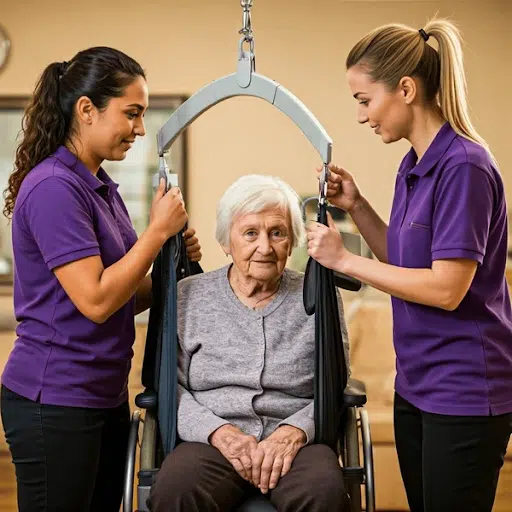
Training alone doesn’t eliminate manual handling hazards. The hierarchy of controls prioritises eliminating the hazard (e.g., using ceiling hoists instead of manual lifts), then engineering solutions (adjustable-height beds, slide sheets), then administrative controls (two-person policies, rotation schedules), and finally personal protective measures like training. Training supports the other controls. It teaches you to recognise when a task is hazardous, apply risk assessment procedures, select the right equipment, and know when to stop and get help.
Body stressing is an injury mechanism where the body is stressed by physical effort such as lifting, pushing, pulling, holding, or repetitive movement. It’s the leading mechanism of injury in Australian workplaces and accounts for the majority of manual handling claims. Symptoms range from acute strains (sudden back pain during a lift) to chronic conditions (shoulder tendinitis after months of repetitive transfers). In healthcare and aged care, manual handling risk is driven as much by unpredictable loads and awkward spaces as it is by weight.
Risk factors include:
- Force (the physical demand of the task)
- Posture (bending, twisting, reaching overhead)
- Repetition (how often you perform the task)
- Duration (how long you hold a position or exert force)
- Environment (confined spaces, wet floors, poor lighting)
A single transfer in a spacious room with equipment might be low risk. The same transfer in a cluttered ensuite, repeated 12 times a day, becomes high risk. Queensland workplaces must assess these factors and implement controls before relying on worker technique.
What HLTWHS005 Covers for Healthcare and Aged Care
HLTWHS005 is designed to build competence in planning and performing manual tasks safely, including identifying hazards and applying controls. The unit isn’t ‘lifting technique training’—it’s about applying risk assessment procedures and controls to real manual tasks, including patient movement and equipment handling. Musculoskeletal incidents among nurses can lead to long incapacity periods (average 151.8 days in one Australian analysis), which is why competency-based evidence matters for both worker safety and workplace compliance.
Risk Assessment Procedures
The core of HLTWHS005 is risk assessment procedures. You’ll learn to identify hazardous manual tasks in your work area, assess the five risk factors (force, posture, repetition, duration, environment), and select controls using the hierarchy of controls. In a healthcare context, this means recognising when a transfer requires equipment, when you need a second person, and when the environment itself (bed height, space, flooring) makes a task unsafe. Assessment isn’t a one-time checklist—it’s repeated every time the task, patient, or environment changes.
People-Handling Skills
People-handling skills form the practical heart of the unit for care workers. You’ll practice planned transfers:
- Bed-to-chair
- Chair-to-toilet
- Repositioning in bed
- Sit-to-stand assists
Each transfer includes communication cues, correct hand placement, weight distribution, and responses if the person becomes unsteady or uncooperative. Quality training simulates real conditions such as tight spaces, resistance, and equipment constraints.
Equipment Competence
Equipment competence is critical. High-quality HLTWHS005 training includes correct selection and safe use principles for aids commonly used in care settings, including:
- Hoists (ceiling-mounted and portable)
- Slide sheets and boards
- Transfer belts
- Standing aids
Training should cover appropriate use, pre-use checks, maintenance reporting, and failure response procedures.
Workplace Documentation
Workplace documentation ties the practical skills to compliance. You’ll learn how to complete hazard reports, follow SOPs, and record incidents or near misses. When an auditor or your manager asks “How do you know this worker is competent?”, your Statement of Attainment and documented workplace assessments provide the answer.
Competency-Based Assessment
Competency-based assessment means you must demonstrate you can perform the required tasks to the standard, not just describe them. An assessor watches you assess a manual task, select controls, and carry out a transfer safely, checking communication, posture, equipment use, and responses to changing conditions.
Skills Assessment Table
| Skill Area | Example Healthcare Task | Evidence an Assessor Looks For |
| Hazard identification | Assess a bed-to-wheelchair transfer in a resident’s room | Identifies floor clutter, bed height, patient mobility, space constraints |
| Risk assessment procedures | Complete a risk assessment tool for a manual task | Rates force, posture, repetition, duration; proposes controls in hierarchy order |
| Equipment selection | Choose slide sheet vs hoist for a bedbound resident | Justifies choice based on resident weight, cooperation, bed design, staff availability |
| Two-person transfer | Reposition resident higher in bed with a colleague | Clear verbal cues, synchronised movement, correct slide sheet placement, no twisting |
| Communication | Explain a sit-to-stand assist to a confused resident | Simple language, reassurance, checks understanding, adjusts if resident resists |
| Incident reporting | Document a near-miss where equipment wasn’t available | Completes form accurately, identifies contributing factors, suggests corrective action |
What a Manual Handling Refresher or Update Is and Isn’t
A manual handling refresher is an update of skills and site procedures; it may not be nationally recognised unless it results in an accredited outcome. Refreshers keep competent workers current on workplace changes such as new equipment models, updated SOPs, incident learnings, or facility-specific hazards. They’re shorter than initial training (often 2–4 hours), assume you already know the fundamentals, and focus on what’s changed since your last session.
Best use cases for refreshers include:
- Existing staff in stable roles
- Facilities with new equipment or layout changes
- Annual compliance top-ups
- Skills tune-ups after an incident trend
A refresher works when you already have the foundation and your employer accepts it as sufficient evidence.
Quality refreshers should include:
- Re-check of risk assessment procedures
- Updated equipment use
- Local SOP changes
- Lessons from recent incidents
- Short practical drills relevant to your site
Red flags include:
- “100% online manual handling certificate for patient handling” without practical verification
- Unclear provider registration status
- No explanation of evidence issued
- Instant certification without assessment
USI (Unique Student Identifier) is a personal reference number that links to your nationally recognised training records in Australia. You need a USI to receive a Statement of Attainment for HLTWHS005.
A refresher can maintain safe habits, but it doesn’t automatically provide the same compliance evidence as a nationally recognised HLTWHS005 outcome.
HLTWHS005 vs Refresher Side by Side
Use this table to choose the option your employer is most likely to accept for healthcare and aged care work in Queensland. Healthcare and social assistance accounted for 29,100 serious claims in 2023–24, which is why clarity on training outcomes matters for both worker protection and organisational compliance.
| Feature | HLTWHS005 (Nationally Recognised) | Refresher/Update (May Be Non-Accredited) |
| Outcome type | Nationally recognised unit of competency | May be non-accredited training; no unit code |
| Practical assessment | Yes—supervised demonstration of manual tasks and risk controls | Variable—may include practical drills, often no formal assessment |
| Evidence issued | Statement of Attainment (RTO-issued, USI-linked) | Certificate of completion or attendance (provider-issued) |
| USI required | Yes | No (unless part of accredited pathway) |
| Typical employer acceptance | High—accepted for new starters, agency work, tenders, audits | Variable—depends on employer policy and whether prior competency exists |
| Best for | New workers, role changes, onboarding, frequent patient transfers | Existing staff, stable role, annual updates, equipment/procedure changes |
| Not ideal for | Quick annual updates if prior HLTWHS005 is recent and role unchanged | Initial competency proof, new employers, contractor verification |
| Risk assessment depth | Full training on identifying hazards, assessing risk factors, applying hierarchy of controls | Recap of concepts; assumes prior knowledge |
| People-handling coverage | Comprehensive—planned transfers, communication, equipment, team coordination | Brief review or site-specific scenarios; less foundational instruction |
| Time/cost considerations | Longer (4–8 hours total); higher cost due to assessment and RTO compliance | Shorter (2–4 hours); lower cost; may be delivered in-house |
| Common refresher cycle | No mandated expiry; workplaces commonly require update every 2–3 years or upon role change | Often annual or biennial, set by workplace policy |
| Main risk if chosen wrong | Overkill if you recently completed it and only need a quick update | Insufficient evidence for onboarding |
If an employer asks for “HLTWHS005,” a refresher certificate usually won’t substitute unless the employer confirms it in writing. Some facilities have formal training matrices that specify unit codes for each role. Others use generic language like “manual handling certificate” and accept anything. Ask for clarity before you book. For readers in South East Queensland, CPR First Aid’s Logan manual handling course guide offers location-specific next steps.
QLD Workplace Compliance: What Managers Need for Onboarding and Audits
Training is evidence of competence; compliance is evidence of risk control. Managers should keep a documentation pack that includes:
- A role-based training matrix
- Which roles require HLTWHS005
- Which need refreshers
- Which require both
- Completion records
- Who trained
- When training occurred
- What evidence was issued
- Assessment records where relevant
- Practical assessments for HLTWHS005
- Observations for refreshers
- A refresher schedule
- Next due dates by worker
Risk Management Documentation
The risk management pack sits alongside training records and includes:
- Task-specific risk assessment procedures. Documented assessments for high-risk manual tasks in your facility.
- Implemented controls. Equipment purchases, environmental modifications, and staffing policies.
- Maintenance logs for handling aids. Inspection dates, repairs, and replacements.
- Review dates. Records of when each control was last evaluated.
Training supports these controls. It doesn’t replace them. Understanding what HSE means in your compliance framework helps you see manual handling as one part of a broader WHS system.
Incident Learning Loop
The incident learning loop connects near-miss reporting to refresher topics and equipment changes.
When workers report that a hoist was unavailable and they had to improvise, that’s a control failure, not a training failure. Appropriate responses include:
- Corrective action
- Increase hoist availability
- Adjust rostering
- Targeted refresher content
- Reinforce procedures when equipment is missing
- Reinforce the duty to stop work
Training content should evolve based on real workplace experience.
Injury Data and Risk Context
Body stressing contributed to 34.5% of serious claims in 2023–24. A separate Safe Work Australia release noted that in 2022, around 22% of serious claims were attributed to body stressing, showing the persistent nature of these injuries across years.
These figures demonstrate that manual handling risk requires:
- Engineered controls
- Appropriate equipment
- Environment design
- Competent staff working together
Training alone is insufficient.
Hierarchy of Controls in Manual Handling
Hierarchy of controls prioritises eliminating hazards before relying on behaviour-based controls.
Examples in manual handling:
| Control Level | Example |
| Elimination | Ceiling hoists replacing manual lifts |
| Engineering controls | Adjustable-height beds, electric trolleys, slide sheets |
| Administrative controls | Two-person lift policies, rotation schedules |
| Personal controls (training) | Technique instruction and awareness |
Training sits at the bottom because people forget, become fatigued, or face time pressure. Workplaces relying only on training typically experience higher injury rates.
A strong manual handling program combines:
- Risk assessment procedures
- Equipment controls
- Competency checks
Training alone is not a control.
Auditors look for:
- Documented risk assessments
- Records of corrective actions
- Evidence of control reviews after incidents
- Verified worker training and assessment evidence
If training evidence is weak, the broader program will not withstand audit scrutiny.
Compliance Documentation Overview
| Document | Owner | Review Frequency | Why It Matters |
| Training matrix by role | HR/WHS coordinator | Annually or when roles change | Defines required training and prevents gaps |
| Worker training records | HR/Manager | Updated at completion; checked quarterly | Proves workers are trained and identifies overdue refreshers |
| Task-specific risk assessments | WHS coordinator/Manager | After incidents, equipment changes, or annually | Demonstrates hazard assessment and control implementation |
| Equipment maintenance logs | Maintenance officer/Manager | After each inspection or repair | Proves controls are functional |
| Incident/near-miss reports | Workers/Manager | Immediate reporting; reviewed monthly | Identifies risks and drives corrective action |
| SOP for manual handling tasks | Manager/WHS coordinator | Reviewed annually or after incidents | Standardises safe work methods |
How to Choose the Best Manual Handling Course Provider in Queensland
The best manual handling course is the one your workplace accepts and that genuinely improves task performance. Price and convenience matter, but evidence quality and practical relevance matter more.
A cheap online-only course that doesn’t prove competence can lead to:
- Delayed onboarding
- Rejected documentation
- Workplace injuries
Outcome Clarity
Confirm:
- Whether the course is HLTWHS005 or a refresher
- What evidence is issued:
- Statement of Attainment
- Completion certificate
- Attendance record
Avoid vague wording like “nationally recognised manual handling certificate.”
Assessment Quality
For HLTWHS005, expect:
- Supervised practical assessment
- Demonstration of transfers
- Communication and technique evaluation
If a provider claims HLTWHS005 can be completed 100% online, it is not compliant delivery.
Healthcare and Aged Care Relevance
Training should include scenarios such as:
- Resident refusing movement during shower assist
- Two-person bed repositioning
- Transfers in confined spaces
Generic warehouse examples do not translate to care work.
Musculoskeletal disorder prevalence among nurses has been reported between 71.8% and 84%, highlighting the need for sector-specific training.
Trainer Capability
Look for trainers who:
- Understand care environments
- Can safely correct technique
- Have healthcare or aged care experience
RTO registration is baseline; sector experience differentiates quality providers.
Organisational Support
Facilities should assess whether providers offer:
- On-site delivery
- Training aligned with facility equipment
- Audit-ready documentation
- Customised content based on SOPs and incidents
Contextualised Training
Contextualised sessions use:
- Actual workplace equipment
- Real SOP references
- Facility-specific hazard discussions
Generic training teaches theory; contextualised training prepares workers for reality.
Provider Evaluation Checklist
| Criteria | Why It Matters | What to Look For | Questions to Ask Before Booking |
| Outcome clarity | Avoids wrong bookings | Clear HLTWHS005 or refresher statement | “What document will I receive?” |
| RTO registration | Required for national recognition | RTO number listed | “What’s your RTO number?” |
| Practical assessment | Proves competence | Observed performance | “Will I demonstrate transfers?” |
| Healthcare relevance | Matches real tasks | Patient-transfer scenarios | “Is content aged care–specific?” |
| Trainer background | Improves learning quality | Sector experience | “Do trainers have care experience?” |
| Group/on-site options | Supports team training | On-site delivery | “Can you train using our equipment?” |
| Record-keeping | Needed for audits | Digital certificates, registers | “What audit records are supplied?” |
How Fast Can You Get Certified in QLD? Step by Step
Fast certification depends more on preparation than speed.
Typical timelines:
- HLTWHS005: 1–2 days intensive or ~1 week blended
- Refresher: 2–4 hours
Common delays include missing paperwork or unavailable practical sessions.
Step 1: Confirm Required Outcome
Ask HR:
“Do you require HLTWHS005 Statement of Attainment or a refresher certificate?”
Never assume.
Step 2: Prepare USI and Identification
Requirements:
- USI (create at usi.gov.au if needed)
- Photo ID
- Name-change documentation if applicable
Missing USI is the most common certification delay.
Step 3: Complete Pre-Learning and Book Practical
Blended courses typically include:
- Online theory (2–4 hours)
- Practical assessment (2–4 hours)
Expect 1–2 weeks from enrolment to assessment during busy periods.
Step 4: Attend Assessment and Store Evidence
After successful assessment:
- Certificates issued within 1–5 business days
- Save copies:
- Phone
- Professional records folder
Healthcare recorded 29,100 serious claims in 2023–24, reinforcing the importance of verified evidence.
Step 5: Schedule Your Refresher Cycle
Common workplace cycles:
- Annual refresher
- Two-year acceptance
- Three-year re-certification
Manual handling expiry is workplace-determined, not nationally regulated.
Blended Delivery Explained
Blended delivery combines:
- Online theory learning
- In-person practical assessment
This maintains competency verification while reducing time away from work.
Fully online courses cannot assess physical manual handling competence.
The fastest accepted pathway:
- Confirm requirement
- Prepare USI
- Complete pre-learning
- Attend supervised practical
- Receive certificate
Plan for 1–2 weeks total under normal conditions.
Frequently Asked Questions
What topics are covered in a manual handling course in Queensland?
A manual handling course should cover:
- Risk assessment procedures
- Hierarchy of controls
- Safe lifting, pushing, pulling, and carrying
- People-handling practices in healthcare and aged care
Quality courses include:
- The five risk factors:
- Force
- Posture
- Repetition
- Duration
- Environment
- Equipment selection (hoists, slide sheets, transfer belts)
- Communication during transfers
- Documentation and incident reporting
Sector-specific contextualisation is essential.
Is HLTWHS005 nationally recognised?
Yes. HLTWHS005 is a nationally recognised unit of competency within the Health Training Package (HLT).
Successful completion results in:
- Statement of Attainment
- USI-linked verification
- National employer recognition
Employers prefer it because it is verifiable and competency-based.
Can I do a manual handling course online?
Theory components are often online, but healthcare and aged care manual handling typically requires supervised practical demonstration.
Accepted delivery model:
- Blended delivery (online theory + in-person practical)
Fully online courses claiming to issue HLTWHS005 without practical assessment are not compliant.
How long does a manual handling certificate last in QLD?
In practice, manual handling currency is set by employer policy, and many Queensland workplaces require refreshers every 12–24 months depending on risk. HLTWHS005 itself doesn’t have a regulatory expiry date—it remains valid evidence of initial competency. Workplaces impose refresher cycles based on their risk profile, incident history, and operational needs. High-risk environments (frequent patient transfers, heavy equipment use) often require annual refreshers. Lower-risk settings may accept two-year cycles. Always follow your facility’s policy and document your refresher completion. Higher-frequency refreshers may be triggered by equipment changes, layout modifications, or injury spikes.
What’s the difference between a Statement of Attainment and a certificate of attendance?
A Statement of Attainment confirms competency in a nationally recognised unit, while a certificate of attendance only confirms you attended training. The Statement of Attainment is issued by an RTO, linked to your USI, and proves you met the unit’s performance criteria through assessment. A certificate of attendance (or completion certificate) is issued by any provider—RTO or not—and typically confirms participation, not competence. For onboarding and audits, employers want competency evidence (Statement of Attainment) because it’s verifiable and meaningful. Attendance certificates are fine for non-accredited refreshers if that’s what your employer policy specifies.
I work in aged care—do I need HLTWHS005 or is a refresher enough?
If you’re new, changing employers, or doing frequent transfers, HLTWHS005 is usually the safer choice; a refresher is better for existing staff updating site procedures. New workers need to prove foundational competency, which a refresher can’t provide. Agency and contractor staff typically need HLTWHS005 because they work across multiple sites and must show portable, verifiable evidence. If you’ve been in the same aged care role for 12–24 months, completed HLTWHS005 previously, and your duties haven’t changed, a refresher may be sufficient—but confirm with your HR department. When in doubt, choose HLTWHS005. It’s accepted everywhere; refreshers are conditional on prior competency.
What injuries is manual handling training trying to prevent in healthcare?
Manual handling training aims to reduce ‘body stressing’ injuries such as strains and sprains that commonly occur during lifting, transfers, and repetitive tasks. These injuries affect the back, shoulders, neck, and upper limbs. Body stressing contributed to 34.5% of serious workers’ compensation claims in 2023–24, with healthcare and social assistance workers disproportionately affected. Training alone doesn’t prevent these injuries—it works alongside engineered controls (hoists, adjustable beds), administrative policies (two-person lifts, rotation), and equipment (slide sheets, transfer belts). The goal is to teach workers how to recognise hazards, apply controls, and avoid high-risk postures and forces that lead to musculoskeletal disorders.
Conclusion
Choosing between HLTWHS005 and a refresher comes down to what your employer requires and what you can prove. For Queensland healthcare and aged care workers starting new roles, moving between facilities, or handling patients daily, HLTWHS005 with supervised practical assessment provides the strongest evidence of competence. It’s recognised across Australia, verifiable through your USI, and accepted by employers, auditors, and insurers. Refreshers serve a different purpose—keeping competent workers current on equipment, procedures, and site-specific hazards. They’re faster and cheaper, but they don’t replace initial competency assessment.
Managers should integrate manual handling training into a broader WHS system that includes risk assessment procedures, engineered controls, equipment maintenance, and incident learning loops. Training is evidence of competence, not a control in itself. Workers deserve environments where safe manual handling is possible—appropriate equipment, adequate staffing, and facilities designed to minimise hazards. When training, controls, and organisational support align, injury rates drop and workers stay healthy.
Book CPR First Aid’s manual handling training in QLD and get the right outcome the first time—HLTWHS005 for nationally recognised evidence, or a refresher for skills maintenance. If you’re unsure which you need, contact CPR First Aid’s team and they’ll help you match the course to your workplace requirement. For managers and training coordinators, CPR First Aid offers on-site group training and can provide an audit-ready training matrix that documents who trained, when, and what evidence was issued. The investment in quality training pays off in reduced injuries, smoother onboarding, and compliance confidence when auditors arrive.
References
- Deriving Insights From an Occupational Incident Reporting Database — Cited for average incapacity days (151.8) and total musculoskeletal claims among nurses (1,936) to support the importance of competency-based manual handling training in healthcare.
- Key Work Health and Safety Statistics Australia 2025 — Cited for serious claims totals (146,700 in 2023–24), healthcare and social assistance claims (29,100), and body stressing proportion (34.5%) to contextualise manual handling risk in Queensland workplaces.
- Key Work Health and Safety Statistics Australia 2023 — Cited for body stressing share (~22% in 2022) as supporting context for manual handling injury persistence across years.
- The Effect of Interventions on Preventing Musculoskeletal Injuries Related to Nurses’ Work — Cited for nurse musculoskeletal disorder prevalence range (71.8% to 84%) to justify healthcare-specific training and high-quality provider selection.