
If you’re searching for a CPR course in Sydney CBD that delivers nationally recognised certification, clear course content, and same-day results, you need to know exactly what you’re booking before you walk through the door. A CPR course in Sydney CBD for HLTAID009 includes DRSABCD, adult CPR skills, AED use, and a practical competency assessment. When delivered by a Registered Training Organisation, it’s a nationally recognised unit listed on training.gov.au. This guide breaks down every module, every assessment task, and every step to receiving your certificate the same day you complete your training.
Quick Answers About CPR Courses in Sydney CBD
Need the basics fast? Here’s what you need to know about CPR training in Sydney CBD.
- HLTAID009 is Australia’s current CPR unit: HLTAID009 is the nationally recognised unit of competency for providing cardiopulmonary resuscitation in Australia, as listed on the National Training Register.
- Course content covers life-saving essentials: You’ll practise DRSABCD, chest compressions, rescue breaths, AED operation, and recovery position basics.
- Nationally recognised means workplace-accepted: A valid statement of attainment from an RTO is recognised across all Australian states and territories.
- Same-day certificates are standard: Most Sydney CBD providers issue digital certificates the day you successfully complete your assessment, provided your student details and USI are correct.
- Sydney CBD location saves time: Classes run close to transport hubs, making it easy to fit training into a work day or lunch break.
- Refreshers keep skills current: Renew your CPR certification annually to maintain competency and comply with workplace expectations.
Why does this matter? Research shows that around 25,000 Australians experience cardiac arrest each year, yet only 12% survive. Early CPR and defibrillation are the most significant factors in improving survival rates. Knowing what to do in the first minutes can mean the difference between life and death.
What’s Included in a CPR Course in Sydney CBD
If you’re comparing providers, this section shows exactly what you’ll do in class. Competitors list 3 to 6 generic points. We publish a module-by-module outline with assessment tasks and common mistakes to avoid.
DRSABCD Action Plan
Every CPR course begins with DRSABCD. DRSABCD is the step-by-step basic life support action plan used to assess danger, check response, send for help, and begin CPR and defibrillation. You’ll learn to check the scene for hazards, determine if the person is responsive, and make the decision to call emergency services. This framework guides you through every emergency situation. For a detailed breakdown, see our guide on DRSABCD meaning.
Checking Breathing and Responsiveness
You’ll practise checking for normal breathing and signs of life. This involves looking for chest movement, listening for breath sounds, and feeling for air on your cheek. The course teaches you to recognise abnormal breathing patterns that signal cardiac arrest.
Calling for Help
Timing matters. You’ll learn when to call 000 immediately and when to perform CPR first, depending on the situation and whether you’re alone or with others. The course covers how to communicate clearly with emergency operators and what information they need.
CPR Technique for Adults
This is the hands-on core of HLTAID009. You’ll perform CPR on an adult manikin positioned on the floor. The course teaches correct hand placement, compression depth (approximately 5-6 cm), compression rate (100-120 per minute), and the 30:2 compression-to-breath ratio. Trainers provide real-time feedback on your technique. To prepare for this section, review how to perform CPR before class.
AED Setup and Safe Shock Delivery
Automated external defibrillators save lives when used quickly. You’ll learn to turn on the AED, attach pads to bare skin in the correct positions, follow voice prompts, and deliver a shock safely. The course emphasises the “stand clear” check and continuing CPR immediately after shock delivery. Learn more about using an AED in our dedicated guide.
Post-Resuscitation Steps
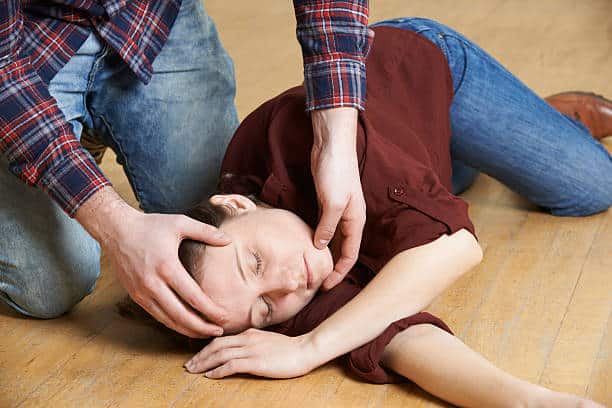
If the person starts breathing normally, you’ll learn to place them in the recovery position. The course covers monitoring vital signs, reassuring the person, and preparing information for expert.
Handover and Incident Reporting Basics
You’ll understand what information to give expert when they arrive and how to document the incident for workplace reporting purposes.
Practical Skills You Must Demonstrate
Assessment is competency-based. You must demonstrate at least 2 minutes of continuous CPR on an adult manikin positioned on the floor. Trainers assess compression depth, rate, hand placement, and rescue breath technique. You’ll also demonstrate correct AED pad placement and safe shock delivery with proper “stand clear” checks.
What Hands-On Looks Like
Expect scenario-based practice where you respond to simulated emergencies. Trainers provide immediate feedback. You’ll rotate practice with other students and work through different emergency scenarios. All equipment is cleaned between uses following infection control protocols.
Assessment Types
HLTAID009 combines practical demonstration with a short knowledge check. Some providers offer online pre-learning followed by face-to-face assessment. Others conduct all learning and assessment in person. The practical component is always face-to-face because CPR competency cannot be assessed remotely.
What’s Included with CPR First Aid
When you book with CPR First Aid in Sydney CBD, you receive same-day certificate processing when you successfully complete assessment and provide correct student details. Our trainers bring current expert, nursing, or emergency services experience. Classes run in convenient Sydney CBD venues with public transport access. We provide clear arrival instructions and support for group bookings or workplace training.
| Included in HLTAID009 (must-have) | Not included (common misconceptions) |
| DRSABCD action plan training | Advanced life support techniques |
| Adult CPR on floor with manikin | Paediatric or infant CPR (different units) |
| AED operation and pad placement | Medical equipment beyond AED |
| Practical competency assessment | Fully online-only certificate pathways |
| Recovery position basics | Substitute for professional expert care |
| Nationally recognised statement of attainment | International recognition in all countries |
One critical statistic drives home why this training matters. NSW Government data shows that for every minute without CPR or defibrillation, chance of survival drops by 7 to 10%. That’s why the course drills compression technique until it becomes automatic.
Is HLTAID009 Nationally Recognised in Australia
Yes. HLTAID009 is nationally recognised in Australia because it is a unit listed on training.gov.au when issued by an RTO. Let’s break down what that means in plain language.
National recognition means your certificate is valid and accepted across all Australian states and territories. It’s not a branded certificate from a single training provider. It’s a formal qualification issued under the Australian Qualifications Framework.
The Role of the Registered Training Organisation
An RTO is an organisation approved by the Australian Skills Quality Authority to deliver nationally recognised training. When you complete HLTAID009 through an RTO, they assess your competency against national standards and issue a statement of attainment. This document includes the RTO’s registration number, the unit code HLTAID009, your name, and the date you achieved competency.
Nationally Recognised vs Non-Accredited Online Courses
Some websites offer “CPR awareness” courses that are fully online. These are generally not nationally recognised for workplace certification. Why? HLTAID009 requires practical demonstration of CPR and AED skills. You cannot be marked competent without physically performing CPR on a manikin and operating an AED under supervision. If a course has no face-to-face practical assessment, it won’t meet the HLTAID009 requirements most employers specify.
Nationally recognised training is VET training delivered and assessed under a unit listed on training.gov.au and issued by an RTO. This is the definition that matters for workplace compliance.
How to Confirm Your Course Is Recognised
Before booking, check these five things:
- Unit code HLTAID009: Confirm the course delivers HLTAID009 Provide cardiopulmonary resuscitation. This code superseded HLTAID001 in 2020.
- RTO registration number: The provider should display their RTO number on their website. You can verify this on the training.gov.au register.
- Statement of attainment wording: Ask what document you’ll receive. It should say “statement of attainment” and list HLTAID009.
- Face-to-face practical component: Confirm the course includes in-person CPR and AED assessment, not just online theory.
- Date and student details: Your certificate must include your full name, date of birth, and the date you achieved competency.
For more context on certificate validity, see our guide on how long first aid certificates last in Australia.
| Course type | Nationally recognised | Accepted for work | Notes |
| HLTAID009 via RTO | Yes | Yes | Standard CPR unit for workplace compliance |
| Non-accredited online CPR awareness | No | Generally no | Lacks practical assessment component |
| HLTAID011 (includes CPR) | Yes | Yes | Broader first aid course that includes HLTAID009 |
| HLTAID012 (childcare first aid) | Yes | Yes for education/care | Includes HLTAID009 plus paediatric content |
One final point about currency. HLTAID009 superseded HLTAID001 in October 2020, as confirmed on the National Training Register. If someone offers you HLTAID001, they’re using outdated unit codes.
Same-Day Certification in Sydney CBD and How It Works
You can usually receive your HLTAID009 statement of attainment the same day after you successfully complete assessment and your student details are validated. Here’s the step-by-step process and what can delay your certificate.
Before Class
Complete your enrolment with accurate personal details. Name, date of birth, and address must match your ID. Obtain your Unique Student Identifier from the USI website if you don’t have one. Some providers require pre-learning modules to be completed online before the face-to-face session. Read your course confirmation email carefully for arrival time and location.
In Class
Arrive on time. Late arrivals may not be admitted because you need to complete all learning and assessment content. During the session, you’ll practise CPR and AED skills under trainer supervision. The trainer assesses your competency by watching you perform 2 minutes of CPR and demonstrate safe AED use. Competent means you meet the performance criteria consistently and safely.
Before class, it helps to review perform CPR steps so you arrive confident about the basic technique.
After Class
Once the trainer marks you as competent, the RTO processes your results. The RTO validates your student details against your USI and photo ID. If everything matches, they generate your digital statement of attainment. Most Sydney CBD providers email your PDF certificate within hours of class completion.
Common Delays and How to Avoid Them
Four issues cause most certificate delays:
- Missing or incorrect USI: Create your USI at usi.gov.au before class and bring the number with you.
- Late arrival: Arrive at least 10 minutes before the scheduled start time. Providers cannot admit late students who miss assessment requirements.
- Incomplete assessment: You must demonstrate all required skills to a competent standard. If you don’t meet the criteria, you may need additional practice.
- Incorrect enrolment details: Double-check your name spelling and date of birth match your ID exactly.
A same-day certificate means your HLTAID009 statement of attainment is issued digitally after you successfully complete assessment and your student details are validated.
| Item | Why it matters | What to do if missing |
| Valid photo ID | Confirms your identity for certificate issuance | Bring driver licence, passport, or proof of age card |
| Unique Student Identifier (USI) | Legal requirement for issuing VET certificates in Australia | Create free at usi.gov.au before class |
| Pre-learning completion (if required) | Some courses split theory online and practical in-person | Complete modules before your scheduled class date |
| On-time arrival | Late arrivals miss content and may not be admitted | Plan to arrive 10-15 minutes early |
| Comfortable clothing | You’ll kneel on the floor to perform CPR | Wear casual clothes that allow movement |
Policy clarity matters in Sydney CBD because time is tight for most students. CPR First Aid’s policy is clear: arrive on time or you may not be admitted. We set this expectation because late arrivals cannot complete the full assessment fairly.
Survival statistics reinforce why speed matters. NSW Ambulance data shows they attend around 9,000 out-of-hospital cardiac arrests each year. The first 8 minutes are decisive. Training prepares you to act in that critical window.
Which CPR or First Aid Course Do You Need for Work
If your employer said “CPR only”, book HLTAID009. If they said “First Aid Officer”, you likely need HLTAID011. Here’s how to choose the right course based on your job role and compliance context.
HLTAID009 CPR Only
HLTAID009 covers cardiopulmonary resuscitation and AED use. This is the right course if your workplace specifically asks for CPR certification or you need to renew your CPR competency without completing full first aid training. Common roles that require CPR-only include gym trainers, hospitality supervisors, office wardens, and security personnel.
HLTAID011 Provide First Aid
HLTAID011 is a broader first aid course that includes HLTAID009 plus additional content. HLTAID011 covers bleeding control, fracture management, burns, allergic reactions, asthma, and other common first aid scenarios. This is the standard qualification for workplace First Aid Officers. If your job description mentions “first aid certificate” without specifying CPR-only, HLTAID011 is usually what they mean. Read more about what HLTAID011 covers to decide if this is the right course.
HLTAID012 Provide First Aid in an Education and Care Setting
HLTAID012 is designed for educators and support staff in childcare, preschool, and outside school hours care settings. This course includes HLTAID009 plus paediatric and infant CPR, asthma management for children, and anaphylaxis response. ACECQA guidance requires education and care services to have staff with current approved first aid qualifications. For childcare workers, see our dedicated childcare first aid guide.
Role-Based Examples
Here’s what different workplace roles typically require:
- Hospitality supervisor: HLTAID009 is usually sufficient unless you’re designated First Aid Officer.
- Gym personal trainer: HLTAID009 meets most fitness industry insurance requirements.
- Office warden or fire warden: HLTAID009 is common, but some organisations prefer HLTAID011.
- Childcare educator: HLTAID012 is the standard, with CPR refreshed annually.
- Construction or industrial worker: HLTAID011 is typical for site safety requirements.
Workplace Compliance in 2026
Employers increasingly expect current, verifiable statements of attainment. WHS legislation doesn’t mandate specific qualifications for all workplaces, but many industries have codes of practice or insurance requirements that effectively require first aid training. Check with your manager or HR team about what your organisation specifies. Having the wrong qualification can mean rebooking and repeating training.
A statement of attainment is the official VET document an RTO issues when you achieve competency in a unit such as HLTAID009.
One key compliance point for education and care: ACECQA states that CPR must be completed within the previous year to be considered current. First aid qualifications must be renewed every three years, but CPR needs annual updating in many education contexts.
| Course code | Best for | Typical refresher expectation | What’s included (high-level) |
| HLTAID009 | CPR-only roles, annual refreshers | Annually (many workplaces) | DRSABCD, adult CPR, AED use |
| HLTAID011 | First Aid Officers, general workplace | Every 3 years (CPR annually) | Full first aid including CPR, bleeding, fractures, burns |
| HLTAID012 | Childcare, preschool, OSHC educators | Every 3 years (CPR annually) | Paediatric first aid, infant CPR, asthma, anaphylaxis |
Don’t forget about workplace first aid kits, which are another compliance requirement that goes hand-in-hand with having trained staff.
Why Choose CPR First Aid for Sydney CBD Training
When you’re comparing CPR course providers, here’s what you should demand from any RTO, then see how CPR First Aid meets each requirement.
What You Should Demand from Any Provider
Start with this checklist:
- Current RTO registration with nationally recognised unit codes
- Trainers with verifiable qualifications and current industry experience
- Clear assessment criteria explained before you book
- Sydney CBD location accessible by public transport
- Transparent policies on late arrivals, rescheduling, and refunds
- Same-day certificate issuance when you meet requirements
An accredited CPR course is one that assesses you against a nationally recognised unit (HLTAID009) and is issued by an RTO.
How CPR First Aid Meets These Standards
CPR First Aid is a Registered Training Organisation delivering HLTAID009 and related units across Australia. Our Sydney CBD courses run in accessible venues close to major transport hubs. Trainers hold current TAE qualifications plus relevant industry experience, often including expert, nursing, or emergency services backgrounds.
We assess competency fairly. You’ll receive clear feedback during practice. If you meet the performance criteria, your certificate is processed the same day. If you need more practice, trainers provide guidance on what to work on.
Sydney CBD Convenience
Location matters when you’re fitting training into a busy work schedule. Our Sydney CBD classes run within walking distance of Central Station and other major stops. You can attend during a lunch break or after work without losing half a day to travel.
Group Bookings and Workplace Training
Need to train a team? We offer group discounts and onsite workplace delivery. This is often more cost-effective than sending staff individually to public classes. Contact us to discuss your organisation’s needs.
Book your Sydney CBD courses through our website to see current availability and pricing.
| Requirement | CPR First Aid | What to check with other providers |
| RTO registration | Yes, publicly listed RTO | Ask for RTO number and verify on training.gov.au |
| Trainer credentials | TAE qualified with expert/nursing background | Ask what qualifications trainers hold |
| Assessment integrity | Competency-based, not tick-and-flick | Ask how practical skills are assessed |
| Same-day certificates | Standard when requirements met | Confirm certificate processing timeline |
| Sydney CBD location | Central, transport-accessible venues | Check exact address and transport options |
| Rebooking policy | Clear published policy | Ask about fees and notice required |
The statistics are sobering. Australian Resuscitation Council data shows 25,000 Australians experience cardiac arrest annually, with only 12% surviving. Quality training that builds genuine competency matters because when seconds count, you need skills that are automatic.
Frequently Asked Questions
Do I need to do online learning before the CPR course?
It depends on the class format, but HLTAID009 always requires a face-to-face practical CPR assessment. Some providers offer express courses where all theory and practical happens in one session, typically 30 minutes to an hour or two. Others split the content with online pre-learning modules you complete at home, followed by a shorter face-to-face practical session. Both pathways are valid as long as you demonstrate competency in person. Check your course confirmation email for specific requirements.
Is HLTAID009 nationally recognised in Australia?
Yes. HLTAID009 is a nationally recognised unit listed on training.gov.au when issued by an RTO. Your statement of attainment will include the unit code HLTAID009, the RTO’s registration number, your name, and the date you achieved competency. This document is recognised across all Australian states and territories for workplace compliance.
How long does a CPR course take in Sydney CBD?
Most Sydney CBD HLTAID009 sessions run from about 1 to 3 hours depending on whether you complete theory beforehand. Express courses with all content delivered in one session typically take 30 minutes. Courses with online pre-learning reduce the face-to-face time to around 1 to 1.5 hours for practical assessment. Arrival time matters. Plan to arrive 10 minutes early because late arrivals may not be admitted.
Can I get my CPR certificate the same day?
You can usually receive your HLTAID009 statement of attainment the same day after successful assessment and admin checks. The RTO needs to validate your student details, confirm your USI, and verify your ID before issuing the certificate. Most Sydney CBD providers email your digital certificate within hours of class completion. Common delays include missing USI, late arrival that results in incomplete assessment, or incorrect enrolment details that don’t match your ID.
How often should CPR be refreshed for work?
In education and care settings, CPR is generally expected to be refreshed annually to stay current. ACECQA specifies that CPR must be completed within the previous year for educators in regulated services. Outside childcare, refresher expectations vary by industry and employer policy. Many organisations prefer annual CPR updates even when not legally mandated, because skills fade over time.
What do I need to bring to the CPR course?
Bring photo ID and be ready to kneel on the floor to demonstrate CPR on a manikin. Valid ID options include driver licence, passport, or proof of age card. You’ll also need your Unique Student Identifier number, which you can create free at usi.gov.au if you don’t have one. Wear comfortable casual clothing that allows you to kneel and move freely. Avoid tight skirts or restrictive clothing. Some venues have mats, but you’ll be performing CPR at floor level.
What if I’m not physically able to do CPR on the floor?
To be marked competent for HLTAID009, you must complete the required practical CPR demonstration, so speak with the provider before booking if you have limitations. The assessment criteria require you to perform CPR at the depth, rate, and technique specified in the performance standards. Trainers may be able to offer reasonable adjustments for some situations, but the competency requirements cannot be waived. If you have concerns about physical ability, contact the RTO before enrolment to discuss your specific circumstances.
Where is the CPR course venue in Sydney CBD and how early should I arrive?
Plan to arrive early in Sydney CBD because late arrivals may not be admitted and can miss assessment requirements. CPR First Aid runs classes at venues within walking distance of major transport hubs, typically near Central Station or Wynyard. Your course confirmation email will include the exact address, floor number, and arrival instructions. We recommend arriving 10 to 15 minutes before the scheduled start time. This gives you time to find the room, complete any remaining paperwork, and be ready when the session begins. Parking can be expensive and limited in Sydney CBD, so public transport is usually the better option.
Take the Next Step
You now know exactly what’s included in a Sydney CBD CPR course, how national recognition works, and what it takes to receive your same-day certificate. HLTAID009 is the current standard for CPR training in Australia, and completing it through a reputable RTO gives you workplace-ready skills backed by a nationally recognised qualification.
The course teaches you DRSABCD, adult CPR technique, and AED operation through hands-on practice and competency-based assessment. You’ll leave knowing how to respond in those critical first minutes when survival rates drop by 7 to 10% each minute without intervention.
Book your CPR First Aid HLTAID009 CPR course in Sydney CBD and get workplace-ready with clear, nationally recognised training and a fast same-day certification process. For group bookings or workplace training, contact our team to discuss your organisation’s specific needs. View Sydney CBD course dates and secure your place in the next available session.
References
- National Training Register – HLTAID011 Provide First Aid – Used to confirm HLTAID011 listing and national recognition
- First aid qualifications & training (ACECQA) – Used for childcare/education expectations and CPR currency guidance
- HLTAID009 Provide cardiopulmonary resuscitation – Used to confirm HLTAID009 listing and that it supersedes HLTAID001
- Australian Resuscitation Council: ARC Home – Used for national cardiac arrest prevalence and survival statistics
- Restart a Heart and save a life (NSW Government) – Used for NSW statistics and the 7-10% survival drop per minute