

When the person ceases breathing, his brain and vital organs lose oxygen. If left unattended, that is, CPR and rescue breathing are not administered immediately, the potential for survival lessens every second minute. This manual offers direct, straightforward instructions on how to respond to a person who is not breathing, using the accepted DRS ABCD action plan. Following these steps, you will be well-equipped to save a life.

What is “Not Breathing”?
If a person is not breathing, it represents a severe medical emergency, e.g., respiratory arrest, in which the patient cannot breathe on his or her own. It is essential to differentiate between agonal breathing (gasping), which can occur at the onset of respiratory failure, and respiratory arrest. Although agonal breathing is ineffective for oxygenation, it remains a sign of life that necessitates urgent response.
- Respiratory Arrest: Total loss of breathing.
- Agonal Breathing: Ineffective, abnormal breathing usually observed in unconscious individuals.
Being aware of the distinction between the two can inform your response and the level of urgency required.
What to Do Immediately (General Procedures)
Should a person fail to breathe, each passing second is essential. Follow these guidelines to achieve the best outcome:
- Check for Danger (D): Don’t jump in until you’ve checked that the area is safe. Dangers such as traffic, fire, or electricity hazards may hurt you or the casualty. If it’s not safe, don’t go in to help.
- Check for Responsiveness (R): Call out the person’s name and shake their shoulders gently. If they do not respond, assume they are unconscious and move on to the next step.
- Call for Help (S): Call 000 immediately or ask someone nearby to do so. Provide clear details about the location, what happened, and the person’s condition (unresponsive and not breathing).
- Open the Airway (A): Use the head-tilt, chin-lift method to open the airway. Ensure there are no obstructions like vomit or foreign objects blocking the airway.
- Check Breathing (B): Look at the chest for rise and fall, listen for breath sounds, and check for airflow on your cheek. Do this for 10 seconds or less.
If the victim is not breathing or has agonal breathing, begin CPR at once.
Step-by-Step CPR Guide
When a person is not breathing, CPR can help save them. Below is a step-by-step, detailed guide on how to perform CPR:
1. Check Responsiveness & Breathing
Begin by ensuring the casualty is breathing. If not, use the DRS ABCD method.
2. Call 000 (or get somebody to call)
Call emergency services at once. Give the location, tell them what’s happening, and remain on the line for instructions.
3. Chest Compressions
For all unbreathing, unconscious casualties, start chest compressions:
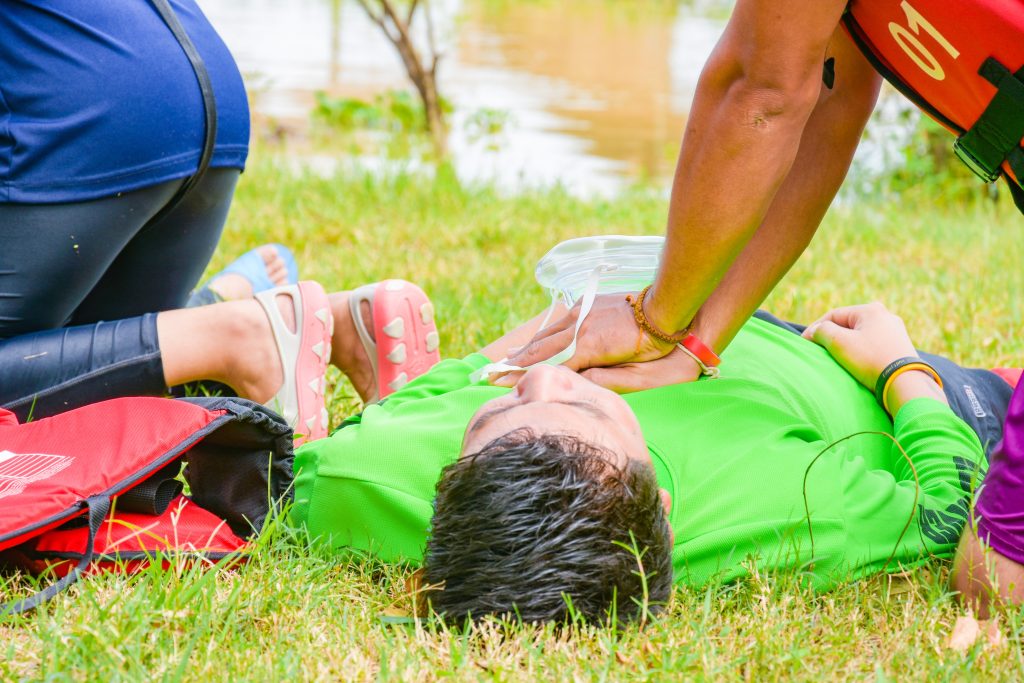
- Kneel next to the casualty’s chest.
- Position the heel of one hand in the middle of the chest (lower half of the breastbone).
- Put the other hand on top, with your fingers interlaced.
- Compression rate: 100–120 compressions per minute (about two compressions per second).
- Compression depth: A minimum of 5–6 cm (about one third of chest depth).
- Continue: Administer 30 compressions.
4. Rescue Breaths & Head-Tilt Chin-Lift
After 30 compressions, give two rescue breaths:
- Mouth-to-Mouth: Pinch the nose shut, seal your mouth onto theirs, and blow until the chest rises.
- Mouth-to-Mask (if present): Utilize a barrier mask to deliver rescue breaths.
Continue the cycle of 30 chest compressions and 2 rescue breaths.
5. Hands-Only CPR
If rescue breaths make you nervous, hands-only CPR (only chest compressions) works well to boost survival rates, particularly for lay rescuers.
6. When You’ve Initiated CPR
Continue CPR until one of the following happens:
- The individual starts to breathe normally.
- A trained responder or medical professional continues.
- There is an Automated External Defibrillator (AED) on hand, and you are asked to use it.
When to Do Hands-Only CPR
Hands-only CPR only involves chest compressions and is advised for the lay public or individuals not trained to provide rescue breaths. It can be very effective in saving lives if done properly, and especially when a trained responder or AED cannot be reached immediately.
After CPR: AED Use and Monitoring
After initiating CPR, getting access to an Automated External Defibrillator (AED) soon after will be able to save the individual’s life by giving them a shock to re-establish the normal heartbeat rhythm.
- Switch on the AED: Listen to the voice instructions.
- Position the AED pads on the individual’s chest according to the diagrams.
- Stand back while the AED reads the heart rhythm and administers a shock if necessary.
- Resume CPR once the shock is delivered, or if no shock is indicated.
Post-Event Care:
Recovery Position
If the individual resumes breathing, carefully recover them to the recovery position:
- Roll the person onto their side.
- Tilt the head back to keep the airway open.
- Closely monitor their condition.
Monitor & Handover
Remain with the individual until emergency personnel arrive. After they arrive, inform them about what happened, the first aid you have given, and any subsequent changes in the individual’s status.
Frequently Asked Questions (FAQs)
Q: How deep should compressions be?
A: Compressions must be a minimum of 5–6 cm deep, roughly a third of the chest, and at a rate of 100–120 compressions per minute.
Q: Can I just do chest compressions?
A: Yes, if you cannot administer rescue breaths, hands-only CPR (compressions) is preferred. It can still significantly enhance the survival chance.
Q: What if the person vomits during CPR?
A: Roll the person onto their side and rapidly remove the airway. Then, resume CPR if necessary.
Q: How long should I do CPR?
A: Perform CPR until the person begins breathing regularly, emergency services arrive, or the AED tells you to discontinue.
Q: Can CPR harm the casualty?
A: Although rib fractures may happen, the risks of CPR are less than the benefits. Rib fractures are frequent but seldom prove fatal, and proper CPR raises survival rates considerably.
Take a CPR First Aid Course
To learn CPR techniques and other essential first aid skills, consider enrolling in a CPR First Aid course. These courses provide the confidence and knowledge necessary to act swiftly in an emergency and save lives.
Visit CPR First Aid for more information on first aid courses near you.