
HLTAID012 (Provide First Aid in an education and care setting) covers infant, child and adult CPR, AED use, asthma and anaphylaxis management, choking response, and a complete first aid response process tailored to childcare and school settings. If you work in early education in Brisbane, this is the qualification you need. It’s designed specifically for educators, not general office workers. The course trains you to handle real emergencies involving children, from a severe allergic reaction during snack time to a toddler choking on a toy.
What HLTAID012 Covers in 2026
HLTAID012 is the nationally recognised unit titled “Provide First Aid in an education and care setting”. It prepares educators and carers to respond to first aid emergencies involving infants, children and adults in childcare centres, schools, and family day care settings. Unlike general workplace first aid, childcare first aid focuses heavily on paediatric emergencies and the specific documentation and communication requirements of education environments.
The five headline inclusions are CPR across all age groups, asthma management, anaphylaxis response, choking protocols, and AED operation. You’ll also learn incident reporting, communication with parents and guardians, and how to follow workplace emergency procedures. The course aligns with Australian Resuscitation Council guidelines and reflects 2026 best practice for education and care settings.
Most providers package HLTAID012 with three supporting units: HLTAID009 (CPR), HLTAID010 (basic emergency life support), and HLTAID011 (provide first aid). When you complete the course and are deemed competent, you receive a Statement of Attainment listing all four units. This bundled approach gives you comprehensive first aid certification suitable for most childcare compliance requirements.
Australia experiences around 26,000 cardiac arrests every year, and most occur at home. CPR and AED skills aren’t just workplace requirements. They’re life skills that matter in your community.
Who Needs HLTAID012 in Queensland and Why It’s Different
If you work in a long day care centre, kindergarten, outside school hours care program, or as a family day care educator in Brisbane, you almost always need HLTAID012. It’s also the preferred qualification for teacher aides, school support staff, and nannies who supervise children regularly. Centre directors booking group training should confirm whether their team needs the full HLTAID012 or if some roles can meet requirements with HLTAID011.
The difference between HLTAID012 and other first aid courses matters. HLTAID011 is general workplace first aid. It covers adult emergencies and basic paediatric care. HLTAID012 adds education-specific scenarios, detailed asthma and anaphylaxis management, and incident documentation tailored to childcare environments. HLTAID009 is CPR only. It doesn’t cover asthma, anaphylaxis, wounds, or choking beyond airway management.
Queensland services must have staff with current approved first aid, anaphylaxis, and asthma capability. HLTAID012 is widely accepted as meeting these requirements because it’s designed for education and care settings. ACECQA guidance supports this approach. ACECQA is the national authority that guides quality and compliance across children’s education and care services in Australia.
Early response matters. Queensland ambulance services reported 4.5 million incidents and dispatched 5.9 million responses in 2024–25. Educators trained in first aid can stabilise children while emergency help is on the way.
| Course | Best For | Focus | Typical Workplaces | Renewal Guidance |
| HLTAID009 | CPR refreshers, minimal requirement roles | CPR only (adult, child, infant) | General workplaces, some volunteer roles | Annually |
| HLTAID011 | General workplace compliance | Workplace first aid, basic paediatric | Offices, retail, construction, hospitality | 3 years (CPR annually) |
| HLTAID012 | Childcare, schools, education settings | Infant/child emergencies, asthma, anaphylaxis | Long day care, OSHC, kindergarten, schools | 3 years (CPR annually) |
The Units Included and What You Get on Completion
HLTAID012 is commonly delivered as a package that includes HLTAID009 (CPR), HLTAID010 (basic emergency life support) and HLTAID011 (first aid), plus the education-and-care setting requirements. Each unit contributes specific skills you’ll use in real childcare scenarios. A Statement of Attainment is an official VET document showing you’ve successfully completed one or more nationally recognised units of competency.
When you finish the course and demonstrate competency in all required skills, your RTO issues a Statement of Attainment. The document lists each unit you’ve completed. Timeframes vary by provider. Some can issue certificates the same day if your online pre-learning is complete, your USI is verified, and you pass all practical assessments. Others take a few business days to process documentation.
All training aligns with Australian Resuscitation Council guidelines. CPR techniques, AED protocols, and emergency response steps taught in 2026 reflect the latest evidence-based practice. This alignment ensures your skills match what expert and hospital staff expect when they arrive.
| Unit | Plain-English Outcome | Where It Shows Up in Childcare |
| HLTAID009 | You can perform CPR on adults, children, and infants | Cardiac arrest at pick-up time, playground collapse, infant breathing emergency |
| HLTAID010 | You can manage life-threatening emergencies and use an AED | Severe injury response, AED use if a visitor collapses, calling triple zero effectively |
| HLTAID011 | You can treat common injuries and illnesses in any setting | Cuts and scrapes, minor burns, nosebleeds, fainting, basic wound care |
| HLTAID012 | You can respond to education-specific emergencies and document incidents | Anaphylaxis at lunch, asthma during outdoor play, choking, incident reports, parent communication |
Understanding first aid basics before attending can help you absorb practical training more quickly. The more familiar you are with concepts like DRSABCD, the more confident you’ll feel during scenarios.
Course Structure and Duration in 2026
In 2026, many HLTAID012 courses are delivered as blended training: you complete online theory first, then attend a face-to-face session for practical training and assessment. Blended delivery means you complete theory online at your own pace and attend a face-to-face session to practise and be assessed on practical skills. Duration varies based on delivery mode, your prior experience, and class size.
A common blended format is around 6.5 hours in class plus 3–6 hours of online learning, depending on your experience and provider. Some RTOs offer half-day formats if you’ve recently completed similar training. Express or assessment-only options exist for renewals, but you’ll need proof of current or recently expired certification.
What changes duration? If you skip pre-learning, you’ll need extra time in class to cover theory. Larger classes may take longer for everyone to rotate through practical stations. First-time learners usually need the full duration. Experienced educators renewing may finish faster. Brisbane City commuters want clear start and finish times. Check your provider’s schedule before booking.
Finishing online pre-learning on time is critical. If you arrive unprepared, you may not be able to participate in practical assessment. That means rescheduling, paying again, or missing the compliance deadline your centre set. Most providers send login details within 24 hours of enrolment. Plan to finish theory at least two days before your class date.
| Option | Best For | What’s Online | What’s Face-to-Face | Typical Total Time | Risk If You Don’t Complete Pre-Learning |
| Full blended | First-time learners, those wanting flexibility | Theory, videos, knowledge checks (3–6 hours) | Practical skills, scenarios, assessment (6.5 hours) | 9.5–12.5 hours total | Can’t attend practical session, forced to reschedule |
| Face-to-face only | Learners who prefer in-person teaching | None | Full theory and practical (full day, 7–8 hours) | 7–8 hours | N/A |
| Assessment-only | Renewals with recent certification | Brief refresher (1–2 hours) | Practical reassessment (3–4 hours) | 4–6 hours total | May not meet prerequisite requirements, delays renewal |
If you’re considering online theory, review online first aid training pros and cons to understand what works best for your learning style and schedule.
CPR and AED Training (Adult, Child, Infant)
Survival after out-of-hospital cardiac arrest is typically less than 10%, but community CPR and AED interventions can improve outcomes. HLTAID012 trains you to recognise cardiac arrest, start CPR immediately, and use an AED confidently. These skills matter in childcare settings and beyond. Most cardiac arrests happen at home, so the training protects your own family too.
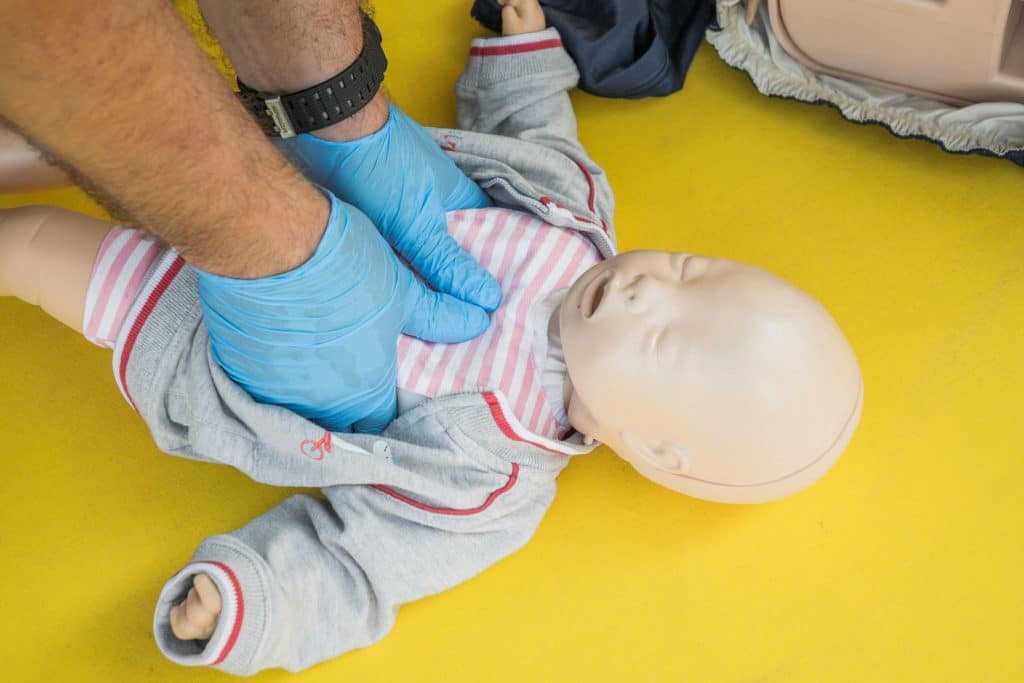
You’ll practise CPR on adult, child, and infant manikins. The course uses the DRSABCD framework. DRSABCD stands for Danger, Response, Send for help, Airway, Breathing, CPR, Defibrillation. It’s the systematic approach taught across Australia for managing emergencies. You’ll learn how to check for dangers, assess responsiveness, call triple zero, open the airway, check breathing, perform compressions and rescue breaths, and apply an AED when available.
An AED (automated external defibrillator) is a device that analyses heart rhythm and gives spoken and visual prompts to help a rescuer deliver a shock if advised. Training covers how to turn on the device, attach pads correctly for adults and children, follow prompts, and continue CPR between shocks. You don’t need to diagnose heart rhythms. The AED does that. You just need to follow instructions.
Assessment requires at least two minutes of uninterrupted single-rescuer CPR on an adult manikin on the floor. This is a common competency expectation across providers. Two minutes sounds short. It’s physically demanding. If you have mobility limitations, knee problems, or concerns about kneeling and performing compressions, contact your provider before booking. They may offer modified assessments or adaptive techniques.
Infant and child CPR differ from adult technique. Compression depth, hand placement, and the ratio of compressions to breaths change based on age and size. Assessors watch for correct hand position, adequate depth, proper rate (100–120 compressions per minute), and full chest recoil between compressions. Common mistakes include compressions too shallow, hands in the wrong spot, or stopping compressions too often.
| Age Group | What You Practise | Common Mistakes to Avoid | How Assessors Mark Competency |
| Adult | 30 compressions, 2 breaths, AED pad placement, sustained CPR for 2+ minutes | Shallow compressions, incorrect hand position, slow rate, not tilting head back for breaths | Depth 5–6 cm, rate 100–120/min, full recoil, minimal interruptions, correct AED sequence |
| Child (1–8 years) | 30:2 ratio, one or two hands for compressions, child AED pads or adult pads (anterior-posterior) | Using too much force, poor airway positioning, hesitating with AED | Depth about 5 cm (one-third chest depth), clear breathing technique, safe AED application |
| Infant (under 1 year) | 30:2 ratio, two-finger or two-thumb technique, gentle breaths, no AED in most training scenarios | Compressions too deep or too shallow, covering infant’s nose during breaths, not supporting head | Depth about 4 cm (one-third chest depth), correct finger placement, controlled ventilations |
Before attending, review DRSABCD steps and using an AED to build confidence. The more familiar the concepts, the easier practical assessment feels.
Asthma Emergencies in Childcare Settings
Picture this: a four-year-old has been running hard during outdoor play. She stops, clutches her chest, and starts wheezing. Her lips look pale. You need to recognise worsening asthma, follow her action plan, assist with medication, monitor her response, and escalate if she doesn’t improve. HLTAID012 trains you to handle exactly this scenario.
In HLTAID012, asthma management focuses on recognising worsening symptoms in children, assisting with reliever medication via a spacer (where appropriate), monitoring response, and escalating when there’s no improvement. An asthma action plan is a documented plan that tells carers what to do when symptoms worsen, including when to escalate for emergency help. Most children in childcare with asthma have one on file. Your job is to follow it accurately and calmly.
Correct inhaler and spacer technique matters. A Victorian improvement project reported that 84% of families received high-standard education on inhaler and spacer use, up from 39% before the program. That uplift shows how much difference proper teaching makes. In training, you’ll practise shaking the inhaler, inserting it into a spacer, holding the spacer to a child’s face, encouraging slow breaths, and counting the recommended number of puffs.
Documentation and communication are part of the education setting expectation. After an asthma incident, you record what happened, what you did, how the child responded, and who you notified. Parents expect accurate, timely updates. Centre policies guide who you call and when. HLTAID012 covers these workplace procedures so you’re ready.
| Step | Action | What You’re Watching For | When to Escalate |
| Recognise | Check for wheezing, persistent cough, difficulty breathing, pale or blue lips | Child can’t speak in full sentences, using accessory muscles to breathe, distressed | Symptoms severe at onset |
| Act | Sit child upright, stay calm, locate action plan and reliever, assist with spacer | Child’s response to reliever, breathing rate, colour returning | No improvement after 4 puffs, symptoms worsening |
| Monitor | Observe for 5–10 minutes, keep child calm and still, reassure them | Breathing becomes easier, child calms, colour improves | Breathing still difficult, child exhausted, confusion |
| Escalate | Call 000 if no improvement or symptoms severe, keep giving reliever every few minutes as per plan | Response to repeated doses, ability to communicate | Immediate call if child can’t breathe, is turning blue, or collapses |
| Document | Write incident report, note time, doses given, child’s response, who was notified | Accuracy of records for parents and future care | N/A |
Queensland experiences seasonal thunderstorm asthma conditions. Being prepared for sudden asthma flare-ups during weather changes keeps children safe.
For more background on managing asthma year-round, explore asthma management tips that apply both in childcare and at home.
Anaphylaxis Management (EpiPen, Action Plans, Readiness)
Imagine snack time in your preschool room. A child with a known peanut allergy accidentally eats a biscuit containing traces of nuts. Within minutes, she’s scratching her face. Her breathing changes. You grab her ASCIA Action Plan and the anaphylaxis kit. This is anaphylaxis. It’s a severe allergic reaction that can rapidly affect breathing and circulation and is a medical emergency.
Anaphylaxis can occur within 30 minutes of allergen exposure. Speed is critical. HLTAID012 anaphylaxis training focuses on recognising severe allergic reactions early, following the person’s action plan, using an adrenaline auto-injector in simulated scenarios, calling 000, and monitoring until emergency help arrives.
Asthma is a risk factor for more severe respiratory problems during anaphylaxis. If a child has both asthma and allergies, their risk increases. Monitoring breathing closely is even more important. You’ll learn to watch for signs like difficulty breathing, persistent cough, wheeze, hoarse voice, or swelling of the tongue or throat.
ASCIA Action Plans are standardised forms that tell you exactly what to do. They list the child’s allergens, symptoms to watch for, and when to give adrenaline. Queensland services must have medical condition policies and staff trained in anaphylaxis management. Policy requirements reflect this expectation nationally. Training ensures you know how to follow plans accurately under pressure.
Anaphylaxis response kits must be accessible and checked regularly. Recommended contents include at least three ampoules of adrenaline 1:1000, syringes, needles, and other essentials. Your training covers kit awareness, not encouraging untrained medication use. HLTAID012 teaches first aid response within your scope, which includes administering an auto-injector when directed by an action plan.
| Readiness Element | What It Means | Your Role | Common Gaps to Avoid |
| Policies | Centre has documented anaphylaxis and allergy policies | Read, understand, and follow policies during incidents | Assuming everyone knows the policy without reading it |
| Action Plans | Every child with known allergies has a current ASCIA plan | Know where plans are stored, check expiry, follow steps exactly | Outdated plans, plans filed but never reviewed by staff |
| Training | All educators hold current HLTAID012 or equivalent | Keep certification current, attend refreshers, practise scenarios | Letting certification lapse, never practising between renewals |
| Kit Checks | Anaphylaxis kits inspected monthly, adrenaline in date | Complete checks on schedule, replace expired items immediately | Expired auto-injectors, missing syringes, kit stored out of reach during emergency |
| Communication | Parents, educators, and relief staff all informed of child’s allergies | Confirm allergy info at enrolment and update, brief relief staff on arrival | Relief staff unaware of allergies, parents not notified of minor reactions |
| Documentation | Incident recorded accurately, timeline noted, actions logged | Write clear, factual reports, include what you saw, what you did, child’s response | Vague notes, missing timeframes, no record of who was called |
Before training, review what is anaphylaxis to understand the condition. After you’re certified, revisit anaphylaxis first aid steps regularly to keep your response sharp.

Choking (Infants and Children)
Lunch service at your centre. A toddler grabs a cherry tomato from his plate and shoves it in his mouth. Seconds later, he’s silent, clutching his throat, unable to cough. You must respond quickly and communicate clearly. Airway obstruction happens when something blocks airflow into the lungs, making breathing difficult or impossible. Choking is one of the most time-sensitive emergencies in childcare.
HLTAID012 includes practical choking scenarios for infants and children, with a focus on rapid recognition, age-appropriate first aid response, and escalation to CPR and AED use when needed. Training covers recognising ineffective cough and complete airway obstruction signs: inability to cry or speak, silent cough, cyanosis (turning blue), and loss of consciousness.
For infants, you’ll practise a combination of back blows and chest thrusts. For children, back blows and abdominal thrusts (Heimlich manoeuvre) are taught. Technique matters. Incorrect hand placement or excessive force can cause injury. Assessors watch how you position the child, deliver blows or thrusts, reassess after each cycle, and escalate to CPR if the child becomes unconscious.
If choking relief efforts fail and the child collapses, you transition immediately to CPR. You call 000 and begin compressions. The compressions may dislodge the object. The DRSABCD framework guides your response from the moment you notice something is wrong. Every cycle of compressions includes a visual check of the mouth before giving breaths. If you see the object, you remove it carefully.
After the incident, you document what happened, what you did, and the outcome. You notify parents and follow workplace procedures for incident reporting. These steps are part of the HLTAID012 education-setting requirements. Choking documentation helps identify hazards (like food sizes) and improve supervision strategies.
| Age Group | Recognition Signs | Immediate Actions | Escalation Point | Documentation |
| Infant (under 1 year) | Silent, unable to cry, turning blue, weak or absent cough | 5 back blows (infant face-down on your forearm), then 5 chest thrusts (infant face-up), repeat cycle | Infant becomes unconscious, no improvement after several cycles | Record time, object if known, actions taken, when 000 was called, outcome |
| Child (1–8 years) | Cannot speak or cough effectively, clutching throat, panicked expression | 5 back blows (child leaning forward), then up to 5 abdominal thrusts, repeat cycle | Child loses consciousness, object not dislodged after multiple cycles | Record what child was eating, who witnessed it, relief achieved or EMS called, parent notification time |
For practical guidance, review choking in children before your course. Knowing the theory helps you focus on hands-on practice during training.
Assessment, Entry Requirements, and What to Bring
Before you book, make sure you can kneel on the floor and perform CPR for at least two minutes. You’ll need to demonstrate compressions and breaths on a manikin. If you have physical limitations, contact the training provider before enrolment. Some RTOs offer modified assessment techniques or adaptive options. It’s better to discuss this early than arrive unprepared.
Minimum age is often 14 or older. If you’re under 18, you may need parent or guardian consent. Check your provider’s enrolment terms. A USI (Unique Student Identifier) is your personal education number used to record nationally recognised training in Australia. You need one to receive your Statement of Attainment. If you don’t have a USI, you can create one online for free. Most RTOs include instructions in the enrolment confirmation email.
What to bring to your Brisbane City session: photo ID (driver’s licence or passport), comfortable clothing suitable for kneeling and moving on the floor, a water bottle, and your existing first aid certificate if you’re attending an assessment-only or refresher session. Avoid tight jeans or restrictive clothing. You’ll be on your knees performing CPR. Loose, breathable clothes make training easier.
Assessment methods vary slightly by RTO, but most HLTAID012 assessments require hands-on demonstrations, including uninterrupted CPR on a manikin and completing a scenario-based incident report. You’ll answer knowledge questions (often via the online pre-learning platform), perform practical demonstrations (CPR, AED, asthma spacer use, choking response), complete scenario-based tasks (responding to a mock emergency with documentation), and fill out incident reports as you would in a real childcare setting.
| Assessment Type | What You’ll Do | Pass Criteria | Common Challenges |
| Knowledge Questions | Answer multiple-choice or short-answer questions online or on paper | Demonstrate understanding of DRSABCD, duty of care, consent, infection control | Rushing through questions, not reading scenarios carefully |
| Practical Demonstrations | Perform CPR (adult, child, infant), apply AED, assist with asthma inhaler, respond to choking | Correct technique, appropriate depth/rate, safe AED use, following prompts | Shallow compressions, incorrect hand position, hesitating during AED sequence |
| Scenario-Based Tasks | Respond to simulated emergencies (anaphylaxis at lunch, playground injury, child collapse) | Follow DRSABCD, communicate clearly, prioritise life-threatening issues, call 000 appropriately | Forgetting to check danger, not calling for help early, skipping communication steps |
| Documentation | Complete an incident report form as if reporting to your centre director | Accurate details, timeline, actions taken, people notified, clear and factual language | Vague descriptions, missing times, no mention of who was called |
Reviewing how to perform CPR before attending builds confidence. You’ll feel less anxious during practical assessment if the steps are already familiar.
Booking HLTAID012 in Brisbane City with CPR First Aid
To book HLTAID012 in Brisbane City, you typically select a session, provide your USI, complete any required online theory, then attend face-to-face practical assessment. CPR First Aid makes this process straightforward. Here’s the step-by-step booking journey.
Step 1: Choose Your Brisbane City Session. Visit the CPR First Aid website and browse available dates in Brisbane City or nearby suburbs. Sessions run regularly, but availability varies week to week. If you’re booking for a group of educators, ask about group rates and dedicated sessions. Booking early secures your preferred date and avoids last-minute compliance stress.
Step 2: Complete Enrolment Details. Enter your personal information accurately. This includes full name (as it appears on your ID), date of birth, email, phone number, and your USI. If you’re attending an assessment-only session, upload proof of your current or recently expired certificate. Double-check your USI. Errors delay certificate issuance.
Step 3: Finish Online Pre-Learning (If Applicable). Most blended courses require you to complete online theory before the face-to-face session. You’ll receive login details via email within 24 hours of enrolment. The platform includes videos, reading materials, and knowledge checks. Aim to finish at least two days before class. Showing up without completing pre-learning may mean you can’t participate, forcing you to reschedule.
Step 4: Attend Face-to-Face Training and Assessment. Arrive on time with your ID, comfortable clothing, and water. The trainer will guide you through practical skills stations: CPR on manikins, AED operation, asthma and anaphylaxis response, choking protocols. You’ll complete scenario assessments and an incident report. Once you demonstrate competency in all areas, the assessor signs off. Certificate issuance depends on admin requirements like verified USI and completed paperwork. Some RTOs issue same-day certificates; others take a few business days.
| Timeline Stage | What Happens | Your Responsibility | What Can Delay You |
| Booking Day | You select a session, pay, and receive confirmation email | Check email for pre-learning login, add class date to calendar | Booking too close to your compliance deadline |
| Pre-Learning Window | Complete online theory, videos, and knowledge checks | Finish all modules, pass quizzes, submit by deadline | Procrastinating, technical issues on the last day |
| Class Day | Attend face-to-face practical training, rotate through skills stations, complete scenarios | Arrive on time, bring ID and water, participate fully, ask questions if unsure | Arriving late, forgetting ID, not completing pre-learning |
| Certificate Issuance | RTO processes your results, verifies USI, generates Statement of Attainment | Check your email, download certificate, provide copy to employer | Incorrect USI, missing contact details, payment issues |
An assessment-only session is designed for learners who already hold a current or recently expired certificate and need a streamlined reassessment to renew competency. If you’re unsure whether you qualify, contact CPR First Aid before booking. Choosing the wrong option wastes time and money.
For centre directors coordinating team training, group bookings simplify compliance management. You can schedule a dedicated session at your centre or book multiple staff into a single public class. Contact CPR First Aid directly to discuss group options.
Explore other first aid courses in Brisbane if your team needs a mix of HLTAID011, HLTAID012, and CPR-only refreshers. Coordinating different qualifications in one booking round keeps everyone current.
Why CPR First Aid is Brisbane’s Top HLTAID012 Provider in 2026
When comparing HLTAID012 providers in Brisbane, use a checklist. A good HLTAID012 provider makes the practical assessment clear upfront, uses childcare-specific scenarios, and has a straightforward process for issuing your Statement of Attainment once your USI is verified. Not all RTOs meet these standards.
Your provider checklist should include: current RTO registration, training aligned with Australian Resuscitation Council guidelines, childcare-specific scenarios (not generic workplace examples), infant manikins and AED trainers available, transparent pre-learning requirements published on the website, clear certificate issuance process with realistic timeframes, and real student reviews you can verify.
CPR First Aid meets every item on that checklist. The organisation has a national training footprint, with Brisbane City sessions available regularly. The booking platform is streamlined. You pick a date, enter your details, and receive confirmation within minutes. Pre-learning platforms are user-friendly, with clear instructions and support available if you get stuck.
Scenario-based practical assessment mirrors real childcare situations. You won’t just perform CPR on a manikin in isolation. You’ll respond to a simulated emergency: a child collapses on the playground, another child shows signs of anaphylaxis during snack time, a toddler chokes on a toy. These scenarios prepare you for the real thing. Trainers guide you through each step, answer questions, and ensure you feel confident before signing off on competency.
Clear communication and support distinguish quality providers from low-cost, high-volume operators. CPR First Aid staff respond to enquiries quickly. If you have questions about group bookings, accessibility, or whether you need HLTAID012 or HLTAID011, you get answers from people who understand childcare compliance. That level of support reduces booking friction and helps you meet deadlines.
Student feedback matters. One example from an external first aid provider shows what strong review signals look like: 4.9 out of 5 from 1,129 reviews. High volume and high ratings together suggest consistent quality. When evaluating any RTO, look for verified reviews, recent feedback, and responses to complaints. Transparency indicates professionalism.
| Comparison Point | CPR First Aid | Typical Other Providers |
| Booking Speed | Online booking, instant confirmation, pre-learning login within 24 hours | Phone-only bookings, slow email responses, delayed access to online theory |
| Delivery Options | Blended, face-to-face, assessment-only options available | Limited formats, one-size-fits-all approach |
| Childcare Scenarios | Infant/child-focused practical stations, education-specific incident documentation | Generic workplace scenarios, adult-focused training with minimal paediatric content |
| Admin Clarity | Clear instructions on USI, same-day certificate conditions published, support available | Vague timelines, surprise delays, difficult to contact after class |
| Brisbane City Access | Regular sessions in Brisbane CBD and surrounding suburbs, accessible via public transport | Infrequent sessions, inconvenient locations, limited parking information |
Real educators value training that respects their time and provides practical skills they’ll actually use. CPR First Aid’s Brisbane sessions deliver both. You leave with competency, not just a certificate. You know how to respond if a child stops breathing. You understand asthma and anaphylaxis protocols. You can document incidents accurately.
Check CPR First Aid reviews to see what other educators and health professionals say about their training experience. Testimonials give insight into trainer quality, scenario realism, and post-course support.
Renewal and Currency Planning
Your HLTAID012 certificate may be valid for three years, but CPR skills should be refreshed yearly. Plan to renew HLTAID012 about every three years and refresh CPR skills annually to stay current for childcare and education workplaces. This dual timeline confuses some educators. The full first aid qualification lasts three years. CPR competency expires sooner. Refreshing CPR keeps you compliant and confident without redoing the entire HLTAID012 course early.
Currency in first aid means your skills and training are up to date with current guidelines and your workplace requirements. Guidelines change. Resuscitation techniques improve. Staying current ensures you’re trained in 2026 best practice, not outdated methods from three years ago. Annual CPR updates also keep muscle memory sharp. Two minutes of compressions is harder than it sounds. Practising yearly maintains your stamina and technique.
Centre directors should stagger renewals across their team. If everyone’s HLTAID012 expires in the same month, you face a compliance crisis. Spread renewals throughout the year. Keep a spreadsheet with each educator’s certification expiry date. Book refreshers three months ahead of expiry to avoid last-minute stress. Group bookings make this easier and often cost less per person.
CPR refreshers with CPR First Aid let you update CPR skills without repeating asthma, anaphylaxis, and full first aid modules. If your HLTAID012 is still current but your annual CPR update is due, book a HLTAID009 session. It’s faster and cheaper than a full recertification. Check with your employer first to confirm this approach meets their policy.
| Year | Action | What to Book | Why It Matters |
| Year 1 | Complete full HLTAID012 | HLTAID012 blended or face-to-face course | Establishes your baseline certification for childcare compliance |
| Year 2 | Refresh CPR skills | HLTAID009 (CPR only) or short refresher | Keeps CPR competency current, maintains muscle memory, meets annual CPR policy |
| Year 3 | Refresh CPR skills again | HLTAID009 or equivalent CPR update | Ensures you’re still confident and compliant before HLTAID012 expires |
| Year 4 | Renew full HLTAID012 | HLTAID012 (may qualify for assessment-only if recently refreshed) | Resets your three-year first aid certification, updates all skills including asthma, anaphylaxis, choking |
Set calendar reminders six months before expiry. Life gets busy. Certification lapses happen. Reminders keep renewal top of mind. Some employers track this centrally. If yours doesn’t, take ownership. Missing a renewal deadline can mean you’re pulled from the floor until you recertify. That’s disruptive for you and your centre.
Understand how long a first aid certificate lasts in different contexts (workplace, volunteer, childcare) to plan correctly. Learn more about renewing your CPR certification and why spring booking windows help you avoid busy periods.
Frequently Asked Questions
What does the HLTAID012 childcare first aid course cover?
HLTAID012 covers first aid response in education and care settings, including infant, child and adult CPR, AED use, asthma emergencies, anaphylaxis management, and choking scenarios. It also includes incident communication and reporting requirements relevant to childcare and schools. You’ll practise realistic scenarios like responding to a child with a severe allergic reaction, managing an asthma flare-up during outdoor play, and performing CPR if a child collapses. The course trains you to follow DRSABCD, escalate appropriately, and document incidents as required in education settings.
Does HLTAID012 include CPR and AED training?
Yes. HLTAID012 includes practical CPR and AED training as part of the emergency life support skills assessed face-to-face. You’ll practise CPR across adult, child and infant manikins and follow AED prompts in simulated scenarios. Assessment requires at least two minutes of uninterrupted CPR on an adult manikin. You’ll also learn correct AED pad placement for adults and children, and how to continue CPR safely while the device analyses heart rhythm.
How long is the HLTAID012 course in Brisbane?
Duration depends on delivery mode, but a common 2026 blended format is about 6.5 hours in class plus 3–6 hours of online study. Express or assessment-only options may be shorter for renewals. Confirm exact times at booking. If you’re attending a face-to-face-only session, expect a full day (7–8 hours). Your prior experience and the size of the class can influence how long practical assessment takes.
Is HLTAID012 the same as HLTAID011?
No. HLTAID011 is general workplace first aid, while HLTAID012 adds education-and-care setting requirements and focuses on emergencies involving infants and children. HLTAID012 includes detailed asthma and anaphylaxis modules, choking protocols for different age groups, and incident documentation tailored to childcare environments. If your role involves supervising children in a centre, school, or family day care setting, HLTAID012 is the correct choice.
What do I need to bring to HLTAID012 training in Brisbane City?
Bring photo ID, your USI, and comfortable clothing suitable for kneeling on the floor for CPR practice. Add a water bottle, any relevant medical information, and your prior certificate if attending a refresher or assessment-only session. Avoid tight jeans or restrictive clothes. You’ll be moving, kneeling, and demonstrating skills for several hours. Comfortable, breathable clothing makes training easier and assessment less stressful.
How often should CPR be renewed for childcare?
Even when HLTAID012 is held for several years, CPR skills are commonly refreshed every 12 months in childcare and education workplaces. Annual CPR refreshers keep your technique sharp and ensure you’re training in the latest resuscitation guidelines. Centres should set calendar reminders and book group refreshers early. Letting CPR competency lapse can mean being pulled from the floor until you recertify.
How do I book HLTAID012 childcare first aid in Brisbane City with CPR First Aid?
Choose a Brisbane City session on the CPR First Aid website, enrol with your details and USI, complete any required online theory, then attend the face-to-face practical assessment. For centre directors, ask about group booking options to train multiple educators together. Booking early secures your preferred date and avoids compliance stress. Make sure you finish online pre-learning by the deadline to participate in practical training.
Conclusion
HLTAID012 is the childcare-specific first aid qualification that prepares Brisbane educators to respond confidently when emergencies happen. You’ll learn infant, child and adult CPR. You’ll practise using an AED, managing asthma and anaphylaxis, and responding to choking. You’ll understand how to document incidents and communicate with parents and emergency services. This isn’t theoretical training. It’s practical, scenario-based learning that mirrors real childcare situations.
CPR First Aid delivers HLTAID012 training across Brisbane City and surrounding suburbs with a focus on quality, accessibility, and real-world readiness. Booking is straightforward. Sessions run regularly. Pre-learning platforms are clear. Trainers use childcare-specific scenarios that prepare you for the floor, not just the assessment. When you leave, you’re competent, not just certified.
If your centre needs group training, contact CPR First Aid to discuss dedicated sessions or bulk bookings. If you’re an individual educator renewing certification or completing HLTAID012 for the first time, pick a Brisbane City date and enrol today. Staying current protects the children in your care. It protects you. It keeps your centre compliant. Book your HLTAID012 course with CPR First Aid and be ready for whatever happens next.
References
- Child Care First Aid Training | Nationally Accredited – Used for half-day delivery format and accessibility guidance
- HLTAID012 Provide First Aid in an education and care setting – Cited for blended delivery duration benchmark (6.5 hours in class plus 3–6 hours online)
- Ambulance services – Report on Government Services – Cited for 4.5 million incidents and 5.9 million ambulance responses in 2024–25
- Impact of community-based interventions on out-of-hospital cardiac arrest – Cited for survival context (typically less than 10%) and value of CPR/AED interventions
- Anyone can save a life, including kids – Cited for 26,000 cardiac arrests annually in Australia and 76% occurring at home
- Anaphylaxis or allergic reactions | Adult ECAT protocol – Cited for anaphylaxis onset timing (within 30 minutes of exposure)
- Preparing an anaphylaxis response kit – Cited for kit contents (at least 3 ampoules of adrenaline 1:1000) and regular checking requirements
- Anaphylaxis – Perth Children’s Hospital – Cited for asthma as a risk factor for severe respiratory problems during anaphylaxis
- Anaphylaxis and Allergy Prevention and Management – Cited for policy and training requirements in education settings and ASCIA Action Plan guidance
- Improving Childhood Asthma Management – Cited for 84% high-standard teach-back education on inhaler/spacer use (up from 39%)
- Which First Aid Course Do I Need? – Cited for HLTAID012 vs HLTAID011 vs HLTAID009 comparison and childcare focus
- Testimonials – First Aid Training Hornsby CBD – Cited as an example of strong review signals (4.9/5 from 1,129 reviews)