
Starting at a childcare centre in Brisbane City this week? Your employer needs you to complete HLTAID012, the nationally recognised unit ‘Provide First Aid in an education and care setting.’ This is the course designed specifically for first aid in childcare, schools and education environments. It covers CPR skills plus how to respond to common childcare emergencies including asthma and anaphylaxis. You can complete the theory online before you attend a practical training and assessment session in Brisbane City. Here’s exactly what you need to do next, what technology you need, and what happens on the day.
Your Next Steps for Brisbane City Childcare Work
HLTAID012 is the unit code for ‘Provide First Aid in an education and care setting’, as defined by training.gov.au. This is the course you need if you work with children in early childhood education, outside school hours care, family day care or school support roles. It supersedes the older HLTAID004 code and has been updated to reflect current Australian Resuscitation Council expectations for first aid delivery.
Most providers in Brisbane offer blended learning. You complete the theory component online at your own pace. Then you attend a practical session to demonstrate skills and be assessed. CPR First Aid makes this simple for Brisbane City workers. You can book online, access your theory materials immediately, and choose a practical session date that suits your shift roster.
A Statement of Attainment is the official document issued by a registered training organisation (RTO) confirming you have been assessed as competent in a nationally recognised unit. Your employer needs this document to verify your training meets regulatory requirements. Once you pass your practical assessment, CPR First Aid can issue your Statement of Attainment, usually on the same day where course delivery allows.
If you work in childcare in Brisbane, HLTAID012 is the course designed for first aid in education and care settings, and it includes CPR skills plus asthma and anaphylaxis response. Book through CPR First Aid’s Brisbane booking system to secure your spot. Select your preferred date, complete your online learning before the deadline, then attend your practical session ready to demonstrate skills. For more information about courses in Brisbane, explore the full range of options available.

What HLTAID012 is and Who Needs It
The official unit descriptor from training.gov.au states that HLTAID012 describes the skills and knowledge required to provide a first aid response to infants and children in line with first aid guidelines determined by the Australian Resuscitation Council (ARC) and other Australian national peak clinical bodies. The unit applies to workers in education and care settings who are required to respond to first aid emergencies involving infants, children and adults.
This unit supersedes HLTAID004, which was the previous code for childcare first aid. If you see older references to HLTAID004, that course has been replaced by HLTAID012. The new unit reflects updated ARC-aligned expectations and a clearer focus on the specific first aid scenarios common in childcare and school environments.
Who needs this course? Early childhood educators and assistants. Outside school hours care workers. School support staff. Family day care providers. Anyone working directly with children in a regulated education or care setting. Many employers require HLTAID012 as a condition of employment because it meets the regulatory requirements set by the Australian Children’s Education and Care Quality Authority.
Blended learning means you complete the theory online at your own pace, then attend a practical session to demonstrate and be assessed on skills. This delivery mode suits shift workers, people with family commitments, and anyone who needs flexibility. The online theory is accessible 24/7. You study modules covering first aid principles, CPR procedures, asthma and anaphylaxis management, and how to respond to emergencies in childcare settings. Once you finish the theory, you attend a face-to-face practical session where you demonstrate skills to an assessor.
| Feature | HLTAID011 (Provide First Aid) | HLTAID012 (Childcare First Aid) |
| Primary setting | General workplace and community | Education and care settings |
| Child-specific scenarios | Basic coverage | Comprehensive infant and child focus |
| Asthma management | General awareness | Detailed childcare asthma response |
| Anaphylaxis management | Basic procedure | Childcare-specific anaphylaxis protocols |
| Employer expectations | Suitable for general workplaces | Required for most childcare roles |
| Who should choose this | Office workers, retail, general industry | Early childhood educators, school support staff |
HLTAID012 supersedes HLTAID004 and sets the current national benchmark for first aid in education and care settings. If you’re starting in a childcare role, this is the course your employer will expect. To understand the differences between related courses, review information about the HLTAID011 first aid course which covers general workplace first aid.
Brisbane and QLD Delivery Options Explained
When people search ‘HLTAID012 online’, they usually mean online theory plus practical skills assessment. There is no option to complete HLTAID012 100% online with zero face-to-face component. The unit requires you to demonstrate practical skills, including performing CPR on a manikin, responding to scenarios, and showing competence in physical first aid procedures. Online learning handles the knowledge component. Practical assessment handles the skills component.
Here are the main delivery modes you’ll see in Brisbane:
- Face-to-face only: You attend a full-day session where theory and practical are delivered together in a classroom. No online component. Suits people who prefer one-day completion and have a clear schedule.
- Blended learning: You complete theory online before class. Then you attend a shorter practical session (often 3–4 hours) to demonstrate skills and be assessed. Suits shift workers, parents, and anyone needing flexible study times.
- Zoom-supported blended: Some providers offer live online instruction sessions via Zoom to supplement the online theory, followed by the mandatory practical assessment. You still need to attend in person for skills demonstration.
All modes end the same way. You attend a practical session. You demonstrate CPR on a manikin. You respond to realistic scenarios involving asthma, anaphylaxis, choking and other emergencies. An assessor observes and checks your competence against the unit requirements.
A typical blended timeline looks like this:
- Book your course and select your practical session date.
- Receive online access credentials via email (check spam/junk if not in inbox).
- Complete online theory by the deadline (usually 2–7 days before practical).
- Attend your practical session on the date you booked.
- Demonstrate skills and complete assessment tasks.
- Receive your Statement of Attainment (same day or shortly after).
The training.gov.au unit page confirms that HLTAID012 requires practical assessment where you demonstrate skills. This cannot be skipped or replaced with online simulations. CPR compression depth, hand placement, scenario decision-making, and the ability to respond under pressure are all assessed in person.
| Mode | What you do online | What you do live/in person | Who it suits |
| Face-to-face only | Nothing | Full theory and practical in one day | First-timers who prefer structured classroom learning |
| Blended | Complete theory modules, quizzes, readings | Practical skills and assessment (3–4 hours) | Shift workers, parents, anyone with irregular schedules |
| Zoom-supported blended | Live Zoom instruction sessions plus theory modules | Practical skills and assessment (must attend) | Remote learners who want instructor interaction before practical |
| Renewal (shorter) | Refresher theory (reduced content) | Practical reassessment (2–3 hours) | People renewing an existing first aid certificate |
HLTAID012 ‘online’ typically means you complete the knowledge component online first, then attend a practical session to demonstrate and be assessed on skills. To explore the advantages and limitations of online learning formats, read about online learning pros and cons for first aid courses.
What Happens at the Brisbane Practical Assessment
This is the part that can’t be guessed or faked. You’ll demonstrate skills on manikins and in scenarios. Your assessor will observe your technique, your decision-making, and your ability to respond calmly to emergencies. Here’s what to expect.
The training.gov.au unit page specifies that assessment must confirm your competence in practical skills, including the ability to perform CPR. The Australian Resuscitation Council guidelines (used by RTOs to design their practical assessments) include the expectation that you can perform at least 2 minutes of uninterrupted CPR on a manikin placed on the floor. This is a physical test of your stamina, technique and ability to maintain effective compressions.
Typical assessment stations include:
- DRSABCD: You’ll be asked to explain or demonstrate the DRSABCD action plan (Danger, Response, Send for help, Airway, Breathing, CPR, Defibrillation). This is the structured approach to any first aid emergency.
- CPR on adult manikin: Perform chest compressions and rescue breaths. Maintain correct hand placement, compression depth (approximately 1/3 of chest depth), and rate (100–120 compressions per minute).
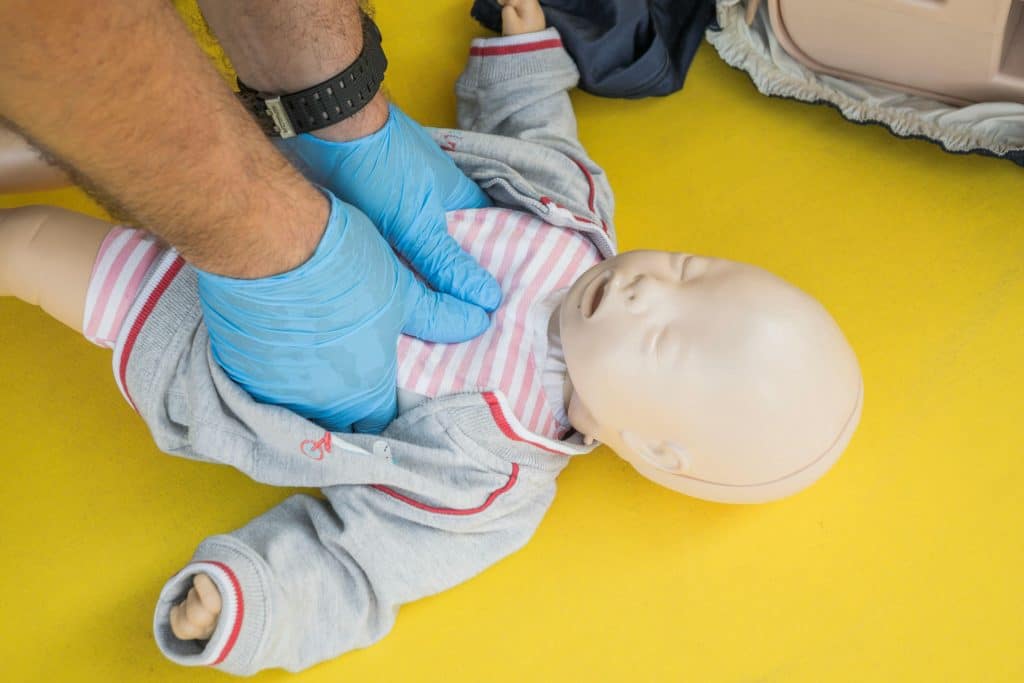
- CPR on infant manikin: Demonstrate infant CPR with modified technique (two-finger compressions, smaller breaths).
- AED trainer use: Attach pads, follow voice prompts, deliver a shock if advised.
- Asthma scenario: Respond to a child having an asthma attack. Use a spacer and inhaler correctly. Call for help. Monitor and reassure.
- Anaphylaxis scenario: Recognise signs of anaphylaxis. Administer an EpiPen trainer correctly. Position the person appropriately. Call 000.
- Incident report: Complete a written incident report documenting what happened, actions taken, and who was notified.
DRSABCD is a first aid action plan used across Australia. It stands for Danger (assess the scene), Response (check if the person is conscious), Send for help (call 000 or ask someone else to), Airway (ensure airway is clear), Breathing (check if breathing normally), CPR (start CPR if no breathing), Defibrillation (use an AED if available). Understanding the DRSABCD protocol is essential for any first aid assessment.
If you have physical limitations, contact CPR First Aid before booking. Reasonable adjustments can be discussed. You might be able to perform CPR on a manikin on a raised surface instead of the floor. You might be given extra time to complete tasks. The key is to communicate ahead of time so the assessor can plan appropriate modifications while still meeting the unit requirements.
| Before you attend | Tick |
| Completed online theory by deadline | ☐ |
| Wearing comfortable clothing (able to kneel) | ☐ |
| Closed-in shoes (not thongs/sandals) | ☐ |
| Brought water bottle and snacks | ☐ |
| Can physically kneel and perform CPR on floor | ☐ |
| If wearing glasses, brought them | ☐ |
| Reviewed asthma and anaphylaxis action plans | ☐ |
| Notified trainer of any injuries or limitations | ☐ |
HLTAID012 assessment includes demonstrating practical CPR skills on a manikin and responding to realistic childcare first aid scenarios. Arrive prepared. Bring a positive attitude. Ask questions if you’re unsure. The assessor wants to see you succeed.
Technology Requirements for Online Theory and Zoom Sessions
If your theory is online, your tech is part of your preparation. Many students fail to complete their online modules because they didn’t check their technology ahead of time. Here’s your tech readiness checklist.
Device options: A laptop or desktop computer is strongly recommended for online theory. Tablets are acceptable if you have a physical keyboard. Phones work as a backup but can be frustrating for quizzes and reading long modules. Larger screens reduce eye strain and make it easier to navigate course content.
Browser requirements: Use a modern, updated browser. Chrome is recommended by most learning management systems. Firefox and Safari usually work fine. Internet Explorer is outdated and can cause problems. Enable pop-ups for your course website (many systems use pop-ups for quizzes and certificate downloads). Enable cookies so your progress is saved. Make sure you can open PDF files (most theory modules include downloadable PDF guides).
Internet connection: A stable connection is essential. Home or office Wi-Fi is best. Avoid public Wi-Fi in cafes or libraries where connections drop frequently. If you only have mobile data, be aware that video-heavy modules can chew through your data allowance quickly. Test your connection before starting your first module.
For live online sessions: You need a working webcam and microphone. Most laptops have these built in. If using a desktop, you may need to buy a USB webcam. Test your camera and mic before the session starts. Find a quiet space where you won’t be interrupted. Background noise from kids, pets or traffic can make it hard for the instructor to hear you. Some providers require you to show your photo ID on camera at the start of the session to verify your identity.
Accessibility features: Turn on captions if available (many online modules include closed captions). Use headphones to reduce distractions and improve audio quality. If you have low bandwidth, turn off HD video in Zoom. Close other apps and browser tabs to free up processing power. Use an ethernet cable instead of Wi-Fi if your connection is unreliable.
Research shows that online accredited learning can be accessed from anywhere, making it easier for remote or geographically dispersed teams to participate. The flexibility of online delivery removes barriers related to travel and fixed schedules.
| Requirement | Minimum | Recommended | Quick fix if it fails |
| Device | Smartphone or tablet | Laptop or desktop with keyboard | Borrow a laptop from a friend or use a library computer |
| Browser | Any modern browser | Chrome (latest version) | Update your browser or switch to Chrome |
| Internet speed | 1 Mbps download | 5+ Mbps download | Move closer to router, use ethernet, close background apps |
| Webcam | Basic 480p camera | 720p or higher | Buy a cheap USB webcam ($30–$50) |
| Microphone | Built-in mic or earbuds | Headset with noise cancellation | Use phone earbuds or buy a cheap headset |
| Quiet space | Low background noise | Dedicated room, door closed | Book a library study room or wait until kids are asleep |
Your Unique Student Identifier (USI) is your unique government-issued reference number that lets your accredited training be recorded and your certificate be issued. You must have a USI before your RTO can issue your Statement of Attainment. If you don’t have one, create it free at usi.gov.au. It takes 5 minutes.
For HLTAID012 online theory, use a reliable internet connection and a modern browser; for Zoom delivery, you also need a working webcam, microphone and a quiet space. If you’re preparing for your practical skills, review guides on how to perform CPR correctly to build your confidence before class.
What HLTAID012 Covers in Detail
In childcare, the emergencies you’re most likely to face are the ones you practise. HLTAID012 is childcare first aid training that prepares you to respond to CPR emergencies, asthma attacks and anaphylaxis in an education and care setting. Here’s what you’ll learn and practise.
CPR for infants, children and adults: You’ll learn the theory behind why CPR works, when to start it, and how to perform it correctly on people of different ages. You’ll practise chest compressions and rescue breaths on manikins until your technique is correct. You’ll understand the compression-to-breath ratios (30:2 for adults and children, 15:2 for infants when two rescuers are present). You’ll learn how to use an AED safely and effectively.
Asthma management: Asthma is common in Australian children. You’ll learn to recognise the signs of an asthma attack (wheezing, difficulty breathing, chest tightness, persistent cough). You’ll practise using a spacer and inhaler correctly. You’ll learn when to call 000 and when the situation can be managed with the child’s asthma action plan. For more information on asthma response, see resources on asthma management in Queensland.
Anaphylaxis response: Anaphylaxis is a severe allergic reaction that can be life-threatening and needs urgent first aid and emergency support. Common triggers in childcare include nuts, eggs, shellfish, and insect stings. You’ll learn to recognise the signs (swelling of face or lips, difficulty breathing, rapid pulse, dizziness, collapse). You’ll practise using an EpiPen trainer. You’ll understand correct positioning (lying flat with legs elevated unless breathing is difficult). You’ll know when to call 000 immediately. To deepen your understanding, explore detailed guides on anaphylaxis response in childcare settings.
Here are three realistic scenarios you might practise during the practical session:
Scenario 1 (Choking): A three-year-old is eating lunch and starts coughing weakly. Their face turns red, then blue. They can’t speak or cry. You need to recognise this as severe choking. You perform back blows (leaning the child forward, striking firmly between the shoulder blades). If back blows fail, you perform chest thrusts. You ask a colleague to call 000. You continue back blows and chest thrusts until the object dislodges or emergency services arrive. You document the incident and notify the child’s parents immediately.
Scenario 2 (Asthma flare-up): A five-year-old is playing outside on a windy day. They come inside saying they can’t breathe properly. You hear wheezing. They’re coughing and clutching their chest. You sit them upright and calm them. You ask where their inhaler is. You help them use the inhaler with a spacer (4 puffs, 4 breaths per puff). You wait 4 minutes. If symptoms don’t improve, you repeat. You call the child’s emergency contact. If symptoms worsen or don’t improve after a second round, you call 000.
Scenario 3 (Anaphylaxis): A child has just eaten a snack brought from home. Within minutes, they complain their tongue feels funny. You notice their lips are swelling. They say they feel dizzy. You recognise this as possible anaphylaxis. You call 000 immediately. You locate the child’s EpiPen. You lay the child flat (or sitting if breathing is difficult). You remove the EpiPen safety cap and press it firmly into the outer mid-thigh for 3 seconds. You hold the child still and reassure them. You stay with the child until the ambulance arrives. You complete an incident report and notify parents.
Content also covers managing bleeding, burns, fractures, shock, seizures and other emergencies. You’ll learn how to complete incident reports accurately. You’ll understand your legal responsibilities as a first aider in an education setting. You’ll practise communicating with parents, guardians and emergency services clearly and calmly under pressure. For additional background on infant first aid, review information on babies first aid courses available in Brisbane.
Duration, Certificate Validity and Renewal
How long does HLTAID012 take? It depends on your delivery method. A blended course typically involves around 2–4 hours of online theory (self-paced, you control the speed) plus a 3–4 hour practical session. A face-to-face-only course runs for a full day (6–8 hours). Renewal courses are often shorter because you’re refreshing existing skills rather than learning from scratch.
For CPR First Aid, an Express session includes an online theory component that students can complete on their own days before the practical session, which is 1.25 hours long. A regular session has the same sessions with longer durations. The online theory lasts 5 to 10 hours, and the practical session goes up to 3.5 hours.
One provider example describes a blended structure with approximately 10 hours of self-paced online learning followed by one day of practical training. Times vary by provider and by your reading speed, but this gives you a realistic benchmark.
Your Statement of Attainment doesn’t have an expiry date printed on it. The unit itself is valid indefinitely once you’re assessed as competent. But here’s what employers and regulators actually expect: CPR skills are commonly refreshed every 12 months because technique and guidelines can change. Full first aid (including HLTAID012) is often refreshed every 3 years. This isn’t a legal requirement, it’s an industry standard followed by most childcare centres, schools and RTOs.
Currency means keeping your skills and knowledge up to date, especially CPR, which many workplaces expect to be refreshed regularly. If you completed HLTAID012 three years ago and haven’t practised since, your technique may have degraded. You may not remember the correct compression depth or the steps in the anaphylaxis protocol. Renewal training keeps you current and confident.
| Component | Typical time | Where it happens | Common mistakes to avoid |
| Online theory (first time) | 2–4 hours (self-paced) | At home, on your device | Leaving it to the last minute and missing the deadline |
| Practical session (first time) | 3–4 hours | CPR First Aid training venue in Brisbane City | Arriving late or unprepared (no water, wrong clothing) |
| Full face-to-face (first time) | 6–8 hours (one day) | CPR First Aid training venue in Brisbane City | Not allowing enough time (booking it the day before you start work) |
| Renewal (theory) | 1–2 hours | At home, online | Thinking you don’t need to review theory if you did the course before |
| Renewal (practical) | 2–3 hours | CPR First Aid training venue | Not practising CPR technique before attending |
HLTAID012 is usually completed via online theory plus a practical training and assessment session, and many workplaces expect CPR skills to be refreshed annually. To understand renewal expectations in more detail, read about certificate validity for first aid qualifications across Australia.
How to Book HLTAID012 in Brisbane City with CPR First Aid
If you need HLTAID012 for a childcare job in Brisbane City, here’s the fastest way to book and be ready. CPR First Aid has streamlined the process so you can go from booking to certified in a matter of days.
Step 1: Choose your location and course
Visit the CPR First Aid website. Navigate to Queensland courses. Select Brisbane City as your location. Choose HLTAID012 (Provide First Aid in an education and care setting). The HLTAID012 course page shows current availability, pricing and session dates.
Step 2: Complete your booking and receive online access
Select your preferred practical session date. Complete the booking form with your details. Pay securely online. You’ll receive a confirmation email with your online theory access credentials. Check your junk/spam folder if the email doesn’t appear in your inbox within 10 minutes. The email contains your login details and instructions for accessing the learning management system.
Step 3: Prepare your USI
As confirmed by AITS, your USI is mandatory for accredited enrolment and certificate issuance. USI verification is the process your training provider uses to confirm your USI so your accredited result can be issued. If you don’t have a USI, create one free at usi.gov.au before you start your online theory. You’ll need it to complete your enrolment.
Step 4: Complete your online theory by the deadline
Log in to the online learning portal. Work through the modules at your own pace. Complete the quizzes to check your understanding. Finish all required modules by the deadline stated in your booking confirmation (usually 2–7 days before your practical session). If you have questions, contact CPR First Aid support before the deadline. Don’t leave it until the last night.
Step 5: Attend your practical session
Arrive 10–15 minutes early for sign-in. Bring your photo ID and your USI. Wear comfortable clothing suitable for kneeling and floor-based CPR practice. Bring a water bottle. Be ready to demonstrate skills, ask questions, and engage with scenarios. Your assessor will observe your technique and provide feedback.
| Before you book | Before you attend |
| Check your roster for available dates | Complete online theory by deadline |
| Have your payment method ready | Pack photo ID and USI |
| Create or locate your USI | Check venue address and parking |
| Check your email settings (unblock cprfirstaid.com.au) | Wear comfortable clothing |
| Confirm you can kneel and perform CPR on floor | Bring water and snacks |
| Ask questions if you’re unsure about course format | Arrive 10–15 minutes early |
To book HLTAID012 in Brisbane City, choose your QLD location, complete the online theory by the deadline, then attend the practical assessment to receive your Statement of Attainment. CPR First Aid’s Brisbane City venues are accessible by public transport and offer nearby parking. For a broader view of what childcare first aid involves, explore general information on childcare first aid training requirements.

What to Bring on the Day
Bring these items to your Brisbane practical session to avoid delays. Being prepared makes the day smoother for you and your classmates.
| Must bring | Strongly recommended | Optional but helpful |
| Photo ID (driver licence, passport, proof of age card) | Water bottle | Small snack (banana, muesli bar) |
| Your USI number (written down or saved in phone) | Comfortable clothing (tracksuit pants, T-shirt) | Notebook and pen for personal notes |
| Confirmation of online theory completion (email or screenshot) | Closed-in shoes (not thongs or sandals) | Reading glasses if you need them |
| Positive attitude and willingness to participate | Hair tie if you have long hair | Hand sanitiser |
Health considerations matter. Tell your trainer at the start of the session if you have any injuries, back problems, pregnancy, or other physical limitations. The assessor can often make reasonable adjustments while still meeting the assessment requirements. If you have a knee injury, you might be allowed to perform CPR on a manikin on a raised surface. If you’re pregnant, you can still participate but may need extra breaks. Communication is key.
Arrive early. Sessions usually start promptly. If you arrive late, you may not be allowed to participate (the trainer needs to cover safety information and set expectations at the start). Brisbane City traffic can be unpredictable. Allow extra time, especially during peak hour. Check parking options before you leave home. Some venues offer free parking, others require paid street parking.
In accredited first aid training, ‘competent’ means you can consistently perform the required skills to the expected standard in both theory and practical assessment. The assessor isn’t looking for perfection. They’re looking for safe, effective technique and the ability to respond appropriately to emergencies. If you make a small mistake, they’ll give you feedback and let you try again.
On the day, bring photo ID and your USI, wear comfortable clothing for floor-based CPR practice, and arrive early for sign-in. To prepare for the AED component of the practical assessment, review simple guides on AED steps so you feel confident using the trainer.
Frequently Asked Questions
What is HLTAID012?
HLTAID012 is the nationally recognised unit ‘Provide First Aid in an education and care setting’, designed for people who work with children in schools and childcare. It supersedes HLTAID004 and reflects current Australian Resuscitation Council expectations for providing first aid to infants, children and adults in education and care environments.
Does HLTAID012 include CPR, asthma and anaphylaxis training?
Yes. HLTAID012 childcare first aid training includes CPR skills and covers emergency response for asthma and anaphylaxis in education and care settings. You’ll learn to recognise the signs of asthma attacks and anaphylaxis, use inhalers and EpiPens correctly, and respond appropriately. Skills are assessed in practical scenarios during your training session.
How long does HLTAID012 take in Brisbane?
It depends on the delivery option, but many courses use blended learning with online theory plus a practical training and assessment session. A typical blended structure involves 2–4 hours of self-paced online learning followed by a 3–4 hour practical session. Face-to-face-only courses run for a full day (6–8 hours). Check the CPR First Aid booking calendar for exact session times.
Can HLTAID012 be done 100% online?
HLTAID012 requires you to be assessed as competent in practical first aid skills, so a practical assessment component still applies even when theory is online. You cannot complete HLTAID012 entirely online without attending a face-to-face session. The unit requirements specify practical evidence, including demonstrating CPR on a manikin.
What are the physical requirements for the HLTAID012 practical assessment?
You need to be able to demonstrate CPR skills on a manikin as part of assessment, which is typically performed on the floor. This includes performing at least 2 minutes of continuous chest compressions. If you have physical limitations, back problems, or injuries, contact CPR First Aid before booking to discuss possible adjustments. The RTO will work with you to find reasonable modifications while still meeting unit requirements.
Do I need a USI for HLTAID012?
Yes. Your USI is required for accredited training so your result can be issued and recorded. As stated by AITS, the USI is mandatory for enrolment in accredited courses. If you don’t have one, create it free at usi.gov.au. It takes about 5 minutes and you’ll need it before your certificate can be finalised.
What tech do I need for HLTAID012 online theory or Zoom?
Use a reliable internet connection and a modern browser; for Zoom sessions you’ll also need a working webcam, microphone, and a quiet space. A laptop or desktop is recommended. Make sure your browser is updated, pop-ups are enabled, and you can open PDF files. Test your webcam and microphone before any live sessions. Some providers require you to show ID on camera to verify your identity.
How do I book HLTAID012 in Brisbane City?
Choose a Brisbane City session, book online, complete the pre-course theory (if included), then attend the practical assessment to be issued your Statement of Attainment. Visit the CPR First Aid website, select Queensland, choose your Brisbane City venue, and pick a practical session date that suits your schedule. You’ll receive online theory access immediately after booking. Support is available if you need help choosing the right delivery mode for your circumstances.
Conclusion
HLTAID012 is the course that prepares you for real childcare emergencies. It covers CPR, asthma, anaphylaxis and the scenarios you’ll face working with children in Brisbane City. The blended delivery option (online theory plus practical assessment) gives you flexibility without compromising the quality of your training. You study at your own pace, then demonstrate skills in person to an assessor who checks you’re competent and ready.
CPR First Aid makes the process clear and accessible for Brisbane workers. Book online, complete your theory by the deadline, bring your ID and USI, and arrive ready to learn. Your practical session is where everything comes together. You’ll leave with the skills, confidence and certification your employer requires.
If you’re starting in a childcare role this week, don’t delay. Check availability, secure your booking, and complete your online theory as soon as you receive access. Questions about delivery modes, technology requirements, or accessibility? Contact CPR First Aid directly. The team can guide you through the booking process and answer any concerns before you start.
Your ability to respond calmly and correctly in an emergency could save a child’s life. HLTAID012 equips you with that ability. Book your Brisbane City course today.
References
- HLTAID012 Provide First Aid in an education and care setting – Official unit descriptor, supersedes HLTAID004, assessment requirements aligned with ARC guidelines
- Accredited First Aid & CPR Courses Online – Milcom Institute – Online learning accessibility and flexibility statements
- HLTAID012 Provide Emergency First Aid Response in an Education and Care Setting – Blended structure example (online learning plus one-day practical)
- HLTAID012 Provide first aid in an education and care setting (AITS) – USI mandatory requirement for accredited enrolment